
Capecitabine,
does it really help with Reduced recurrence and death in residual HER2-negative breast cancer after neoadjuvant chemotherapy?
research showsCapecitabine is rated B because it reduced recurrence and death in patients with residual invasive HER2-negative breast cancer at surgery after anthracycline- or taxane-based neoadjuvant chemotherapy. The open-label phase 3 CREATE-X trial in Japan and South Korea randomized 910 participants. Five-year disease-free survival was 74.1% versus 67.6% (HR 0.70), and overall survival was 89.2% versus 83.6% (HR for death 0.59). This is ingredient-specific randomized evidence on direct clinical endpoints of recurrence and death, but the positive evidence in this exact residual-disease setting depends largely on one open-label trial, with limited independent replication in non-Asian populations, so it does not merit A. Hand-foot syndrome, diarrhea, myelosuppression, and severe toxicity related to DPD deficiency are recorded separately under safety.
ads claimA summary can broaden the finding into an oral chemotherapy pill prevents breast-cancer recurrence. The evidence applies specifically to high-risk patients with residual invasive HER2-negative disease after standard neoadjuvant chemotherapy, not to every breast cancer.
Useful facts when choosing a product
- Capecitabine is an oral prescription fluoropyrimidine anticancer medicine that is converted to 5-fluorouracil in the body. Oncology teams adjust dose and schedule according to body-surface area, kidney function, other treatment, and toxicity.
- CREATE-X enrolled patients with residual invasive HER2-negative disease at surgery after anthracycline- or taxane-based neoadjuvant chemotherapy. The same benefit cannot be assumed for every early breast cancer or for patients with a pathologic complete response.
- Hand-foot syndrome, diarrhea, stomatitis, fatigue, and reduced white-cell, neutrophil, or platelet counts can occur. Hand-foot syndrome was reported in 73.4% of capecitabine recipients in CREATE-X.
- Complete DPD deficiency greatly increases the risk of early severe or fatal fluoropyrimidine toxicity. Assessment of DPYD-related risk, kidney function, and prompt interruption or dose reduction for toxicity are important.
Chamgap Semantic Classification Code
Candidate index · review held
M.capecitabine.oral.recurrence-and-death-in-residual-her2-negative-breast-cancer-after-neoadjuvant-chemotherapy.reduce.UNKMedicinal interventions > Capecitabine > Oral > recurrence and death in residual HER2-negative breast cancer after neoadjuvant chemotherapy > Reduction claim > Unknown
An automated migration candidate, not an issued permanent code; exact claim scope remains under review. This machine-generated migration candidate helps retrieval but is not a permanent assignment. The original verdict ID and URL remain authoritative.
What the research actually shows
CREATE-X randomized 910 participants in Japan and South Korea, with 455 assigned to capecitabine and 455 to control, and 887 included in the final efficacy analysis. Participants had residual invasive HER2-negative disease at surgery after neoadjuvant chemotherapy containing an anthracycline, a taxane, or both. Capecitabine was added for six to eight cycles, and absolute improvements at five years were 6.5 percentage points for disease-free survival and 5.6 percentage points for overall survival. The 2017 analysis by Zujewski and Rubinstein noted that CREATE-X was the single randomized trial addressing this exact postoperative residual-disease question. Earlier broad adjuvant capecitabine trials had not met their primary endpoints, but selection for chemotherapy-refractory residual disease could explain the positive CREATE-X result.
Why this is classified as B (76)
In CREATE-X, adding capecitabine alone improved the composite of recurrence, second cancer, or death and also improved overall survival, meeting the ingredient-specific direct hard-endpoint rule. The key evidence in the exact residual HER2-negative setting is one open-label phase 3 trial in Japan and South Korea, however, with limited independent replication in other regions. This gives B with 76 points. Hand-foot syndrome, diarrhea, myelosuppression, and DPD-deficiency toxicity remain independent safety issues.
Counterpoint. The subgroup effect was especially large in triple-negative residual disease, but subgroup results alone cannot establish an identical benefit in hormone-receptor-positive, HER2-negative disease. Prior neoadjuvant treatment, pathology, and current alternative postoperative options should be considered together.
Rejudgment record. New verdict — Accepted the ingredient-specific direct clinical benefit for disease-free and overall survival from adding capecitabine alone in CREATE-X, but applied B because the key evidence in the exact residual HER2-negative population is one open-label phase 3 trial in Japan and South Korea with limited independent regional replication
Sub-claim grades by effect
This ingredient is marketed for several effects. A single overall grade blends strong and weak claims together, so each effect is graded separately here. The overall grade reflects the strongest disconfirming or core claim.
| Effect (sub-claim) | Grade | Basis |
|---|---|---|
| Prolonged disease-free survival in residual HER2-negative breast cancer after neoadjuvant chemotherapy | B | In CREATE-X, five-year disease-free survival was 74.1% versus 67.6% with an HR of 0.70, but the evidence comes from one open-label trial. |
| Prolonged overall survival in residual HER2-negative breast cancer after neoadjuvant chemotherapy | B | Five-year overall survival was 89.2% versus 83.6% with an HR for death of 0.59, but independent replication outside Asia is limited. |
| Reduced recurrence and death in residual triple-negative breast cancer after neoadjuvant chemotherapy | B | The CREATE-X subgroup HRs of 0.58 for disease-free survival and 0.52 for overall survival were positive, but they came from a subgroup analysis. |
Cross-check — AI research and Codex final gate
Evidence Table
| Study | Design | Sample | Funding | Endpoint | Result | Weight |
|---|---|---|---|---|---|---|
| Masuda N et al. 2017 CREATE-X | Multicenter open-label randomized phase 3 controlled trial | 910 patients randomized in Japan and South Korea; 887 in the final efficacy analysis | Funded by the Advanced Clinical Research Organization and the Japan Breast Cancer Research Group | Disease-free survival and overall survival, with a triple-negative subgroup analysis | Five-year disease-free survival was 74.1% versus 67.6% (HR 0.70), overall survival was 89.2% versus 83.6% (HR for death 0.59), and the corresponding triple-negative subgroup HRs were 0.58 and 0.52. | Key ingredient-specific direct hard-endpoint randomized trial |
| Zujewski JA and Rubinstein L. 2017 | Evidence analysis of CREATE-X and earlier adjuvant capecitabine trials | The 910-participant CREATE-X trial and related randomized early-breast-cancer literature | United States government work; the authors declared no competing financial interest | Applicability of the CREATE-X survival benefit and consistency with other adjuvant trials | CREATE-X was the single randomized trial addressing the exact residual-disease question; earlier broad adjuvant trials did not meet their primary endpoints, but added benefit was considered plausible in the selected residual-disease population. | Assessment of single-trial dependence and external validity |
Receipt — 2 References
All 2 cited sources were verified for existence at the original page (as of 2026-07-23).
Final verification and publication gate: Codex · Evidence date: 2026-07-23 · Corrections: none
Cite this verdict
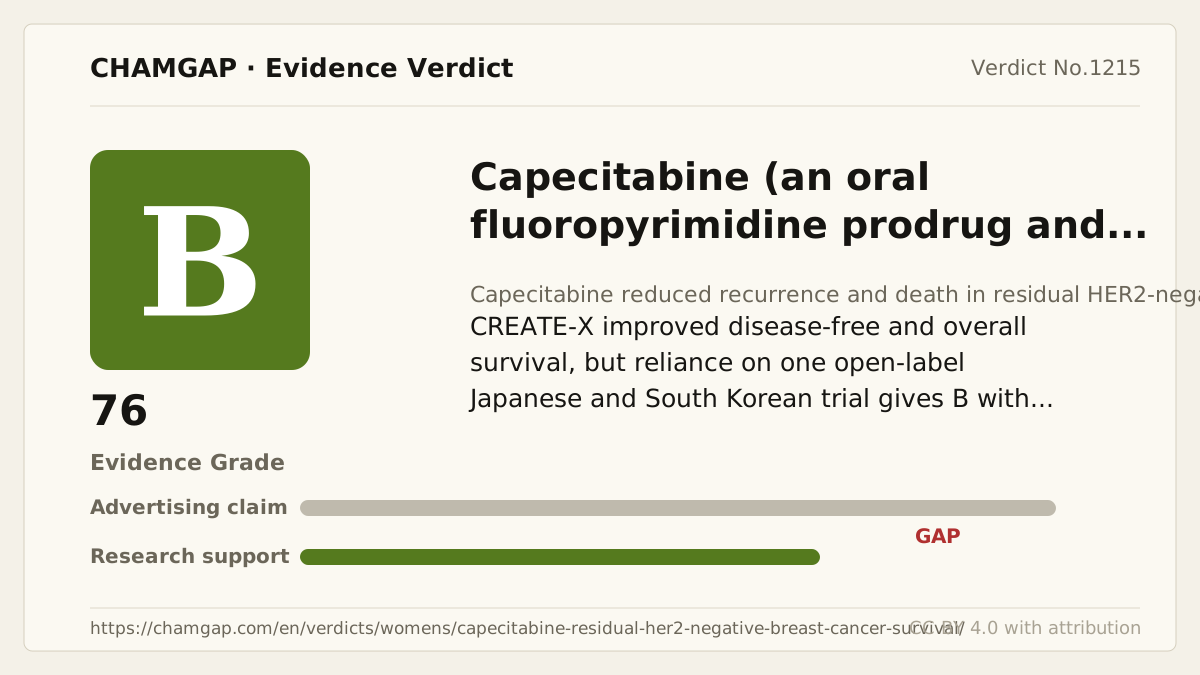
[Chamgap] Capecitabine x reduced recurrence and death in residual HER2-negative breast cancer after neoadjuvant chemotherapy — Evidence Grade B·76. 2 cited sources checked. Source: https://chamgap.com/en/verdicts/womens/capecitabine-residual-her2-negative-breast-cancer-survival/ · CC BY 4.0CC BY 4.0 — free to use with attribution; do not distort grades, numbers, or verdict meaning.
What this document does and does not do
Chamgap is an information source. It reports what research has and has not confirmed; it does not tell readers what to take or buy. That decision belongs to readers and, when needed, medical or legal professionals. This verdict reflects literature available up to the search date and may change as new research appears. Nothing here is medical advice.