
Bra wearing,
does it really help with Higher breast-cancer incidence?
research showsThe grade is D. A population-based case-control study in postmenopausal women found no association of daily wearing time, underwire use, or age at first regular wear with invasive breast cancer. Only one participant had never worn a bra and was excluded; the reference was wear of ten hours or less daily, not nonwear. The null result therefore cannot be expanded into a claim that bras are proven safe.
ads claimThe claim that bras block lymph flow and trap toxins was popularized by the 1995 consumer book Dressed to Kill by Singer and Grismaijer, not by a peer-reviewed epidemiologic study. That mechanism claim was not used for grading.
Useful facts when choosing a product
- The reference was lifetime average wear of ten hours or less daily, not nonwear.
- The sole participant who had never worn a bra was excluded.
- Underwire, age at first regular wear, and current and lifetime daily duration were assessed.
- Controls were selected by random-digit dialing and 71% of eligible controls were interviewed.
Chamgap Semantic Classification Code
Candidate index · review held
UNK.bra-wearing.UNK.higher-breast-cancer-incidence.increase.UNKUnknown > Bra wearing > Unknown > Higher breast-cancer incidence > Increase claim > Unknown
An automated migration candidate, not an issued permanent code; exact claim scope remains under review. This machine-generated migration candidate helps retrieval but is not a permanent assignment. The original verdict ID and URL remain authoritative.
What the research actually shows
Chen and colleagues conducted a population-based case-control study among postmenopausal women, identifying 2000-2004 cases through the Seattle-Puget Sound cancer registry and selecting controls by random-digit dialing. In-person interviews covered hours and days worn, underwire, age at first regular wear, and cup and band size. Models automatically adjusted for reference age, reference year, and county. Investigators evaluated race and ethnicity, education, income, BMI at age 30 and at reference, band size, age at first full-term pregnancy, hormone therapy, type of menopause, parity, family history, and recent mammography; none changed estimates by more than 10%, so they were omitted from final models. Funding was NCI grant R01 CA85913, and no conflicts were disclosed.
Why this is classified as D (34)
Detailed exposure assessment, two histologic types, and public funding are strengths. One case-control study with near-universal exposure could not make the key nonwear comparison, and no harm boundary was established, giving D with 34 points.
Counterpoint. D means no association was observed among the studied postmenopausal habitual wearers. It does not prove absence of harm across every age or bra type.
Rejudgment record. Cross-check applied — Direct review of reference groups, duration, underwire, starting age, covariates, and results in the case-control paper
| Endpoint | H | Hard endpoint - actual events such as death |
| Replication | R1 | Single confirmatory trial |
| Independence | I2 | Decisive evidence is publicly or non-profit funded |
| Effect size | E0 | Null |
| Precision | C0 | The confidence interval leaves room for benefit |
Stored derived and displayed grades match; this is not a current recalculation or validity check (D).
Sub-claim grades by effect
This ingredient is marketed for several effects. A single overall grade blends strong and weak claims together, so each effect is graded separately here. The overall grade reflects the strongest disconfirming or core claim.
| Effect (sub-claim) | Grade | Basis |
|---|---|---|
| Daily wearing duration and breast cancer | D | The longest lifetime-wear category was null for both histologic types; the reference was ten hours or less. |
| Underwire bra use and breast cancer | D | No consistent increase was found by underwire use. |
| Early age at regular bra use and breast cancer | D | No association was found across start-age categories of 12 or younger, 13-14, and 15 or older. |
Cross-check — AI research and Codex final gate
Evidence Table
| Study | Design | Sample | Funding | Endpoint | Result | Weight |
|---|---|---|---|---|---|---|
| Chen et al. 2014 case-control study | Population-based case-control study | 454 ductal cases, 590 lobular cases, and 469 controls | US National Cancer Institute R01 CA85913; no conflicts disclosed | Invasive ductal and invasive lobular breast cancer | Lifetime at least 14 versus no more than 10 hours: ductal OR 0.9 (0.6-1.3), lobular OR 0.8 (0.6-1.2) | Publicly funded detailed exposure study without a nonwear reference |
Receipt — 2 References
All 2 cited sources were verified for existence at the original page (as of 2026-08-05).
Final verification and publication gate: Codex · Evidence date: 2026-08-05 · Corrections: none
Cite this verdict
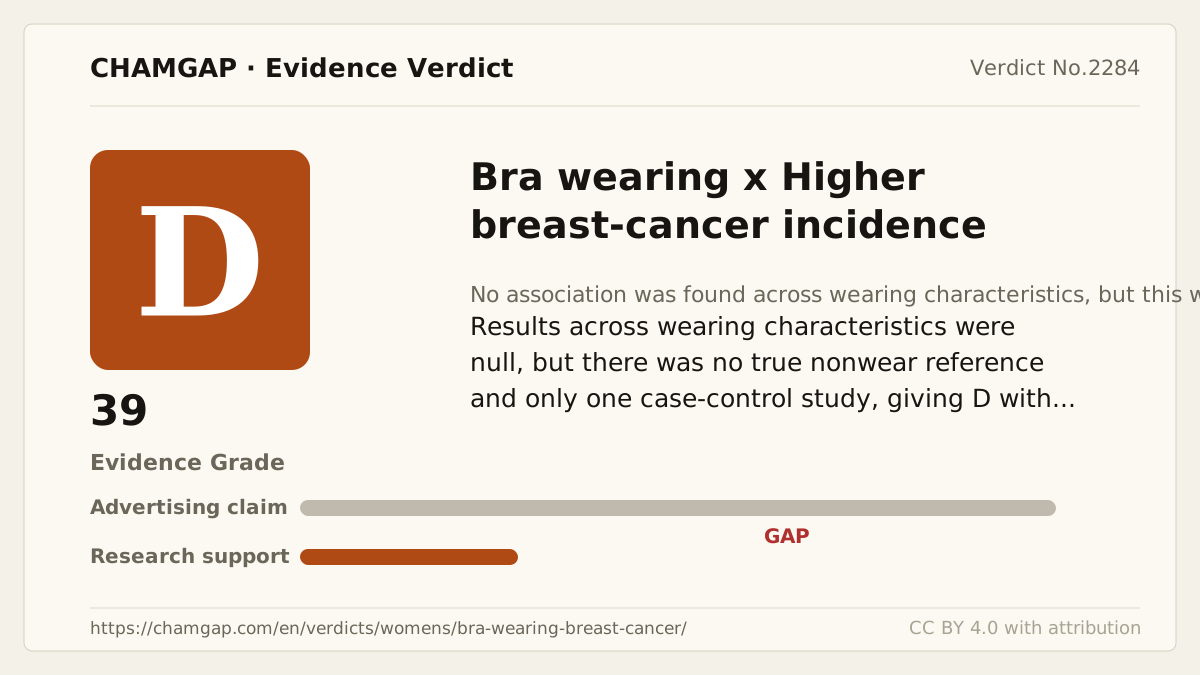
[Chamgap] Bra wearing x breast cancer — Evidence Grade D·34. 2 cited sources checked. Source: https://chamgap.com/en/verdicts/womens/bra-wearing-breast-cancer/ · CC BY 4.0CC BY 4.0 — free to use with attribution; do not distort grades, numbers, or verdict meaning.
What this document does and does not do
Chamgap is an information source. It reports what research has and has not confirmed; it does not tell readers what to take or buy. That decision belongs to readers and, when needed, medical or legal professionals. This verdict reflects literature available up to the search date and may change as new research appears. Nothing here is medical advice.