
Labor positioning or movement programs using a birth ball or peanut ball,
does it really help with Relief of acute labor pain?
research showsGrade C with 50 points. A recent 90-person peanut-ball trial reported less pain and fatigue shortly after use, while total labor duration was null, P=.177. Earlier duration signals were either a primiparous subgroup or a package of ball use plus active pelvic movement, not proof that a ball alone prevents cesarean delivery.
ads claimA labor ball is portrayed as shortening all labor and preventing cesarean delivery based on acute pain, subgroup, or completer findings.
Useful facts when choosing a product
- A peanut ball is peanut-shaped and used differently from a round birth ball.
- Some trials bundled the ball with positioning and pelvic movement.
- Immediate pain and total labor duration are different outcomes.
Chamgap Semantic Classification Code
Permanent code issued
P.birth-or-peanut-ball.procedure.labor-pain.reduce.standard-careProcedures, devices and tests > Labor positioning or movement programs using a birth ball or peanut ball > Procedural delivery > Relief of acute labor pain > Reduction claim > Standard care
Codex retrospectively verified the principal intervention, delivery, population, endpoint, and comparator from the existing reviewed verdict and issued a permanent semantic code. Secondary outcomes on the page are not transferred as separate claims. The code identifies the intervention and claim; it never contains the evidence grade, score, or safety result.
Exact Claim Classification
These independent facets prevent evidence from different forms, routes, populations, effects, and comparators from being mixed.
| Intervention class | P · Procedure, surgery, device, or test |
|---|---|
| Canonical ingredient or intervention | Labor positioning or movement programs using a birth ball or peanut ball |
| Source or part used | Plant source not applicable; specified device or procedure |
| Formulation or processing | Labor positioning or movement programs using a birth ball or peanut ball |
| Route | Procedural delivery |
| Dose | Labor positioning or movement programs using a birth ball or peanut ball |
| Duration | During the index labor |
| Population | Randomized trial in laboring women |
| Effect or condition | Relief of acute labor pain |
| Primary endpoint | First-stage and pushing duration |
| Comparator | Standard care |
| Duplicate-detection key | birth-or-peanut-ball|procedure|Randomized trial in laboring women|labor-pain|During the index labor |
What the research actually shows
Randomized studies differed by epidural use, ball shape, timing, and accompanying position changes or pelvic movement. Vaginal delivery among completers was not treated as evidence of preventing surgery.
Why this is classified as C (50)
Patient-centered pain signals are limited by heterogeneous interventions, small unblinded trials, and null duration findings, giving C with 50 points.
Counterpoint. Precise reductions in analgesic use, cesarean delivery, or instrumental delivery remain unconfirmed.
Rejudgment record. Cross-check applied — Separated birth versus peanut balls, epidural status, ball-only versus movement packages, and pain, time, and operative outcomes
| Endpoint | P | Symptom or function itself is the target - including patient reports and performance tests |
| Replication | R1 | Single confirmatory trial |
| Independence | I1 | Mixed funding sources |
| Effect size | E+ | Meets the clinically important threshold |
Stored derived and displayed grades match; this is not a current recalculation or validity check (C).
Sub-claim grades by effect
This ingredient is marketed for several effects. A single overall grade blends strong and weak claims together, so each effect is graded separately here. The overall grade reflects the strongest disconfirming or core claim.
| Effect (sub-claim) | Grade | Basis |
|---|---|---|
| Acute labor-pain relief | C | A short-term signal from several small unblinded trials. |
| Shorter labor or cesarean prevention | D | Overall duration and operative events were not consistently established. |
Cross-check — AI research and Codex final gate
Evidence Table
| Study | Design | Sample | Funding | Endpoint | Result | Weight |
|---|---|---|---|---|---|---|
| Payton CL et al. 2016 | Randomized epidural peanut-ball trial | Randomized trial in laboring women | Funding not verified | First-stage and pushing duration | Primiparous interaction P=.018; multiparous P=.057; pushing null | Epidural duration evidence |
| Alan Dikmen H et al. 2025 | Randomized acute pain and fatigue trial | 90 participants | Funding not verified | Pain and fatigue after 15 minutes; total labor duration | Pain and fatigue positive; total labor duration P=.177 | Direct pain evidence |
| Ozkececi F et al. 2026 | Randomized co-primary trial in high-BMI participants | 70 randomized, 59 analyzed | Funding not verified | Pain and active-labor duration | Pain P=.001; duration 202.9±59.5 vs 213.6±67.5 min, P=.522 | Positive pain and null duration evidence |
Receipt — 3 References
All 3 cited sources were verified for existence at the original page (as of 2026-09-07).
Final verification and publication gate: Codex · Evidence date: 2026-09-07 · Corrections: none
Cite this verdict
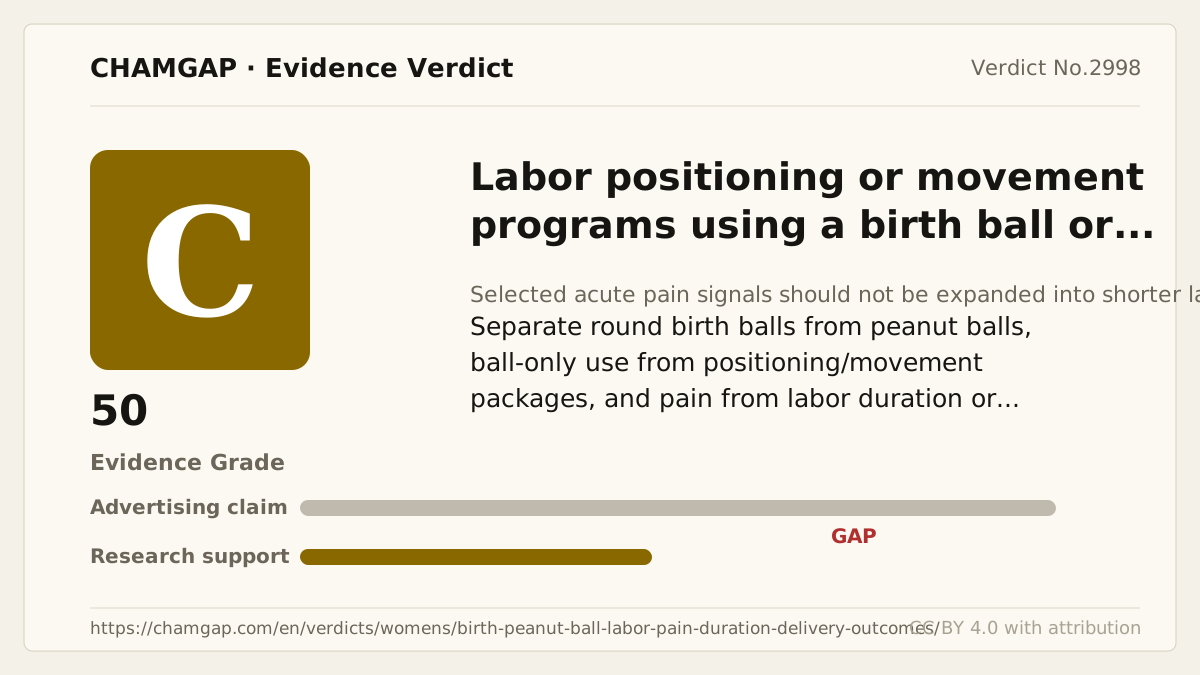
[Chamgap] Labor Balls for Acute Labor Pain—Duration and Operative Delivery Are Separate Outcomes — Evidence Grade C·50. 3 cited sources checked. Source: https://chamgap.com/en/verdicts/womens/birth-peanut-ball-labor-pain-duration-delivery-outcomes/ · CC BY 4.0CC BY 4.0 — free to use with attribution; do not distort grades, numbers, or verdict meaning.
What this document does and does not do
Chamgap is an information source. It reports what research has and has not confirmed; it does not tell readers what to take or buy. That decision belongs to readers and, when needed, medical or legal professionals. This verdict reflects literature available up to the search date and may change as new research appears. Nothing here is medical advice.