
Acupuncture,
does it really help with Reduction in frequency and severity of menopausal hot flashes?
research showsAcupuncture can look better than waiting-list or usual-care controls, but a hot-flash effect beyond noninsertive sham acupuncture is not established, yielding D. In the 327-person Ee 2016 intention-to-treat trial, the eight-week score was 15.36 with real acupuncture and 15.04 with sham, MD 0.33 (95% CI minus 1.87 to 2.52), and both groups improved about 40%. Liu 2022 found null end scores for frequency and severity, but a modestly positive frequency change score. An earlier Cochrane review likewise found null frequency but some positive severity results, supporting conflicting R0 rather than repeated refutation.
ads claimA large response also seen with sham and advantages over no treatment are presented as a specific therapeutic effect of acupuncture.
Useful facts when choosing a product
- In the Ee trial, real and noninsertive sham procedures were both delivered in ten sessions over eight weeks; only treating acupuncturists knew allocation.
- For comparison, verdict 1676, which is C with 48 points, concerns allergic rhinitis; verdict 1696, which is C with 50 points, concerns migraine; verdict 1660, which is F with 8 points, concerns acupuncture around embryo transfer. Evidence from these other acupuncture indications was not pooled.
- For comparison, verdict 1073, which is B with 64 points, concerns fezolinetant; verdict 063, which is C with 46 points, concerns soy isoflavones; verdict 148, which is D with 33 points, concerns black cohosh; verdict 096, which is C with 54 points, concerns flaxseed. Evidence from these other vasomotor interventions was not transferred to acupuncture.
Chamgap Semantic Classification Code
Candidate index · review held
K.acupuncture.UNK.frequency-and-severity-of-menopausal-hot-flashes.reduce.shamFolk and alternative interventions > Acupuncture > Unknown > frequency and severity of menopausal hot flashes > Reduction claim > Sham procedure or device
An automated migration candidate, not an issued permanent code; exact claim scope remains under review. This machine-generated migration candidate helps retrieval but is not a permanent assignment. The original verdict ID and URL remain authoritative.
What the research actually shows
Ee and colleagues randomized 327 women to real acupuncture, 163, or Park noninsertive sham, 164, and used an intention-to-treat mixed model. The eight-week primary hot-flash score was 15.36 versus 15.04, MD 0.33 (95% CI minus 1.87 to 2.52), P=0.77, so the primary endpoint failed. End-of-treatment loss was 16% and 13%, and both groups improved about 40% from baseline. Liu 2022 reviewed 13 randomized trials and 1,784 women; end-of-study frequency versus sham was MD 0.19 (95% CI minus 0.61 to 0.99) and severity MD 0.02 (minus 0.13 to 0.17). A change-score estimate for frequency alone was modestly positive at minus 0.84 but did not overturn the null end scores.
Why this is classified as D (30)
The profile is P, R0, I2, E0, B1, and C0. The large sham-controlled primary endpoint and end scores were null, but positive frequency-change and some severity results create conflict; precision does not exclude small benefit, yielding D with 30 points.
Counterpoint. When hot flashes substantially impair sleep or daily life, treatments with clearer evidence, hormonal or nonhormonal, can be discussed with a clinician.
Rejudgment record. Cross-check applied — Applied R0 for null representative sham comparisons but positive change-score frequency and some severity outcomes, with C0 because small benefit was not excluded
| Endpoint | P | Symptom or function itself is the target - including patient reports and performance tests |
| Replication | R0 | Trials conflict in direction |
| Independence | I2 | Decisive evidence is publicly or non-profit funded |
| Effect size | E0 | Null |
| Precision | C0 | The confidence interval leaves room for benefit |
Stored derived and displayed grades match; this is not a current recalculation or validity check (D).
Sub-claim grades by effect
This ingredient is marketed for several effects. A single overall grade blends strong and weak claims together, so each effect is graded separately here. The overall grade reflects the strongest disconfirming or core claim.
| Effect (sub-claim) | Grade | Basis |
|---|---|---|
| Reduction in hot-flash frequency versus sham acupuncture | D | The pooled end score was null. |
| Reduction in hot-flash severity versus sham acupuncture | D | The pooled MD was null at 0.02. |
| Improvement in hot-flash score at eight weeks | D | The primary endpoint failed in the 327-person trial. |
Cross-check — AI research and Codex final gate
Evidence Table
| Study | Design | Sample | Funding | Endpoint | Result | Weight |
|---|---|---|---|---|---|---|
| Ee C et al. 2016 | Multicenter stratified randomized participant- and assessor-blinded sham-controlled trial | 327 randomized and 327 included in the intention-to-treat mixed model; end loss 16% and 13% | Public funding from the Australian National Health and Medical Research Council | Hot-flash score at the end of eight weeks | 15.36 versus 15.04, MD 0.33 (95% CI minus 1.87 to 2.52), P=0.77; primary endpoint failed. Both groups fell about 40%. | Decisive sham-controlled trial |
| Liu C et al. 2022 | Systematic review and meta-analysis of randomized trials | 13 randomized trials and 1,784 participants; seven eligible for meta-analysis | Funding source not stated in the public abstract | Hot-flash frequency and severity versus sham | End frequency MD 0.19 (minus 0.61 to 0.99) and severity MD 0.02 (minus 0.13 to 0.17) were null; frequency change MD minus 0.84 (minus 1.64 to minus 0.05) was positive. | Conflicting sham-comparison synthesis |
Receipt — 2 References
All 2 cited sources were verified for existence at the original page (as of 2026-07-24).
Final verification and publication gate: Codex · Evidence date: 2026-07-24 · Corrections: none
Cite this verdict
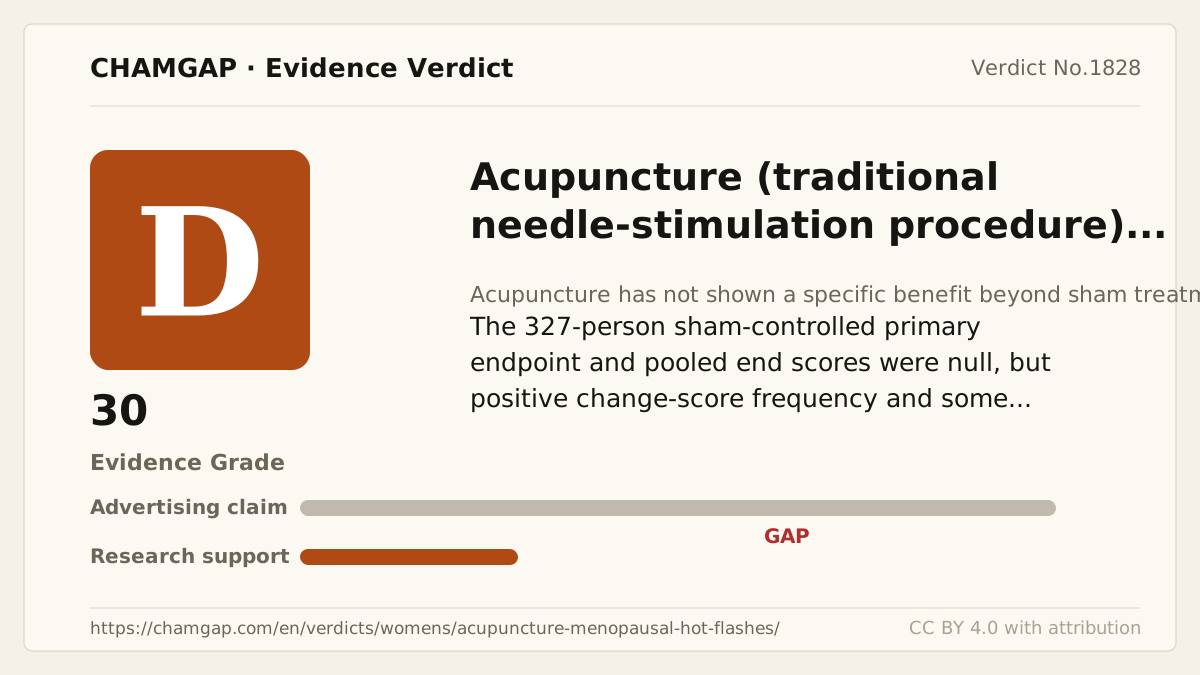
[Chamgap] Acupuncture x reduction of menopausal hot flashes — Evidence Grade D·30. 2 cited sources checked. Source: https://chamgap.com/en/verdicts/womens/acupuncture-menopausal-hot-flashes/ · CC BY 4.0CC BY 4.0 — free to use with attribution; do not distort grades, numbers, or verdict meaning.
What this document does and does not do
Chamgap is an information source. It reports what research has and has not confirmed; it does not tell readers what to take or buy. That decision belongs to readers and, when needed, medical or legal professionals. This verdict reflects literature available up to the search date and may change as new research appears. Nothing here is medical advice.