
Acupuncture,
does it really help with Promotion of spontaneous labour and reduction of medical induction?
research showsAcupuncture for labour induction is rated D. A Cochrane review of 22 trials and 3,456 participants found caesarean-delivery RR 0.80 (95% CI 0.56 to 1.15) versus sham and RR 0.77 (0.51 to 1.17) versus usual care. Both were null, but the confidence intervals do not exclude a meaningful benefit, so the grade is D rather than F. A newer positive no-acupuncture-controlled trial also leaves conflicting evidence, yielding D with 32 points.
ads claimMarketing expands possible cervical preparation into guaranteed spontaneous labour and avoidance of medical induction. Current findings conflict by trial design.
Useful facts when choosing a product
- Acupoints, stimulation, number of sessions, and timing before scheduled induction differ across trials, and no standard protocol is established.
- Choosing acupuncture should not delay obstetric monitoring or a medically indicated scheduled induction.
- Ruptured membranes, reduced fetal movement, bleeding, severe headache, or hypertensive symptoms require prompt obstetric assessment.
Chamgap Semantic Classification Code
Candidate index · review held
K.acupuncture.UNK.promotion-of-spontaneous-labour-and-reduction-of-medical-induction.reduce.MULTIFolk and alternative interventions > Acupuncture > Unknown > Promotion of spontaneous labour and reduction of medical induction > Reduction claim > Multiple: primary unresolved
An automated migration candidate, not an issued permanent code; exact claim scope remains under review. This machine-generated migration candidate helps retrieval but is not a permanent assignment. The original verdict ID and URL remain authoritative.
What the research actually shows
The Modlock trial failed its primary endpoint in all 125 participants, at 12% versus 14%. The 2017 Smith Cochrane review included 22 trials and 3,456 participants. Caesarean-delivery RR was 0.80 (95% CI 0.56 to 1.15) for acupuncture versus sham and 0.77 (0.51 to 1.17) versus usual care. The confidence intervals do not exclude a meaningful benefit, so D is more appropriate than F. verdict 1660, which is F with 8 points, verdict 1670, which is D with 28 points, verdict 1676, which is C with 48 points, and verdict 1696, which is C with 50 points, concern different acupuncture indications; none was used as efficacy evidence for labour induction.
Why this is classified as D (32)
The primary endpoint failed in the 125-person sham-controlled trial and the 22-trial synthesis found no clear benefit. A positive 212-person no-acupuncture-controlled trial prevents a repeated-refutation F rating, leaving D with 32 points.
Counterpoint. The newer positive signal supports further sham-controlled replication, not replacement of medical induction.
Rejudgment record. Cross-check applied — Prioritized failure of the primary endpoint in the 125-person sham-controlled trial and absence of clear benefit in the 22-trial synthesis, while acknowledging a positive 212-person no-acupuncture-controlled trial and therefore assigning conflicting-evidence D rather than repeated-refutation F
Sub-claim grades by effect
This ingredient is marketed for several effects. A single overall grade blends strong and weak claims together, so each effect is graded separately here. The overall grade reflects the strongest disconfirming or core claim.
| Effect (sub-claim) | Grade | Basis |
|---|---|---|
| Promotion of labour or delivery within 24 hours | D | The sham-controlled primary endpoint failed at 12% versus 14%, P=.79. |
| Reduction in caesarean delivery | D | The 22-trial Cochrane synthesis found no clear reduction. |
| Promotion of spontaneous labour before scheduled induction | C | A 212-person no-treatment-controlled trial was positive, but sham-controlled independent replication is absent. |
Cross-check — AI research and Codex final gate
Evidence Table
| Study | Design | Sample | Funding | Endpoint | Result | Weight |
|---|---|---|---|---|---|---|
| Modlock J et al. 2010 | Multicenter randomized double-blind sham-controlled trial | 125 randomized; all 125 in the primary analysis | No external manufacturer funding reported; Danish university-hospital research | Primary endpoint of active labour or delivery within 24 hours | Primary endpoint failed: 7/62 (12%) versus 8/63 (14%), P=.79. | Direct pivotal sham-controlled trial |
| Smith CA et al. 2017 | Cochrane systematic review and meta-analysis of randomized trials | 22 trials with 3,456 participants | Academic Cochrane synthesis; summary support from NCCIH, with mixed funding across included trials | Caesarean delivery, vaginal birth, additional induction methods, and cervical readiness | Caesarean-delivery RR was 0.80 (95% CI 0.56 to 1.15) versus sham and 0.77 (0.51 to 1.17) versus usual care. | Independent synthesized evidence |
| Zamora-Brito M et al. 2024 ACUPUNT | Randomized no-acupuncture-controlled trial | 212 randomized; all 212 analyzed | A specific funding source was not identified in the article; Spanish university-hospital research with no manufacturer leadership reported | Spontaneous labour or membrane rupture before scheduled induction | Positive at 65.1% versus 39.6%, P<.001, but without a sham comparator. | Recent conflicting signal without blinding |
Receipt — 2 References
All 2 cited sources were verified for existence at the original page (as of 2026-07-24).
Final verification and publication gate: Codex · Evidence date: 2026-07-24 · Corrections: none
Cite this verdict
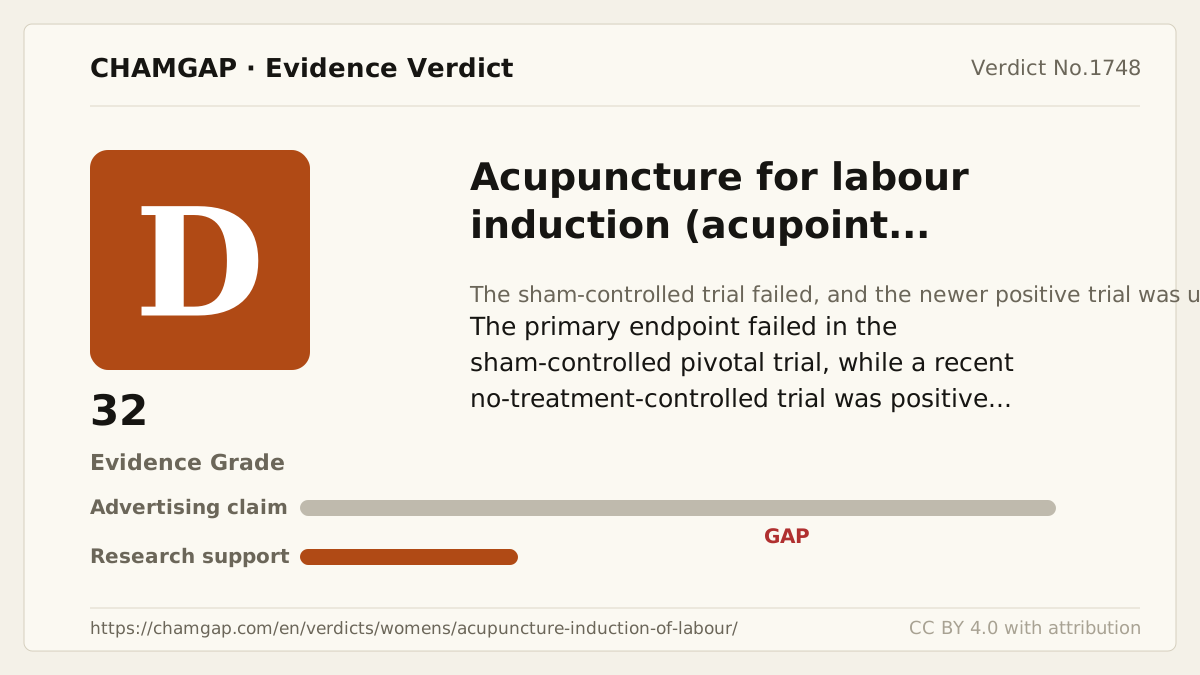
[Chamgap] Acupuncture x induction of labour at term — Evidence Grade D·32. 2 cited sources checked. Source: https://chamgap.com/en/verdicts/womens/acupuncture-induction-of-labour/ · CC BY 4.0CC BY 4.0 — free to use with attribution; do not distort grades, numbers, or verdict meaning.
What this document does and does not do
Chamgap is an information source. It reports what research has and has not confirmed; it does not tell readers what to take or buy. That decision belongs to readers and, when needed, medical or legal professionals. This verdict reflects literature available up to the search date and may change as new research appears. Nothing here is medical advice.