
Acupuncture before and after embryo transfer,
does it really help with Increased live-birth rate in women undergoing in vitro fertilization?
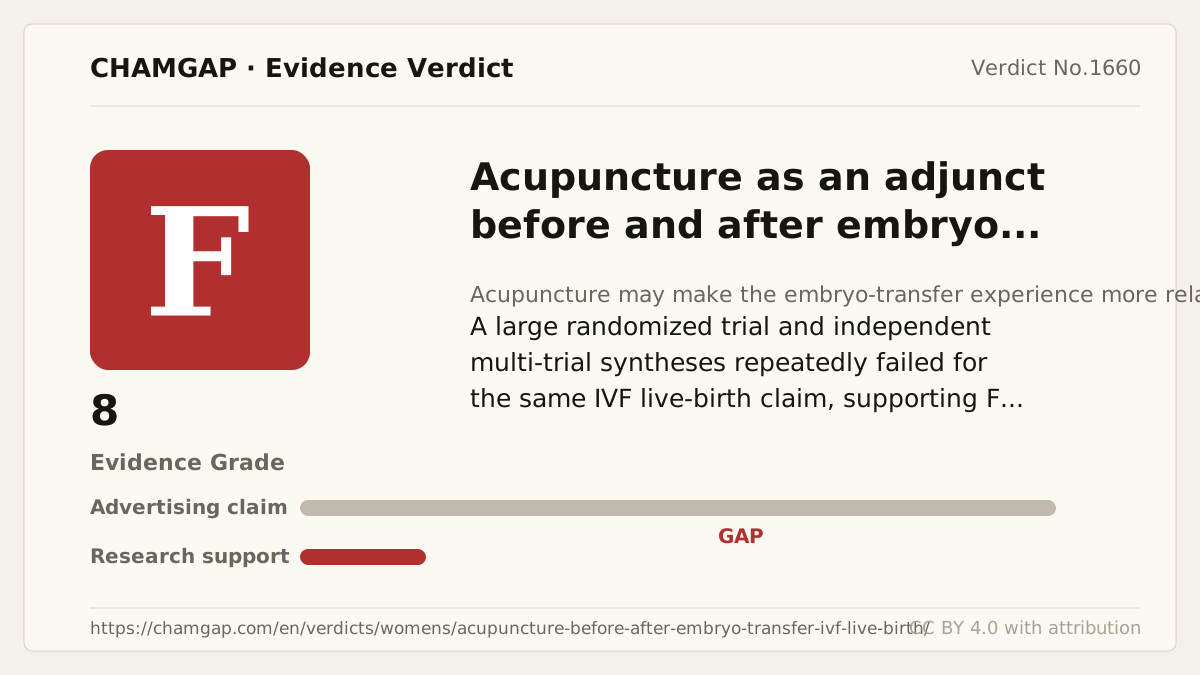
research showsAcupuncture around embryo transfer is rated F for increasing IVF live-birth rates. The trial randomized 848 women, included 824 after consent withdrawals, and ascertained live birth in 809. The primary endpoint failed: 18.3% with acupuncture versus 17.8% with sham, RR 1.02 (95% CI 0.76 to 1.38). A recent meta-analysis of 11 randomized trials and 3,561 women also found RR 1.01 (95% CI 0.88 to 1.15), P=.930, while an earlier sham-controlled meta-analysis was null. Repeated failure supports F with 8 points.
ads claimPromotion claims that improved uterine blood flow or implantation conditions raise success rates and makes acupuncture seem essential around transfer. The patient-important hard endpoint of live birth did not improve in a large sham-controlled trial or repeated syntheses.
Useful facts when choosing a product
- The large trial used one session during stimulation days 6 to 8 and two sessions immediately before and after embryo transfer, with sham participants receiving matched contact time.
- Acupuncture is an optional adjunct and does not replace ovarian stimulation, embryo transfer, luteal support, or embryo-quality assessment in IVF.
- Bruising, pain, minor bleeding, and dizziness can occur, and nonsterile needles or poor technique create infection risk.
- Serious events such as pneumothorax are rare but possible, so a qualified practitioner using sterile single-use needles is essential.
Chamgap Semantic Classification Code
Candidate index · review held
K.acupuncture.UNK.live-birth-rate-undergoing-in-vitro-fertilization.increase.shamFolk and alternative interventions > Acupuncture > Unknown > live-birth rate undergoing in vitro fertilization > Increase claim > Sham procedure or device
An automated migration candidate, not an issued permanent code; exact claim scope remains under review. This machine-generated migration candidate helps retrieval but is not a permanent assignment. The original verdict ID and URL remain authoritative.
What the research actually shows
A 16-center Australian and New Zealand trial compared real acupuncture with nonpenetrating sham acupuncture. Its stages must be distinguished: 848 randomized, 824 included in analysis, and 809 with live-birth ascertainment. The primary live-birth endpoint failed at 18.3% versus 17.8%. A 2025 meta-analysis of embryo-transfer-day acupuncture synthesized 11 randomized trials and 3,561 women and reported live-birth RR 1.01, P=.930. A 2021 sham-controlled meta-analysis likewise found live-birth RR 0.87 (95% CI 0.75 to 1.01) in four trials and 1,835 women and clinical-pregnancy RR 0.99 in six trials and 2,473 women.
Why this is classified as F (8)
The primary endpoint failed at 18.3% versus 17.8% among 809 women with live-birth ascertainment, and meta-analyses of 11 trials and a separate sham-controlled set were also null. Repeated failure in the same indication supports F with 8 points.
Counterpoint. It may be chosen for relaxation or treatment experience, but evidence does not support describing it as increasing live birth or replacing standard IVF care.
Rejudgment record. Cross-check applied — Distinguished 848 randomized women, 824 included in analysis, and 809 with live-birth ascertainment, then confirmed repeated failure of the primary endpoint and independent multi-trial syntheses in the same indication
Sub-claim grades by effect
This ingredient is marketed for several effects. A single overall grade blends strong and weak claims together, so each effect is graded separately here. The overall grade reflects the strongest disconfirming or core claim.
| Effect (sub-claim) | Grade | Basis |
|---|---|---|
| Increased IVF live-birth rate | F | The large-trial primary endpoint and an 11-trial meta-analysis repeatedly failed in the same indication. |
| Increased IVF clinical-pregnancy rate | F | Six sham-controlled trials with 2,473 women were null at RR 0.99; no-treatment subgroup signals did not raise the grade. |
| Increased IVF ongoing-pregnancy rate | F | Four sham-controlled trials with 1,459 women were null at RR 0.88 (95% CI 0.75 to 1.02). |
Cross-check — AI research and Codex final gate
Evidence Table
| Study | Design | Sample | Funding | Endpoint | Result | Weight |
|---|---|---|---|---|---|---|
| Smith CA et al. 2018 | Sixteen-center single-blind randomized sham-acupuncture-controlled trial | 848 randomized; 824 included after consent withdrawals; live birth ascertained in 809 (405/404) | Australian NHMRC public funding | Primary: live birth beyond 20 weeks or birth weight at least 400 g | Primary endpoint failed: 18.3% versus 17.8%, risk difference 0.5 percentage points (95% CI −4.9 to 5.8), RR 1.02. | Key large direct randomized trial |
| Wang Y et al. 2025 | Systematic review and meta-analysis of randomized embryo-transfer-day acupuncture trials | 11 randomized trials and 3,561 women | No commercial or financial conflicts reported | Live-birth and clinical-pregnancy rates | Live birth was null: RR 1.01 (95% CI 0.88 to 1.15), P=.930. | Repeated null evidence across multiple randomized trials in the same indication |
| Coyle ME et al. 2021 | Systematic review and meta-analysis of sham-controlled IVF randomized trials | Eight randomized trials and 3,607 women overall; four trials and 1,835 women for live birth | RMIT University academic research | Live birth, clinical pregnancy, and ongoing pregnancy | Live birth RR 0.87 (95% CI 0.75 to 1.01) and clinical pregnancy RR 0.99 were both null versus sham. | Independent sham-controlled synthesis |
Receipt — 3 References
All 3 cited sources were verified for existence at the original page (as of 2026-07-24).
Final verification and publication gate: Codex · Evidence date: 2026-07-24 · Corrections: none
Cite this verdict
[Chamgap] Acupuncture before and after embryo transfer x increased IVF live-birth rate — Evidence Grade F·8. 3 cited sources checked. Source: https://chamgap.com/en/verdicts/womens/acupuncture-before-after-embryo-transfer-ivf-live-birth/ · CC BY 4.0CC BY 4.0 — free to use with attribution; do not distort grades, numbers, or verdict meaning.
What this document does and does not do
Chamgap is an information source. It reports what research has and has not confirmed; it does not tell readers what to take or buy. That decision belongs to readers and, when needed, medical or legal professionals. This verdict reflects literature available up to the search date and may change as new research appears. Nothing here is medical advice.