
Adjuvant abemaciclib,
does it really help with Reduction of invasive recurrence in hormone receptor-positive, HER2-negative, node-positive high-risk early breast cancer?
research showsThe grade is B. In the 5,637-patient monarchE trial, adding two years of abemaciclib to endocrine therapy produced seven-year invasive disease-free survival of 77.4% versus 70.9%, a 6.5-point difference, HR 0.734 (95% CI 0.657 to 0.820). Overall survival is now mature and significant at 86.8% versus 85.0%, HR 0.842 (95% CI 0.722 to 0.981), but evidence remains concentrated in one Lilly development trial without independent replication.
ads claimThe result does not apply to every HR-positive early breast cancer or to low-risk node-negative disease. Recurrence reduction should not be converted into a claim of a large mortality effect, and two years of additional medication does not replace surgery, radiotherapy, chemotherapy when indicated, or long-term endocrine therapy.
Useful facts when choosing a product
- The article states, 'Funding: Eli Lilly.' Early reports disclosed Lilly employee authors with stock ownership and multiple investigators with Lilly advisory or research relationships.
- In the safety population, diarrhea occurred in 2,304/2,791 (82.6%) versus 218/2,800 (7.8%), and neutropenia in 1,262/2,791 (45.2%) versus 145/2,800 (5.2%).
- Grade 3 or worse diarrhea occurred in 7.8% versus 0.2%, and neutropenia in 19.6% versus 0.9%.
- Verdict 1254 is B with 72 points for olaparib in germline BRCA1/2-mutated disease. This verdict concerns a CDK4/6 inhibitor in HR-positive, HER2-negative, node-positive high-risk disease, so both drug and selected population differ.
Chamgap Semantic Classification Code
Candidate index · review held
UNK.of-adjuvant-abemaciclib-added-to-standard-endocrine-therapy.UNK.invasive-recurrence-in-hormone-receptor-positive-her2-negative-node-positive-high-risk-early-breast-cancer.reduce.addonUnknown > of adjuvant abemaciclib added to standard endocrine therapy > Unknown > invasive recurrence in hormone receptor-positive, HER2-negative, node-positive high-risk early breast cancer > Reduction claim > Added intervention on common background care
An automated migration candidate, not an issued permanent code; exact claim scope remains under review. This machine-generated migration candidate helps retrieval but is not a permanent assignment. The original verdict ID and URL remain authoritative.
What the research actually shows
Eligibility required HR-positive, HER2-negative, node-positive early breast cancer. Cohort 1 required at least four positive axillary nodes, or one to three nodes plus tumor size at least 5 cm or histologic grade 3. Cohort 2 required one to three nodes and Ki-67 at least 20% without meeting cohort 1 clinicopathologic criteria. Participants were assigned to abemaciclib 150 mg twice daily for up to two years plus endocrine therapy, 2,808, or endocrine therapy alone, 2,829. The trial was open label, but objective event outcomes and large longitudinal follow-up are central. No independent abemaciclib randomized replication in the same indication was found.
Why this is classified as B (76)
A 5,637-patient randomized trial measured actual invasive recurrence, distant recurrence, and death and found sustained, precise benefit without a counted avoidable core design defect. However, efficacy evidence comes from the Lilly-funded monarchE trial alone, with no independent replication in the same drug and indication. The single-trial cap gives B with 76 points.
Counterpoint. The 6.5-point absolute recurrence benefit and 1.8-point absolute survival benefit must be weighed against diarrhea, myelosuppression, thrombosis, interstitial lung disease, and two years of treatment according to each patient's pathological risk.
Rejudgment record. Cross-check applied — Verification of monarchE's primary IDFS definition, high-risk eligibility, seven-year absolute effects and mature OS, Lilly funding and conflicts, and absolute harm rates
| Endpoint | H | Hard endpoint - actual events such as death |
| Replication | R1 | Single confirmatory trial |
| Independence | I0 | Evidence comes only from manufacturer studies |
| Effect size | E+ | Meets the clinically important threshold |
Stored derived and displayed grades match; this is not a current recalculation or validity check (B).
Sub-claim grades by effect
This ingredient is marketed for several effects. A single overall grade blends strong and weak claims together, so each effect is graded separately here. The overall grade reflects the strongest disconfirming or core claim.
| Effect (sub-claim) | Grade | Basis |
|---|---|---|
| Reduction of invasive recurrence | B | The seven-year IDFS benefit persisted at 6.5 points but comes from one manufacturer-funded trial. |
| Reduction of all-cause mortality | B | Overall survival is now significant at 86.8% versus 85.0%, HR 0.842. |
| Recurrence reduction in every HR-positive early breast cancer | ? | Node-negative and low-risk patients were outside monarchE's proven population. |
Cross-check — AI research and Codex final gate
Evidence Table
| Study | Design | Sample | Funding | Endpoint | Result | Weight |
|---|---|---|---|---|---|---|
| Johnston SRD et al. 2020 monarchE primary report | International multicenter phase 3 open-label randomized trial | 5,637 randomized, 2,808 versus 2,829; safety 2,791 versus 2,800 | Article wording: 'Funding: Eli Lilly'; Lilly employee-shareholder authors and multiple industry relationships disclosed | Primary invasive disease-free survival | Initial two-year IDFS 92.2% versus 88.7%, HR 0.75 (95% CI 0.60 to 0.93) | Pivotal manufacturer-funded phase 3 trial |
| Johnston S et al. 2026 monarchE primary overall-survival analysis | Prespecified overall-survival and seven-year update of the same randomized trial | 5,637 participants; median follow-up 76.2 months | Eli Lilly | Overall survival, seven-year IDFS, and distant relapse-free survival | Deaths 301/2808 (10.7%) versus 360/2829 (12.7%), HR 0.842 (95% CI 0.722 to 0.981); seven-year IDFS 77.4% versus 70.9% | Mature mortality and sustained recurrence effect from the same trial |
Receipt — 3 References
All 3 cited sources were verified for existence at the original page (as of 2026-08-07).
Final verification and publication gate: Codex · Evidence date: 2026-08-07 · Corrections: none
Cite this verdict
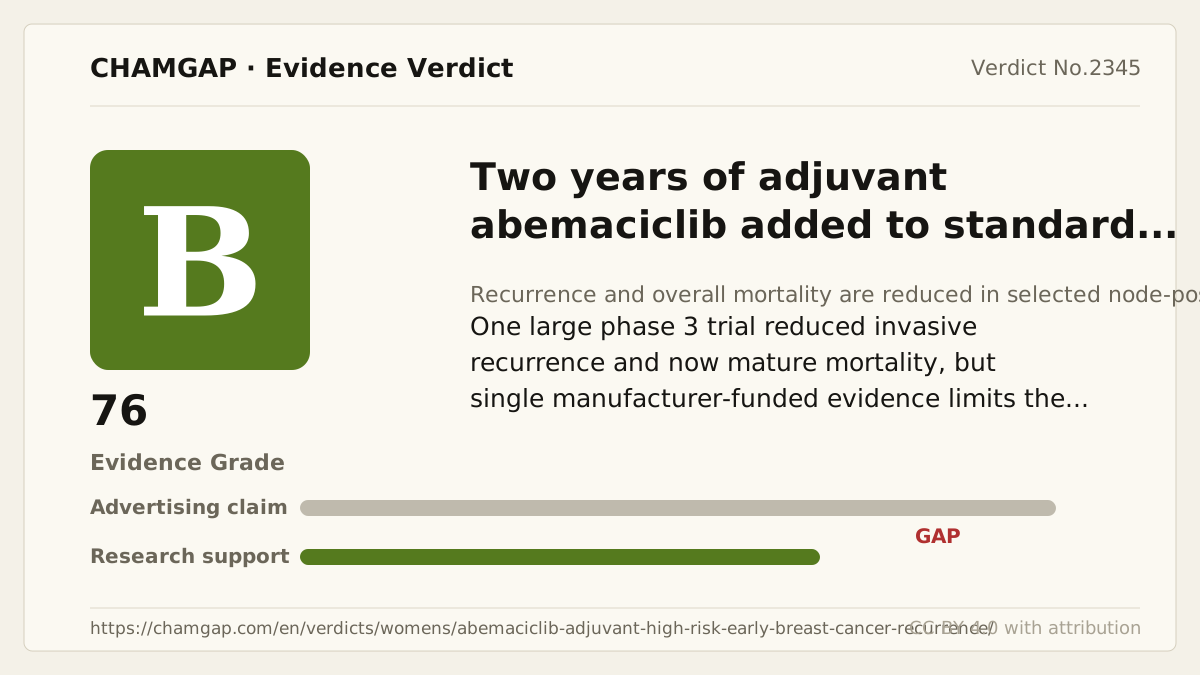
[Chamgap] Adjuvant abemaciclib x recurrence in high-risk early breast cancer — Evidence Grade B·76. 3 cited sources checked. Source: https://chamgap.com/en/verdicts/womens/abemaciclib-adjuvant-high-risk-early-breast-cancer-recurrence/ · CC BY 4.0CC BY 4.0 — free to use with attribution; do not distort grades, numbers, or verdict meaning.
What this document does and does not do
Chamgap is an information source. It reports what research has and has not confirmed; it does not tell readers what to take or buy. That decision belongs to readers and, when needed, medical or legal professionals. This verdict reflects literature available up to the search date and may change as new research appears. Nothing here is medical advice.