
A bed rocking laterally at 0.25 Hz,
does it really help with Increased deep-sleep N3 proportion?
research showsThe grade is C. In a crossover trial, 18 healthy young adults spent one night under each condition. N3 was 27.41%±1.70 SEM with rocking versus 22.37%±1.65 stationary, Bonferroni-adjusted P=0.0006. This did not test insomnia patients or sustained use.
ads claimClaims should say that a one-night deep-sleep marker increased, not that insomnia or durable sleep quality improved.
Useful facts when choosing a product
- The bed moved laterally at 0.25 Hz.
- N3 proportion is a polysomnographic surrogate.
- There was no prespecified safety endpoint or adverse-event table.
Chamgap Semantic Classification Code
Candidate index · review held
UNK.bed-rocking-laterally-at-0-25-hz.UNK.deep-sleep-n3-proportion.increase.UNKUnknown > bed rocking laterally at 0.25 Hz > Unknown > deep-sleep N3 proportion > Increase claim > Unknown
An automated migration candidate, not an issued permanent code; exact claim scope remains under review. This machine-generated migration candidate helps retrieval but is not a permanent assignment. The original verdict ID and URL remain authoritative.
What the research actually shows
Eighteen healthy young adults spent one night in each condition in a randomized counterbalanced crossover study. Polysomnography measured N3 as a proportion of total sleep time. There was no clinically important N3 threshold, only Bonferroni correction. Funding came from the Swiss National Science Foundation and University of Geneva, and authors declared no competing interests. The paper did not report free bed or motor supply or manufacturer involvement. The evidence has two design limitations: 18 participants and one night per condition.
Why this is classified as C (54)
A single 18-person, one-night crossover trial of a polysomnographic surrogate gives C with 54 points.
Counterpoint. Effects in insomnia and persistence with continued use remain unknown.
Rejudgment record. Cross-check applied — A one-night crossover trial in 18 healthy young adults found a higher polysomnographic N3 proportion
| Endpoint | S | Surrogate marker - laboratory or imaging measures |
| Replication | R1 | Single confirmatory trial |
| Independence | I2 | Decisive evidence is publicly or non-profit funded |
| Effect size | E+ | Meets the clinically important threshold |
Stored derived and displayed grades match; this is not a current recalculation or validity check (C).
Sub-claim grades by effect
This ingredient is marketed for several effects. A single overall grade blends strong and weak claims together, so each effect is graded separately here. The overall grade reflects the strongest disconfirming or core claim.
| Effect (sub-claim) | Grade | Basis |
|---|---|---|
| Higher N3 proportion over one night | C | It was 27.41% versus 22.37%, adjusted P=0.0006. |
| Sustained improvement of insomnia | ? | Insomnia patients and sustained use were not tested. |
Cross-check — AI research and Codex final gate
Evidence Table
| Study | Design | Sample | Funding | Endpoint | Result | Weight |
|---|---|---|---|---|---|---|
| Perrault AA et al. 2019 | Randomized counterbalanced crossover sleep study | 18 healthy young adults | Swiss National Science Foundation and University of Geneva | N3 proportion of total sleep time | 27.41%±1.70 SEM vs 22.37%±1.65; adjusted P=0.0006; 95% CI not reported | Surrogate evidence from 18 participants and one night per condition |
Receipt — 1 References
All 1 cited sources were verified for existence at the original page (as of 2026-08-26).
Final verification and publication gate: Codex · Evidence date: 2026-08-26 · Corrections: none
Cite this verdict
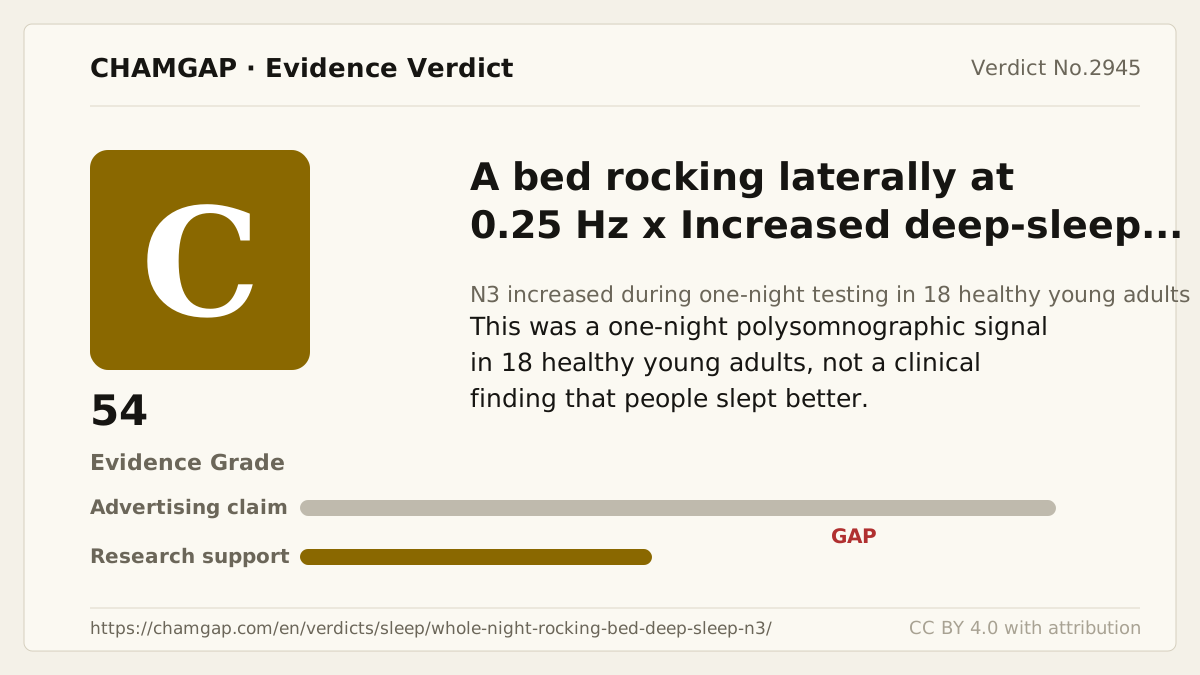
[Chamgap] Benefit of a 0.25-Hz Rocking Bed for the N3 Deep-Sleep Proportion, a Sleep-Study Measure — Evidence Grade C·54. 1 cited sources checked. Source: https://chamgap.com/en/verdicts/sleep/whole-night-rocking-bed-deep-sleep-n3/ · CC BY 4.0CC BY 4.0 — free to use with attribution; do not distort grades, numbers, or verdict meaning.
What this document does and does not do
Chamgap is an information source. It reports what research has and has not confirmed; it does not tell readers what to take or buy. That decision belongs to readers and, when needed, medical or legal professionals. This verdict reflects literature available up to the search date and may change as new research appears. Nothing here is medical advice.