
Lemborexant,
does it really help with Improved sleep onset and sleep maintenance in insomnia?
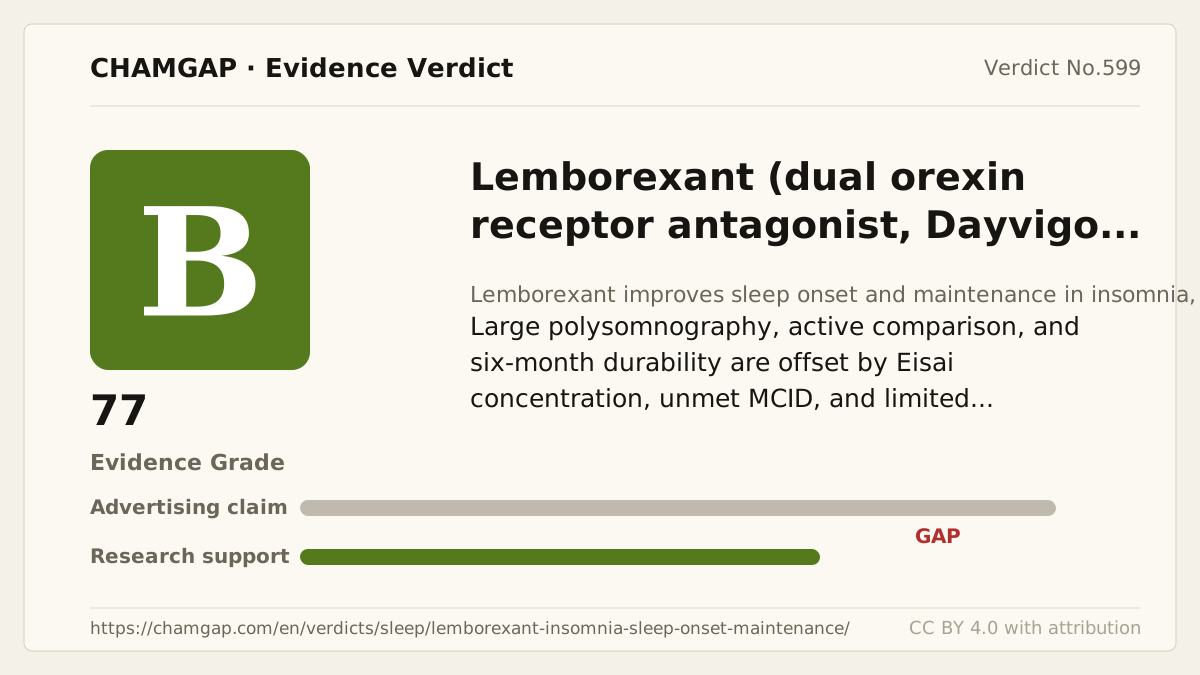
research showsLemborexant is rated B because it repeatedly improves sleep onset and maintenance on objective polysomnography and subjective sleep diaries. SUNRISE-1 included 1,006 participants and an active zolpidem comparator, while SUNRISE-2 sustained subjective benefit for six months in 949 participants. Both trials were Eisai funded, and Eisai also performed the SUNRISE-1 statistical analysis. A Canadian reassessment found that minimum clinically important differences were not met and highlighted insufficient daytime-function evidence, yielding high B with 77 points.
ads claimPhrases such as natural brain sleep, perfect nightly sleep optimization, or no next-day effect and no dependence expand average onset and maintenance improvements in insomnia disorder into maximal sleep for healthy people and risk-free long-term use. More sleep time does not guarantee optimal restoration or daytime function for every person.
Useful facts when choosing a product
- Lemborexant is a prescription dual antagonist of orexin OX1R and OX2R, not a supplement or melatonin product.
- United States labeling starts at 5 mg once immediately before bed and permits up to 10 mg when appropriate, with at least seven hours remaining before planned awakening. The prescription and local label take priority.
- Next-day somnolence and driving impairment, sleep paralysis, hypnagogic or hypnopompic hallucinations, and complex sleep behaviors can occur, and alcohol or other central nervous system depressants increase risk.
- Narcolepsy is a contraindication, while sleep apnea or respiratory disease, older age, hepatic impairment, pregnancy or lactation, and medicines interacting through CYP3A require clinical review.
Chamgap Semantic Classification Code
Candidate index · review held
M.lemborexant.UNK.sleep-onset-and-sleep-maintenance-in-insomnia.improve.MULTIMedicinal interventions > Lemborexant > Unknown > sleep onset and sleep maintenance in insomnia > Improvement claim > Multiple: primary unresolved
An automated migration candidate, not an issued permanent code; exact claim scope remains under review. This machine-generated migration candidate helps retrieval but is not a permanent assignment. The original verdict ID and URL remain authoritative.
What the research actually shows
Rosenberg 2019 SUNRISE-1 compared polysomnographic sleep onset and maintenance with placebo and zolpidem ER in 1,006 adults aged 55 years or older at 67 sites and found improvement on every key objective endpoint for both lemborexant doses. Kärppä 2020 SUNRISE-2 randomized 949 adults for six placebo-controlled months and used daily diaries to show improved subjective latency, wake after sleep onset, and sleep efficiency. Yue 2023 synthesized 69 trials with 17,319 participants and found lemborexant and daridorexant more effective than placebo for latency, wake after sleep onset, and total sleep time. A two-week analysis after abrupt discontinuation following 6 to 12 months found no clear withdrawal or rebound insomnia, but it was a manufacturer-associated secondary analysis rather than definitive proof of no dependence.
Why this is classified as B (77)
SUNRISE-1 provided objective polysomnography and a zolpidem active comparator in 1,006 participants, while SUNRISE-2 sustained subjective benefit for six months in 949 participants. Both were Eisai funded, Eisai performed the SUNRISE-1 statistical analysis, and a Canadian reassessment identified unmet MCID and insufficient daytime-function evidence. The result is high B with 77 points. Next-day somnolence, sleep paralysis, and driving precautions remain separate safety issues.
Counterpoint. Lemborexant can be a prescription option when non-drug treatment is insufficient in diagnosed insomnia disorder. It does not replace first-line CBT-I or evaluation for sleep apnea, depression, pain, medicines, caffeine, and other causes.
Rejudgment record. New verdict — Accepted objective polysomnography and zolpidem active comparison in the 1,006-person SUNRISE-1 trial and six-month subjective durability in the 949-person SUNRISE-2 trial, while accounting for Eisai funding of both trials, Eisai statistical analysis in SUNRISE-1, unmet MCID in a Canadian reassessment, and limited daytime-function evidence
Sub-claim grades by effect
This ingredient is marketed for several effects. A single overall grade blends strong and weak claims together, so each effect is graded separately here. The overall grade reflects the strongest disconfirming or core claim.
| Effect (sub-claim) | Grade | Basis |
|---|---|---|
| Improved sleep onset and maintenance in insomnia disorder | B | Large polysomnography and diary trials, active comparison, and meta-analyses are concordant, but source trials are concentrated in the manufacturer's program. |
| Sleep-quality optimization in healthy people | ? | No efficacy trial has assessed restoration or performance optimization in healthy people without insomnia disorder. |
| Sustained efficacy through six months | B | Subjective onset and maintenance benefit persisted for six months in SUNRISE-2, but it is a single manufacturer-sponsored program. |
| No rebound insomnia or withdrawal after discontinuation | C | A two-week untreated secondary analysis is reassuring but not definitive because it is manufacturer-associated and secondary. |
Cross-check — AI research and Codex final gate
Evidence Table
| Study | Design | Sample | Funding | Endpoint | Result | Weight |
|---|---|---|---|---|---|---|
| SUNRISE-1, Rosenberg R et al. 2019 | Phase 3 randomized double-blind placebo- and zolpidem-ER-controlled trial | 1,006 adults aged 55 years or older with insomnia disorder | Eisai Inc. | One-month polysomnographic latency, sleep efficiency, and wake after sleep onset | Both 5 and 10 mg improved objective onset and maintenance versus placebo and reduced second-half-of-the-night wake time more than zolpidem ER. | Key large objective active-comparator randomized trial |
| SUNRISE-2, Kärppä M et al. 2020 | Phase 3 12-month randomized double-blind trial with six placebo-controlled months | 949 adults with insomnia disorder | Eisai Inc. | Daily-diary subjective sleep latency, wake after sleep onset, and sleep efficiency | Both doses sustained better onset, maintenance, and efficiency than placebo through six months. | Long-term direct subjective randomized trial |
| Yue JL et al. 2023 | Systematic review and network meta-analysis of insomnia medicines | 69 randomized trials, 17,319 participants, and 20 drugs | Chinese public and academic funding | Sleep latency, wake after sleep onset, total sleep time, efficiency, and tolerability | Lemborexant was more effective than placebo for latency, maintenance, and total sleep time. | Independent synthesis, not a substitute for independent source trials |
| Takaesu Y et al. 2023 discontinuation analysis | Secondary analysis of the untreated follow-up in SUNRISE-2 | Participants discontinuing after 6 to 12 months of treatment | Eisai-associated authors and source trial | Two-week rebound insomnia and Tyrer withdrawal scale | No clear rebound insomnia or withdrawal signal was found after abrupt discontinuation. | Manufacturer-associated secondary safety and discontinuation evidence |
Receipt — 5 References
All 5 cited sources were verified for existence at the original page (as of 2026-07-19).
Final verification and publication gate: Codex · Evidence date: 2026-07-19 · Corrections: none
Cite this verdict
[Chamgap] Lemborexant x improved sleep onset and maintenance in insomnia — Evidence Grade B·77. 5 cited sources checked. Source: https://chamgap.com/en/verdicts/sleep/lemborexant-insomnia-sleep-onset-maintenance/ · CC BY 4.0CC BY 4.0 — free to use with attribution; do not distort grades, numbers, or verdict meaning.
What this document does and does not do
Chamgap is an information source. It reports what research has and has not confirmed; it does not tell readers what to take or buy. That decision belongs to readers and, when needed, medical or legal professionals. This verdict reflects literature available up to the search date and may change as new research appears. Nothing here is medical advice.