
Melatonin,
does it really help with Prevention of jet lag and adaptation to destination time?
research showsStandard melatonin reduced jet lag after travel across five or more time zones in eight of ten randomized trials, with an estimated number needed to treat of about two, supporting an A grade. This efficacy applies to standard melatonin with defined dose and timing; it does not establish equivalent content, pharmacokinetics, or efficacy for plant-derived melatonin-containing foods marketed in South Korea.
ads claimKorean marketing may present general foods containing plant-derived ingredients as equivalent to prescription melatonin or trial-grade melatonin for time-zone adaptation. A plant-source label alone does not establish actual melatonin content, absorption, or formulation equivalence.
Useful facts when choosing a product
- Standard melatonin doses in jet-lag studies were mainly 0.5-5 mg, with timing near the destination bedtime as the key factor.
- A 2 mg slow-release formulation was relatively ineffective, and doses above 5 mg showed no additional benefit.
- In South Korea, general foods emphasizing plant-derived melatonin ingredients are marketed separately from prescription melatonin products, but trial equivalence in labeled content, formulation, and bioavailability has not been established.
- An analysis of 31 overseas supplements found actual melatonin content ranging from 83% below to 478% above the label, with undeclared serotonin in some products.
- Short-term use is generally tolerated, but mistimed dosing can cause sleepiness and delayed adaptation; driving, alcohol, warfarin, epilepsy, pregnancy, lactation, and pediatric use warrant clinical review.
Chamgap Semantic Classification Code
Candidate index · review held
UNK.melatonin.UNK.jet-lag-and-adaptation-to-destination-time.prevent.placeboUnknown > Melatonin > Unknown > jet lag and adaptation to destination time > Occurrence-prevention claim > Placebo
An automated migration candidate, not an issued permanent code; exact claim scope remains under review. This machine-generated migration candidate helps retrieval but is not a permanent assignment. The original verdict ID and URL remain authoritative.
What the research actually shows
The Cochrane review by Herxheimer and Petrie included ten randomized trials in air travelers and related populations, nine of which were adequate for assessment. Eight trials found that melatonin taken near the destination bedtime, about 10 p.m. to midnight, reduced jet lag after travel across five or more time zones. Doses of 0.5 to 5 mg were similarly effective, while 5 mg improved sleep onset and quality more than 0.5 mg and doses above 5 mg added no benefit. Effects were greater after eastward travel and after crossing more time zones.
Why this is classified as A (88)
Multiple placebo-controlled randomized trials used direct jet-lag outcomes and eight of ten pointed in the same direction with a practically meaningful effect, supporting A with 88 points. Product-content variability and uncertain equivalence of Korean plant-derived foods are separated as product and safety issues rather than used to deny efficacy.
Counterpoint. The evidence applies most directly to adults crossing at least five time zones. Benefits may be smaller or different for two to four time zones, westward travel, or poorly timed dosing.
Rejudgment record. New verdict — Eight of ten randomized jet-lag trials of standard melatonin were positive, using direct clinical outcomes with a practical effect size
Sub-claim grades by effect
This ingredient is marketed for several effects. A single overall grade blends strong and weak claims together, so each effect is graded separately here. The overall grade reflects the strongest disconfirming or core claim.
| Effect (sub-claim) | Grade | Basis |
|---|---|---|
| Prevention or reduction of jet lag with standard melatonin | A | Eight of ten randomized trials were positive, especially after crossing at least five time zones with dosing near destination bedtime. |
| Clinical equivalence of Korean plant-derived melatonin-containing general foods | ? | No finished-product human trial was identified establishing equivalent content, formulation, bioavailability, and jet-lag efficacy to standard melatonin. |
Cross-check — AI research and Codex final gate
Evidence Table
| Study | Design | Sample | Funding | Endpoint | Result | Weight |
|---|---|---|---|---|---|---|
| Herxheimer A, Petrie KJ 2002 | Cochrane systematic review of randomized trials | 9 | Independent systematic review | Jet-lag ratings, fatigue, sleep, and return to normal rhythms | Eight of ten trials found that melatonin taken near destination bedtime reduced jet lag after crossing at least five time zones; the estimated number needed to treat was about two. | Key |
| Erland LAE, Saxena PK 2017 | Laboratory content analysis of marketed supplements | 31 | Academic | Melatonin content versus label and presence of serotonin | Actual content ranged from 83% below to 478% above the label, and undeclared serotonin was detected in 26% of products. | Product variability, outside efficacy grade |
| Petrie K et al. 1989 | Double-blind placebo-controlled crossover randomized trial (Auckland, New Zealand group; independent replication) | 20 volunteers aged 28-68 with long-haul experience, Auckland-London return flights | Not identified (no statement in abstract or grants list) | Visual analogue scales for jet lag and tiredness, Profile of Mood States, days to recover sleep pattern and energy | Jet-lag scores were lower with melatonin 5 mg than placebo (2.15 v 3.4), with faster recovery of normal sleep (2.85 v 4.15 days), daytime tiredness (3.0 v 4.6 days), and energy (3.25 v 4.7 days); jet lag was more severe on the return westward journey. | Supporting (independent replication) |
| Suhner A et al. 1998 | Double-blind placebo-controlled randomized dose-formulation comparison (Zurich, Switzerland group; independent replication) | 320 recruited, 234 (73.1%) completed, eastward flights over 6-8 time zones | Not identified (no statement in abstract or grants list) | Profile of Mood States, sleep log, symptom questionnaires, Karolinska Sleepiness Scale | Fast-release formulations were more effective than the 2 mg controlled-release form; 5 mg fast-release significantly improved sleep quality, shortened sleep latency, and reduced fatigue and daytime sleepiness (p<.05), while the physiological 0.5 mg dose was almost as effective except for the hypnotic outcomes, which favored 5 mg. | Supporting (independent replication) |
Receipt — 4 References
All 4 cited sources were verified for existence at the original page (as of 2026-08-11).
Final verification and publication gate: Codex · Evidence date: 2026-08-11 · Corrections: none
Cite this verdict
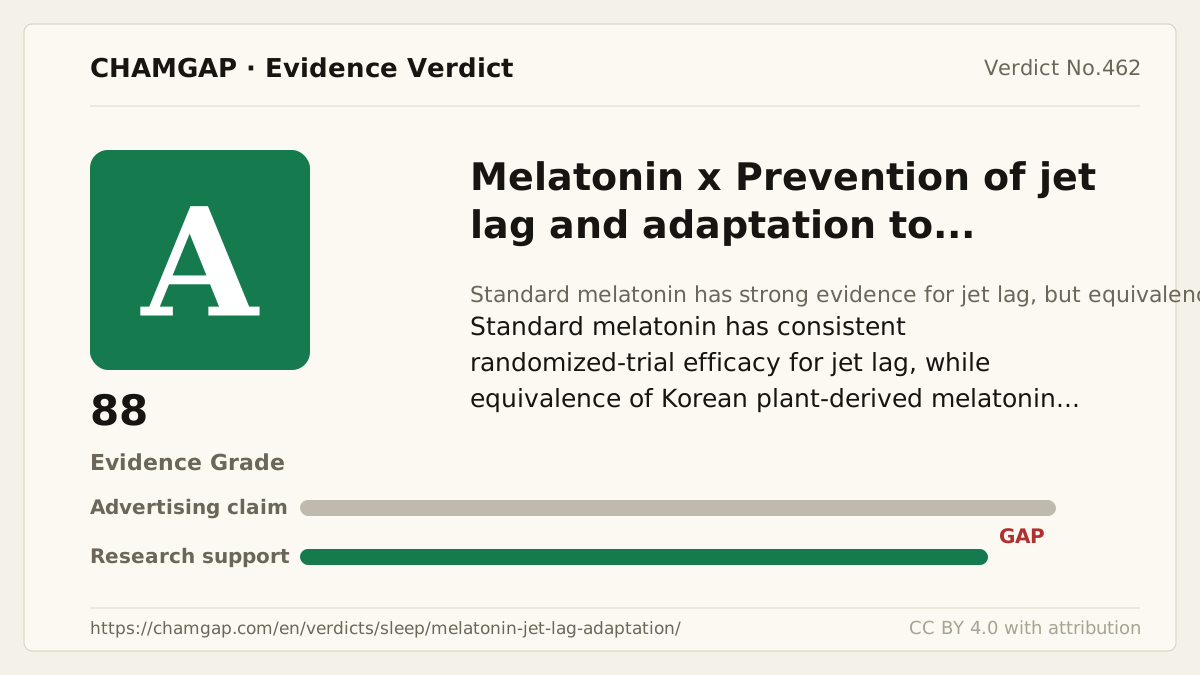
[Chamgap] Melatonin x jet-lag prevention and destination-time adaptation — Evidence Grade A·88. 4 cited sources checked. Source: https://chamgap.com/en/verdicts/sleep/melatonin-jet-lag-adaptation/ · CC BY 4.0CC BY 4.0 — free to use with attribution; do not distort grades, numbers, or verdict meaning.
What this document does and does not do
Chamgap is an information source. It reports what research has and has not confirmed; it does not tell readers what to take or buy. That decision belongs to readers and, when needed, medical or legal professionals. This verdict reflects literature available up to the search date and may change as new research appears. Nothing here is medical advice.