
10 pm late dinner,
does it really help with Worsened sleep architecture over one night?
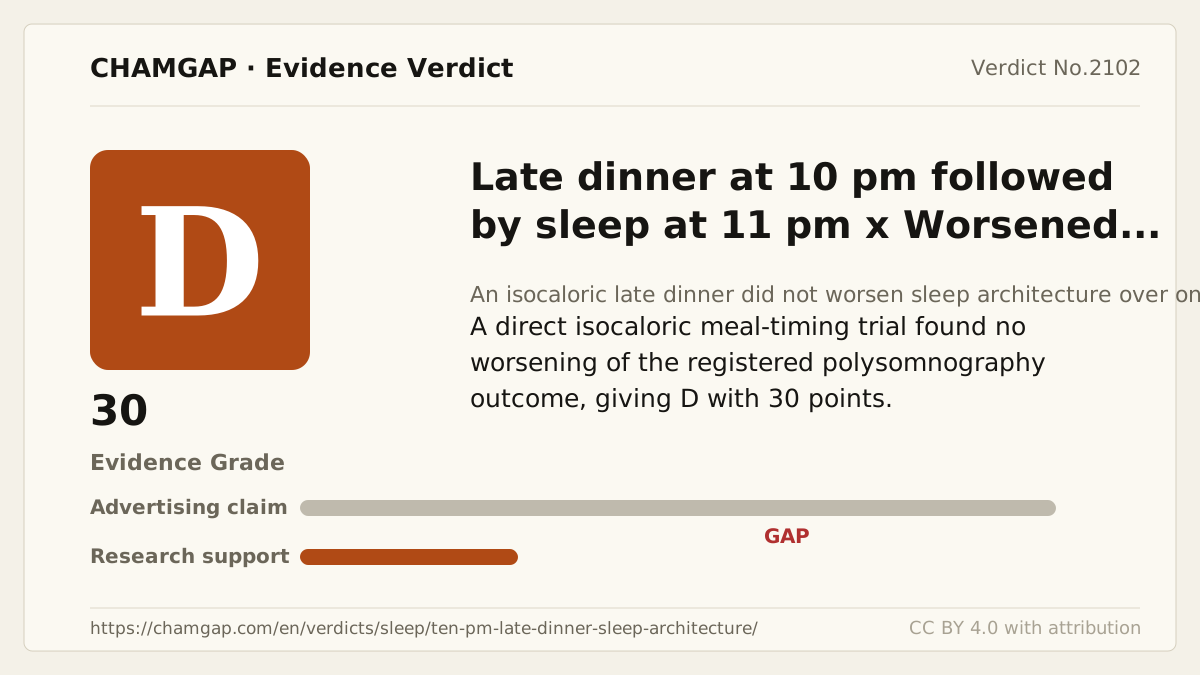
research showsThe grade is D with 30 points. Twenty healthy adults completed a randomized crossover comparison of nutritionally identical, isocaloric dinners at 6 pm and 10 pm, followed by polysomnography from 11 pm. Sleep architecture did not differ. Polysomnography was a registered secondary outcome and this was only a one-night experiment, so it is not repeated refutation, but the direct trial did not support sleep worsening.
ads claimMetabolic changes after eating one hour before bed are not the same as impaired sleep. The latter was not found in this laboratory night.
Useful facts when choosing a product
- Dinner calories and macronutrients were matched; only timing differed.
- The registry enrollment of 34 differs from the paper's analyzed sample of 20.
- Verdict 1647 is D with 34 points for long-term extra weight loss from an eight-hour eating window; this verdict concerns dinner timing and one-night polysomnography.
Chamgap Semantic Classification Code
Candidate index · review held
F.late-dinner-at-10-pm-followed-by-sleep-at-11-pm.food.worsened-sleep-architecture-over-one-night.assess.UNKFoods and beverages > Late dinner at 10 pm followed by sleep at 11 pm > Food consumption > Worsened sleep architecture over one night > Association or change assessment > Unknown
An automated migration candidate, not an issued permanent code; exact claim scope remains under review. This machine-generated migration candidate helps retrieval but is not a permanent assignment. The original verdict ID and URL remain authoritative.
What the research actually shows
The registry lists 34 actual enrollees, whereas the peer-reviewed analysis included 20 healthy adults, 10 women and 10 men. Participants ate dinners with identical calories and macronutrients at 6 pm or 10 pm and slept from 11 pm to 7 am. Registered secondary polysomnography showed no change in sleep architecture. Johns Hopkins was the responsible institution, and public NIH-related and American Heart Association support was reported.
Why this is classified as D (30)
A direct randomized trial found a null registered sleep outcome, with no repeated failure in the same indication, giving D with 30 points.
Counterpoint. D does not mean late dinner is harmless in every respect; it means sleep worsening was unsupported here.
Rejudgment record. Cross-check applied — Null registered polysomnography secondary outcome in a 20-person one-night isocaloric randomized crossover trial
| Endpoint | P | Symptom or function itself is the target - including patient reports and performance tests |
| Replication | R1 | Single confirmatory trial |
| Independence | I2 | Decisive evidence is publicly or non-profit funded |
| Effect size | E0 | Null |
| Precision | CX | No pooled confidence interval could be confirmed |
Stored derived and displayed grades match; this is not a current recalculation or validity check (D).
Sub-claim grades by effect
This ingredient is marketed for several effects. A single overall grade blends strong and weak claims together, so each effect is graded separately here. The overall grade reflects the strongest disconfirming or core claim.
| Effect (sub-claim) | Grade | Basis |
|---|---|---|
| Worsened sleep architecture after a 10 pm dinner | D | No difference was found in the 20-person crossover trial. |
| Nocturnal metabolic changes after a 10 pm dinner | C | Glucose and fat oxidation changed, a separate claim from sleep. |
Cross-check — AI research and Codex final gate
Evidence Table
| Study | Design | Sample | Funding | Endpoint | Result | Weight |
|---|---|---|---|---|---|---|
| Gu et al. 2020 | Randomized crossover isocaloric laboratory trial | 34 enrolled in the registry; 20 analyzed in the paper | Public or nonprofit NIH-related and American Heart Association support | Registered secondary polysomnography outcome | No difference in sleep architecture; a sleep treatment estimate and CI were not recovered from publicly verified material | Direct null evidence but acute and small |
Receipt — 2 References
All 2 cited sources were verified for existence at the original page (as of 2026-08-03).
Final verification and publication gate: Codex · Evidence date: 2026-08-03 · Corrections: none
Cite this verdict
[Chamgap] 10 pm late dinner x worsened sleep — Evidence Grade D·30. 2 cited sources checked. Source: https://chamgap.com/en/verdicts/sleep/ten-pm-late-dinner-sleep-architecture/ · CC BY 4.0CC BY 4.0 — free to use with attribution; do not distort grades, numbers, or verdict meaning.
What this document does and does not do
Chamgap is an information source. It reports what research has and has not confirmed; it does not tell readers what to take or buy. That decision belongs to readers and, when needed, medical or legal professionals. This verdict reflects literature available up to the search date and may change as new research appears. Nothing here is medical advice.