
Suvorexant,
does it really help with Improved sleep onset, sleep maintenance, and total sleep time in adults with insomnia?
research showsSuvorexant is rated B because multiple phase 3 placebo-controlled trials show improvements in sleep onset, maintenance, and total sleep time in adults with insomnia. Two three-month trials involving about 2,040 participants were generally positive across patient-reported and polysomnographic measures, and a one-year trial supported subjective sleep efficacy. The average benefit is moderate, sponsorship is concentrated, and the AASM recommendation is conditional, supporting B with 72 points in line with daridorexant. Next-day sleepiness is a separate safety issue.
ads claimMarketing may turn the evidence into restoration of natural sleep or restful sleep without next-day effects. Average improvements are measured in tens of minutes, some patients experience next-day somnolence, and the drug does not treat causes of insomnia or replace cognitive behavioral therapy.
Useful facts when choosing a product
- Suvorexant blocks both OX1R and OX2R and is taken once before bedtime when at least seven hours remain available for sleep.
- A high-fat meal can delay onset, while CYP3A inhibitors and inducers can substantially alter exposure and require medication review.
- Daytime somnolence, dizziness, and impaired driving can occur, with reports of complex sleep behaviors and uncommon sleep paralysis or sleep-onset hallucinations.
- Worsening depression or suicidal thinking requires observation, narcolepsy is a contraindication, and alcohol or other central nervous system depressants can intensify sedation.
Chamgap Semantic Classification Code
Candidate index · review held
M.suvorexant.UNK.sleep-onset-sleep-maintenance-and-total-sleep-time-with-insomnia.improve.placeboMedicinal interventions > Suvorexant > Unknown > sleep onset, sleep maintenance, and total sleep time with insomnia > Improvement claim > Placebo
An automated migration candidate, not an issued permanent code; exact claim scope remains under review. This machine-generated migration candidate helps retrieval but is not a permanent assignment. The original verdict ID and URL remain authoritative.
What the research actually shows
The pivotal phase 3 program followed about 2,040 adult and older patients for three months and measured subjective total sleep time and sleep onset plus polysomnographic wake after sleep onset and latency to persistent sleep. Sleep maintenance and total sleep generally improved, while sleep-onset effects varied somewhat by dose and time. A separate one-year trial supported subjective sleep duration and onset, but efficacy was secondary and doses were 40/30 mg. The AASM conditionally suggested suvorexant for sleep-maintenance insomnia.
Why this is classified as B (72)
Multiple large phase 3 placebo-controlled trials improved both patient-reported and polysomnographic outcomes, with additional one-year data, supporting B. Moderate average effects, sponsor concentration, limited independent long-term evidence, and a weak AASM recommendation align with daridorexant at B with 72 points. Next-day somnolence and complex sleep behavior are separate safety issues.
Counterpoint. It is an evidence-based option when sleep maintenance is prominent. Cognitive behavioral therapy for insomnia and evaluation of sleep apnea, depression, pain, and medicines remain important.
Rejudgment record. New verdict — Accepted improvements in patient-reported sleep duration and onset and polysomnographic maintenance and onset across multiple large three-month placebo-controlled trials plus one-year data, while accounting for moderate effect size, sponsor concentration, some dose and time-point inconsistency, and the conditional AASM recommendation
Sub-claim grades by effect
This ingredient is marketed for several effects. A single overall grade blends strong and weak claims together, so each effect is graded separately here. The overall grade reflects the strongest disconfirming or core claim.
| Effect (sub-claim) | Grade | Basis |
|---|---|---|
| Improved sleep onset in adults with insomnia | B | Subjective and polysomnographic onset generally improved, with inconsistency at some doses and time points. |
| Improved sleep maintenance in adults with insomnia | B | Subjective and polysomnographic wake after sleep onset improved across multiple trials. |
| Increased total sleep time in adults with insomnia | B | Average increases were observed in three-month trials and the one-year study. |
Cross-check — AI research and Codex final gate
Evidence Table
| Study | Design | Sample | Funding | Endpoint | Result | Weight |
|---|---|---|---|---|---|---|
| Herring WJ et al. 2016 | Two similarly designed randomized double-blind placebo-controlled phase 3 trials | 1,021 participants in trial 1 and 1,019 in trial 2 | Funded by Merck; many authors were employees | Three-month subjective total sleep time and sleep onset plus polysomnographic wake after sleep onset and persistent-sleep latency | Sleep maintenance and total sleep improved across multiple doses and time points, while onset generally favored suvorexant but some comparisons were not significant. | Pivotal short-term direct evidence |
| Michelson D et al. 2014 | One-year randomized double-blind placebo-controlled phase 3 trial | 522 assigned to suvorexant and 259 to placebo | Funded by Merck | Primary safety objective; secondary efficacy in subjective total sleep time and sleep onset | At month one, subjective total sleep time increased 22.7 minutes and sleep onset decreased 9.5 minutes versus placebo, with subjective efficacy observed over one year. | Supportive longer-term durability evidence |
| Sateia MJ et al. AASM guideline. 2017 | Evidence review and clinical practice guideline | Randomized suvorexant evidence | American Academy of Sleep Medicine | Sleep-maintenance insomnia in adults | Conditionally suggested suvorexant. | Context for effect and certainty |
Receipt — 3 References
All 3 cited sources were verified for existence at the original page (as of 2026-07-20).
Final verification and publication gate: Codex · Evidence date: 2026-07-20 · Corrections: none
Cite this verdict
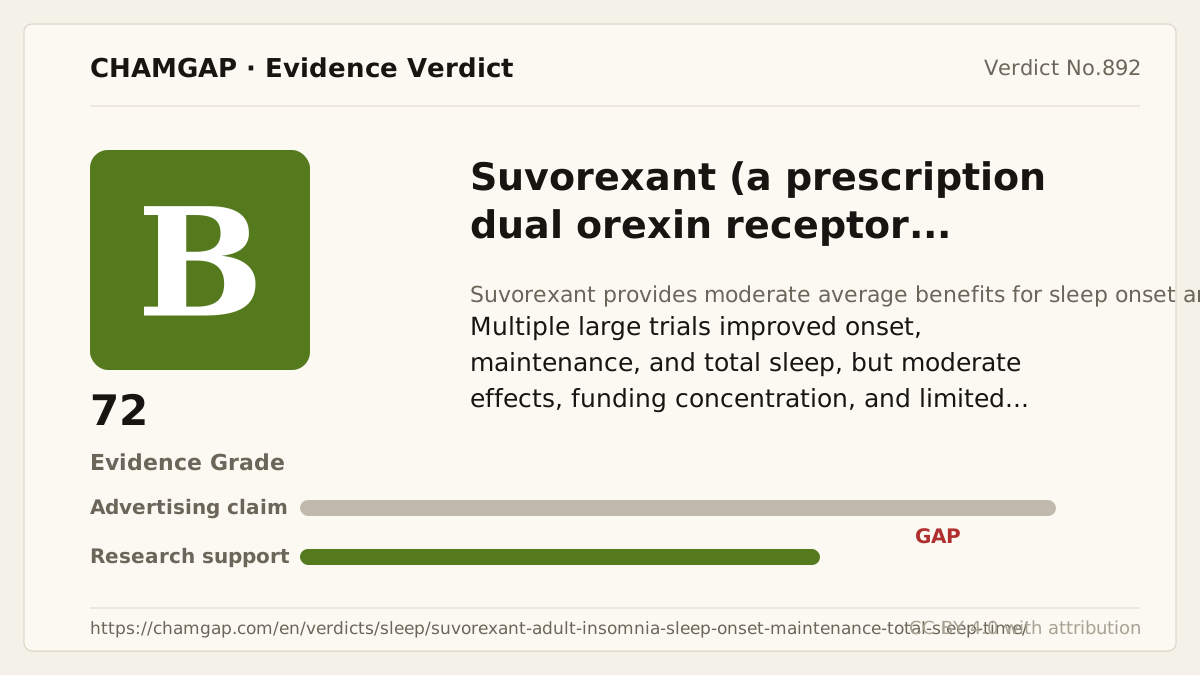
[Chamgap] Suvorexant x improved sleep onset, maintenance, and total sleep time in adult insomnia — Evidence Grade B·72. 3 cited sources checked. Source: https://chamgap.com/en/verdicts/sleep/suvorexant-adult-insomnia-sleep-onset-maintenance-total-sleep-time/ · CC BY 4.0CC BY 4.0 — free to use with attribution; do not distort grades, numbers, or verdict meaning.
What this document does and does not do
Chamgap is an information source. It reports what research has and has not confirmed; it does not tell readers what to take or buy. That decision belongs to readers and, when needed, medical or legal professionals. This verdict reflects literature available up to the search date and may change as new research appears. Nothing here is medical advice.