
Raw onion juice,
does it really help with Improved insomnia and sleep duration in adults aged 60 years or older?
research showsThe grade is C with 54 points. A ten-day randomized trial of 58 adults aged 60 years or older found better daytime sleepiness, insomnia severity, and total sleep time with 10 mL raw onion juice than with 10 mL rice water. Both groups also received yoga and naturopathy lifestyle care. The study was small and extremely short, outcome-specific analysis counts and between-group confidence intervals were unclear, and no prospective registration was identified.
ads claimMarketing can turn a ten-day, single-center add-on experiment into an established stand-alone sleep remedy. Long-term use, relapse prevention, other doses, and general older populations were not tested.
Useful facts when choosing a product
- The intervention was 10 mL daily raw onion juice, not whole onion; the comparator was 10 mL rice water. Both groups also received yoga and naturopathy lifestyle care.
- ClinicalTrials.gov, CTRI, and WHO ICTRP searches by title, author, DOI, onion juice, insomnia, and older adults on 2026-08-02 found no matching prospective registration. The prespecified primary outcome is therefore unknown.
- Onion entered Korea in the late nineteenth century and Japan near the end of the Edo period, so its absence from older Korean texts is expected. The Donguibogam entry 「葱白」 refers to scallion, not bulb onion.
- Dioscorides, book 2 chapter 181, records appetite, bowel, urinary, and eye uses and warns that eating much onion causes headache. Hildegard, Physica book 1 chapter 83, describes raw onion as harmful and recommends cooking. No verified classical entry uses onion as a sleep remedy.
- The whole-onion-powder verdict concerns visceral fat, a different formulation and outcome from raw onion juice for sleep.
Chamgap Semantic Classification Code
Candidate index · review held
F.raw-onion-juice.food.insomnia-and-sleep-duration-aged-or-older.improve.UNKFoods and beverages > Raw onion juice > Food consumption > insomnia and sleep duration aged or older > Improvement claim > Unknown
An automated migration candidate, not an issued permanent code; exact claim scope remains under review. This machine-generated migration candidate helps retrieval but is not a permanent assignment. The original verdict ID and URL remain authoritative.
What the research actually shows
Tewani and colleagues randomized 58 adults aged 60 years or older to 10 mL raw onion juice or 10 mL rice water daily for ten days. Both groups received the same yoga and naturopathy lifestyle intervention. Daytime sleepiness, insomnia severity, total sleep time, and SF-12 quality of life favored onion juice. The paper did not report effect magnitude directly; conversion from its test statistics indicated a conventionally medium magnitude. The SF-12 test statistic t(54) suggests 56 observations for that analysis, but the paper does not clearly separate analyzed counts by outcome. Fifty-eight is the randomized count; outcome-specific analyzed counts are unclear. No registration was identified in ClinicalTrials.gov, CTRI, WHO ICTRP, or reverse searches by title, authors, and DOI. The abstract lists six outcomes without declaring one primary outcome. No external grant or food-company support was identified in the accessible article and bibliographic record.
Why this is classified as C (54)
The paper did not report the magnitude directly; conversion from its test statistics indicated a conventionally medium magnitude. The evidence still comes from one 58-person, ten-day study that did not declare a single primary outcome, with unclear outcome-specific analysis counts, no identified prospective registration, and possible loss of participant masking from onion juice's strong taste and odor. It therefore remains C with 54 points.
Counterpoint. Persistent insomnia warrants assessment of sleep apnea, mood, pain, medication, and schedule, and onion juice should not replace validated cognitive behavioral therapy for insomnia.
Rejudgment record. Cross-check applied — The positive sleep outcomes and conventionally medium magnitude converted from test statistics were retained, with limits for small size, extreme brevity, no identified registration, no single declared primary outcome, unclear outcome-specific analysis counts, unreported between-group confidence intervals, and possible loss of participant masking from taste and odor
| Endpoint | P | Symptom or function itself is the target - including patient reports and performance tests |
| Replication | R1 | Single confirmatory trial |
| Independence | I2 | Decisive evidence is publicly or non-profit funded |
| Effect size | E+ | Meets the clinically important threshold |
| Precision | CX | No pooled confidence interval could be confirmed |
Stored derived and displayed grades match; this is not a current recalculation or validity check (C).
Sub-claim grades by effect
This ingredient is marketed for several effects. A single overall grade blends strong and weak claims together, so each effect is graded separately here. The overall grade reflects the strongest disconfirming or core claim.
| Effect (sub-claim) | Grade | Basis |
|---|---|---|
| Ten-day improvement in insomnia severity with raw onion juice | C | Positive in one small trial with a conventionally medium magnitude converted from test statistics, but without a between-group mean difference or confidence interval. |
| Long-term sleep improvement with raw onion juice | ? | No direct study extends beyond ten days. |
Cross-check — AI research and Codex final gate
Evidence Table
| Study | Design | Sample | Funding | Endpoint | Result | Weight |
|---|---|---|---|---|---|---|
| Tewani GR et al. 2023 | Triple-masked randomized rice-water-controlled parallel trial, ten days | 58 adults aged 60 years or older randomized; analyzed count unclear by outcome, with t(54) for SF-12 | No external grant or food-company support identified in the accessible article and bibliographic record | Daytime sleepiness, insomnia severity, total sleep time, sleep onset, fatigue, and SF-12 | Daytime sleepiness P=.005, insomnia severity P=.013, total sleep time P=.001; no 95% CI for between-group effects | Direct randomized signal limited by small size, ten-day duration, and absent registration |
Receipt — 1 References
All 1 cited sources were verified for existence at the original page (as of 2026-08-02).
Final verification and publication gate: Codex · Evidence date: 2026-08-02 · Corrections: none
Cite this verdict
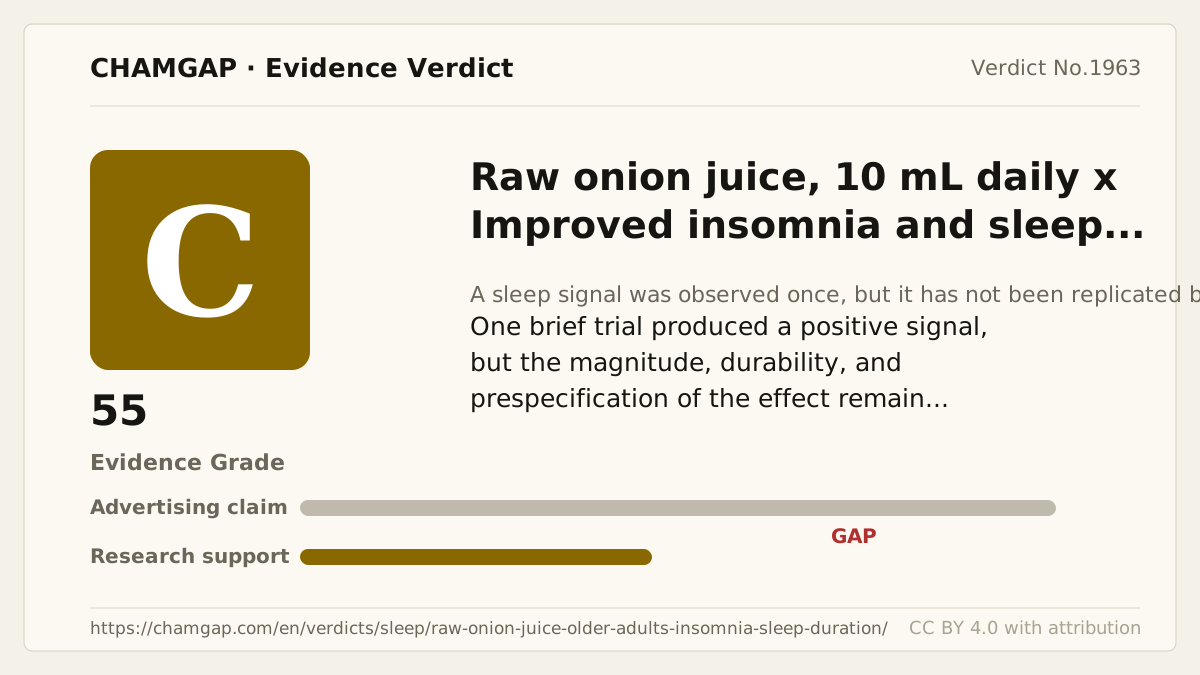
[Chamgap] Raw onion juice x improved insomnia and sleep duration in older adults — Evidence Grade C·54. 1 cited sources checked. Source: https://chamgap.com/en/verdicts/sleep/raw-onion-juice-older-adults-insomnia-sleep-duration/ · CC BY 4.0CC BY 4.0 — free to use with attribution; do not distort grades, numbers, or verdict meaning.
What this document does and does not do
Chamgap is an information source. It reports what research has and has not confirmed; it does not tell readers what to take or buy. That decision belongs to readers and, when needed, medical or legal professionals. This verdict reflects literature available up to the search date and may change as new research appears. Nothing here is medical advice.