
Melatonin,
does it really help with Prevention of delirium in hospitalized older adults and mechanically ventilated critically ill patients?
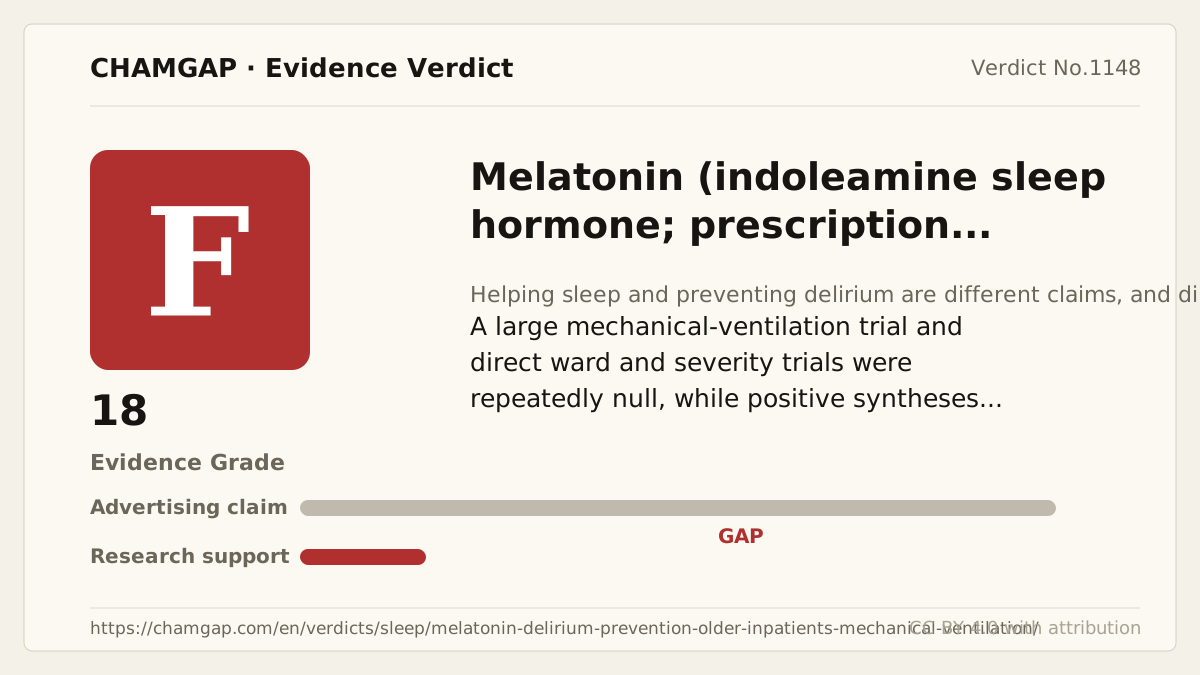
research showsMelatonin for preventing delirium in hospitalized older adults or mechanically ventilated critically ill patients is rated F. In the 20-center French DEMEL trial, delirium occurred in 54.4% with low-dose melatonin and 55.2% with placebo, RR 0.986, and sleep, delirium- and coma-free days, ventilator-free days, length of stay, and mortality were also unchanged. A general medical-ward trial in older adults also found no prevention, and a separate trial in older adults with established delirium found no reduction in severity. A broader meta-analysis combining surgical populations and ramelteon was positive, so uncertainty remains, but repeated null modern trials in the exact target populations receive priority. Sleep, jet-lag, and weight evidence are separate claims. Daytime drowsiness, interactions, and product variability remain safety and product-quality issues.
ads claimMarketing turns the biological plausibility of restoring sleep rhythms into a demonstrated delirium-prevention effect. The ability to promote sleep is not the same outcome as preventing delirium, and DEMEL improved neither sleep measures nor delirium.
Useful facts when choosing a product
- Melatonin is an indoleamine hormone released at night. It is sold as a prolonged-release prescription medicine for older adults with insomnia in some countries and as a supplement with variable dose and quality in others.
- DEMEL did not simply test a typical retail supplement. It compared immediate-release syrup at 0.3 mg and 3 mg, selected the better pharmacokinetic profile of 0.3 mg, and used it for up to 14 days. Formulation and dose differences are product variability, not evidence that reverses a null clinical result.
- Short-term melatonin is generally well tolerated, but daytime drowsiness, dizziness, headache, and vivid dreams can occur. Older adults at risk of falls and anyone driving or operating machinery require particular caution.
- Anticoagulants, antiplatelet drugs, sedatives, and some antidepressants may interact, while drugs that alter hepatic metabolism can change exposure. Delirium prevention should prioritize correcting causes, reducing unnecessary medicines, and multicomponent nonpharmacologic care for sleep, sensory input, and mobility.
Chamgap Semantic Classification Code
Candidate index · review held
UNK.melatonin.UNK.delirium-and-mechanically-ventilated-critically-ill-patients.prevent.placeboUnknown > Melatonin > Unknown > delirium and mechanically ventilated critically ill patients > Occurrence-prevention claim > Placebo
An automated migration candidate, not an issued permanent code; exact claim scope remains under review. This machine-generated migration candidate helps retrieval but is not a permanent assignment. The original verdict ID and URL remain authoritative.
What the research actually shows
DEMEL assigned 355 adults without delirium who were receiving mechanical ventilation to placebo, melatonin 0.3 mg, or melatonin 3 mg in an adaptive phase 2b/3 design. The pharmacokinetic stage selected 0.3 mg, and the final comparison among 147 versus 154 participants was null. Jaiswal 2018 used 3 mg in 87 adults aged at least 65 years on general medical wards and found no prevention or improvement in objective or subjective sleep. Lange 2024 was a treatment rather than prevention trial in 120 older adults with established delirium, but it also did not support reduced severity or duration. Liu 2024 pooled heterogeneous surgical and nonsurgical populations and ramelteon with melatonin and was positive, so the conclusion should not be generalized to every hospital context.
Why this is classified as F (18)
The most directly applicable evidence is the adequately sized, publicly funded, multicenter DEMEL trial, which was null for its primary and all key secondary endpoints. A general-ward prevention trial and an established-delirium severity trial were also null. A positive meta-analysis combining surgical populations and ramelteon is retained as contrary evidence, but its population and intervention heterogeneity do not rescue the exact mechanical-ventilation and general medical-inpatient claim. Repeated-null rule gives F with 18 points; safety and efficacy for sleep are separate.
Counterpoint. Benefit may remain possible in selected perioperative older populations or with a different melatonin receptor agonist. Routine melatonin solely to prevent delirium in an intensive care unit or general medical ward is not supported, however, and it should not replace evaluation of causes or multicomponent nonpharmacologic prevention.
Rejudgment record. New verdict — Retained the contrary positive signal from a 2024 meta-analysis that included surgical patients and ramelteon, but prioritized the publicly funded DEMEL trial's null primary and all key secondary endpoints in mechanically ventilated patients together with repeated null direct prevention and severity trials in medical inpatients, meeting the F standard for repeated refutation
Sub-claim grades by effect
This ingredient is marketed for several effects. A single overall grade blends strong and weak claims together, so each effect is graded separately here. The overall grade reflects the strongest disconfirming or core claim.
| Effect (sub-claim) | Grade | Basis |
|---|---|---|
| Prevention of delirium in mechanically ventilated critically ill patients | F | DEMEL was essentially identical at 54.4% versus 55.2%, RR 0.986, with all key secondary outcomes also null. |
| Prevention of delirium in older adults on general hospital wards | F | A direct general medical-ward trial was null, while the positive meta-analysis mixed surgical patients and ramelteon and had substantial heterogeneity. |
| Reduction of delirium severity or duration in hospitalized older adults | F | In the 5-mg treatment trial, severity improvement was 4.9 versus 5.4 points, P=0.42, and no duration benefit was confirmed. |
Cross-check — AI research and Codex final gate
Evidence Table
| Study | Design | Sample | Funding | Endpoint | Result | Weight |
|---|---|---|---|---|---|---|
| Mekontso Dessap A et al.; CARMAS and the REVA research networks, on behalf of the DEMEL Investigators. 2025 | Twenty-center adaptive multiarm multistage randomized double-blind placebo-controlled phase 2b/3 trial | 355 randomized and 334 in the primary analysis; 147 versus 154 in the final efficacy comparison | French Health Ministry hospital clinical-research program; investigator-initiated | Delirium incidence within 14 days and key secondary clinical outcomes in mechanically ventilated patients | Delirium was 54.4% with melatonin and 55.2% with placebo, RR 0.986 (95% CI 0.803 to 1.211); key secondary outcomes were also similar. | Pivotal large direct null randomized trial in the target population |
| Jaiswal SJ et al. 2018 | Randomized placebo-controlled trial on general medical wards | 87 adults aged at least 65 years in the intention-to-treat analysis; 69 adherent participants | Academic study with an industry affiliation reported for one author | Incident delirium and actigraphic and subjective sleep during hospitalization | Delirium was 22.2% versus 9.1% in adherent participants, P=0.19, with no improvement in sleep measures. | Direct null general-ward trial with a small sample |
| Lange PW et al. 2024 | Randomized double-blind placebo-controlled treatment trial in hospitalized older adults | 120 participants with hyperactive or mixed delirium | Academic and hospital research support | Change in delirium severity over five days | Improvement in the MDAS was 4.9 versus 5.4 points, P=0.42, with no difference. | Direct null evidence for the severity subclaim rather than prevention |
| Liu L et al. 2024 | Systematic review and meta-analysis of randomized trials in hospitalized older adults | 13 randomized trials and 2,086 participants | No external study funding reported | Delirium incidence, length of stay, and mortality with melatonin or ramelteon | Delirium was reduced at OR 0.59 (95% CI 0.40 to 0.87), I-squared 60%, especially in surgical patients, while length of stay and mortality were null. | Contrary positive evidence with substantial population and intervention heterogeneity |
Receipt — 4 References
All 4 cited sources were verified for existence at the original page (as of 2026-07-22).
Final verification and publication gate: Codex · Evidence date: 2026-07-22 · Corrections: none
Cite this verdict
[Chamgap] Melatonin x delirium prevention in older inpatients and mechanically ventilated patients — Evidence Grade F·18. 4 cited sources checked. Source: https://chamgap.com/en/verdicts/sleep/melatonin-delirium-prevention-older-inpatients-mechanical-ventilation/ · CC BY 4.0CC BY 4.0 — free to use with attribution; do not distort grades, numbers, or verdict meaning.
What this document does and does not do
Chamgap is an information source. It reports what research has and has not confirmed; it does not tell readers what to take or buy. That decision belongs to readers and, when needed, medical or legal professionals. This verdict reflects literature available up to the search date and may change as new research appears. Nothing here is medical advice.