
Grounding or earthing sleep mat,
does it really help with Improved insomnia severity, sleep duration, and daytime sleepiness through grounding during sleep?
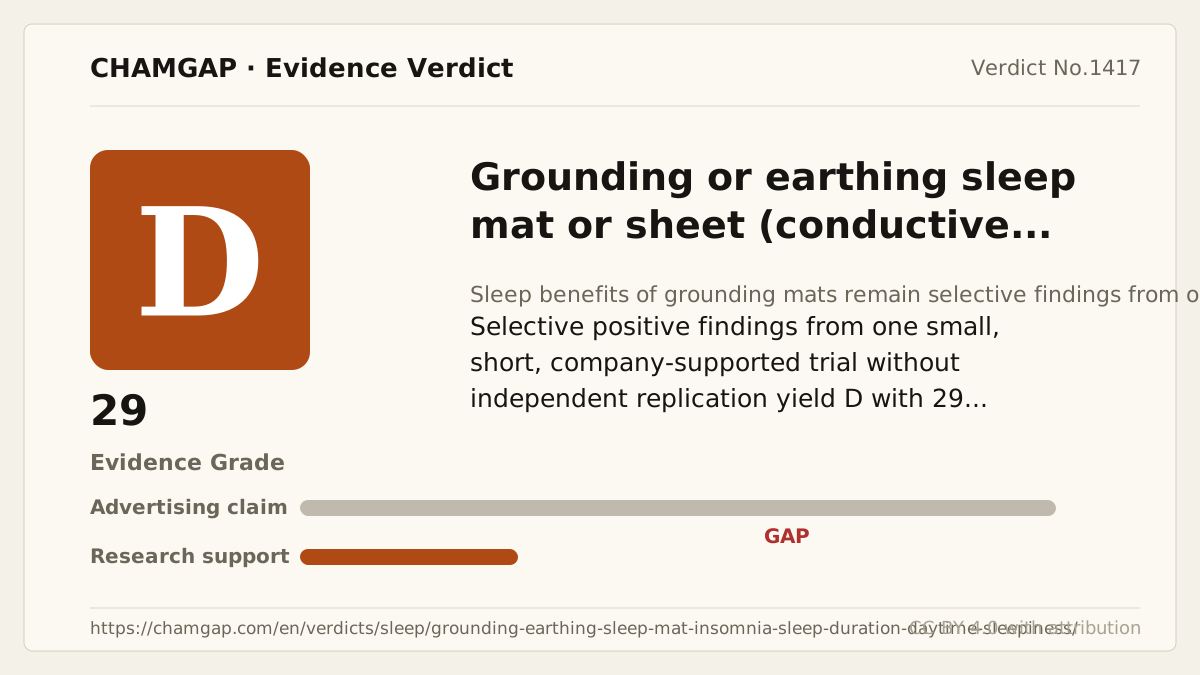
research showsGrounding sleep mats are rated D. A 2025 randomized double-blind sham-controlled trial reported some positive findings in 56 analyzed participants, but it was a single 31-day small study supported by two product companies. Between-group ISI, PSQI, and ESS differences at day 31 were not significant; selected findings such as total sleep time and follow-up ISI were positive. There is no independent replication or established biological mechanism.
ads claimMarketing claims that receiving electrons from Earth normalizes cortisol and inflammation and restores deep sleep. Direct evidence is limited to selective short-term outcomes from one small product trial and does not establish treatment of chronic insomnia or normalized sleep architecture.
Useful facts when choosing a product
- Grounding mats and sheets use a conductive surface connected to a building ground terminal to bring the user's body closer to ground potential.
- Results from one research mat and sham cannot be generalized to all marketed products, whose grounding integrity, resistance, and safety design may differ.
- Damaged cords, incorrectly wired outlets, and wet environments should be avoided. Persistent insomnia, snoring, apneas, or severe daytime sleepiness warrants validated assessment and treatment.
Chamgap Semantic Classification Code
Candidate index · review held
UNK.grounding-or-earthing-sleep-mat-or-sheet.UNK.insomnia-severity-sleep-duration-and-daytime-sleepiness-through-grounding-during-sleep.improve.MULTIUnknown > Grounding or earthing sleep mat or sheet > Unknown > insomnia severity, sleep duration, and daytime sleepiness through grounding during sleep > Improvement claim > Multiple: primary unresolved
An automated migration candidate, not an issued permanent code; exact claim scope remains under review. This machine-generated migration candidate helps retrieval but is not a permanent assignment. The original verdict ID and URL remain authoritative.
What the research actually shows
Park 2025 randomized 60 people and analyzed 56 who used a grounded or ungrounded mat for six hours daily over 31 days. Between-group ISI, PSQI, and ESS differences at day 31 were not significant; actigraphic total sleep time increased in the active group and a day-38 ISI difference was reported. World Home Dr. and Geosan funded the study, and product-company personnel were among the authors. Ghaly 2004 measured cortisol and subjective symptoms before and after grounding in 12 people without a control group. Lin 2022 reported a PSQI signal in a highly selected mild-Alzheimer sample with 22 enrolled and 15 completers.
Why this is classified as D (29)
The company-supported 56-person trial was positive for actigraphic sleep time and selected follow-up results, but major day-31 questionnaire comparisons were null and prior research was uncontrolled or a tiny special population. No independent replication supports more than D with 29 points.
Counterpoint. Use for comfort may be reasonable with verified electrical safety, but lack of benefit should prompt discontinuation and established insomnia care such as cognitive behavioral therapy should take priority.
Rejudgment record. New verdict — Accepted signals for actigraphic sleep time and selected follow-up findings in a 56-person double-blind sham-controlled trial, but applied rule ② and grade D because major day-31 questionnaire comparisons were null, it was a company-supported single trial, and prior evidence was tiny, uncontrolled, or from a special population
Sub-claim grades by effect
This ingredient is marketed for several effects. A single overall grade blends strong and weak claims together, so each effect is graded separately here. The overall grade reflects the strongest disconfirming or core claim.
| Effect (sub-claim) | Grade | Basis |
|---|---|---|
| Improved insomnia severity | D | The day-31 between-group comparison was null in one small company-supported trial, with only selected follow-up findings positive. |
| Increased total sleep time | D | One 56-person trial produced an actigraphy signal without independent replication. |
| Improved daytime sleepiness | D | The day-31 between-group ESS difference was not significant, so within-group change cannot establish efficacy. |
Cross-check — AI research and Codex final gate
Evidence Table
| Study | Design | Sample | Funding | Endpoint | Result | Weight |
|---|---|---|---|---|---|---|
| Park HJ et al. 2025 | Randomized double-blind sham-controlled trial | Sixty randomized and 56 analyzed | Funded by World Home Dr. and Geosan; product-company authors included | ISI, PSQI, ESS, stress, and actigraphic total sleep time | Day-31 between-group ISI, PSQI, and ESS comparisons were null; total sleep time and selected findings such as day-38 ISI were positive. | Key but company-supported single trial |
| Ghaly M, Teplitz D. 2004 | Uncontrolled before-and-after pilot | Twelve adults with sleep dysfunction, pain, and stress | Inadequately reported; pro-earthing research context | Nighttime cortisol and subjective sleep, pain, and stress | Cortisol and subjective symptoms improved after eight weeks, but no control group separated natural variation or expectation effects. | Very weak preliminary evidence |
| Lin CH et al. 2022 | Small placebo-controlled pilot | Twenty-two enrolled and 15 completers with mild Alzheimer disease | Taiwan hospital and academic research; no conflict reported | Twelve-week PSQI, anxiety, and depression | PSQI improved versus sham, but only 15 completed in a special population and anxiety and depression were null. | Indirect very small sample |
Receipt — 3 References
All 3 cited sources were verified for existence at the original page (as of 2026-07-23).
Final verification and publication gate: Codex · Evidence date: 2026-07-23 · Corrections: none
Cite this verdict
[Chamgap] Grounding or earthing sleep mat x improved insomnia severity, sleep duration, and daytime sleepiness — Evidence Grade D·29. 3 cited sources checked. Source: https://chamgap.com/en/verdicts/sleep/grounding-earthing-sleep-mat-insomnia-sleep-duration-daytime-sleepiness/ · CC BY 4.0CC BY 4.0 — free to use with attribution; do not distort grades, numbers, or verdict meaning.
What this document does and does not do
Chamgap is an information source. It reports what research has and has not confirmed; it does not tell readers what to take or buy. That decision belongs to readers and, when needed, medical or legal professionals. This verdict reflects literature available up to the search date and may change as new research appears. Nothing here is medical advice.