
Caffeine nap,
does it really help with Fewer simulated driving incidents than with caffeine alone in sleepy drivers?
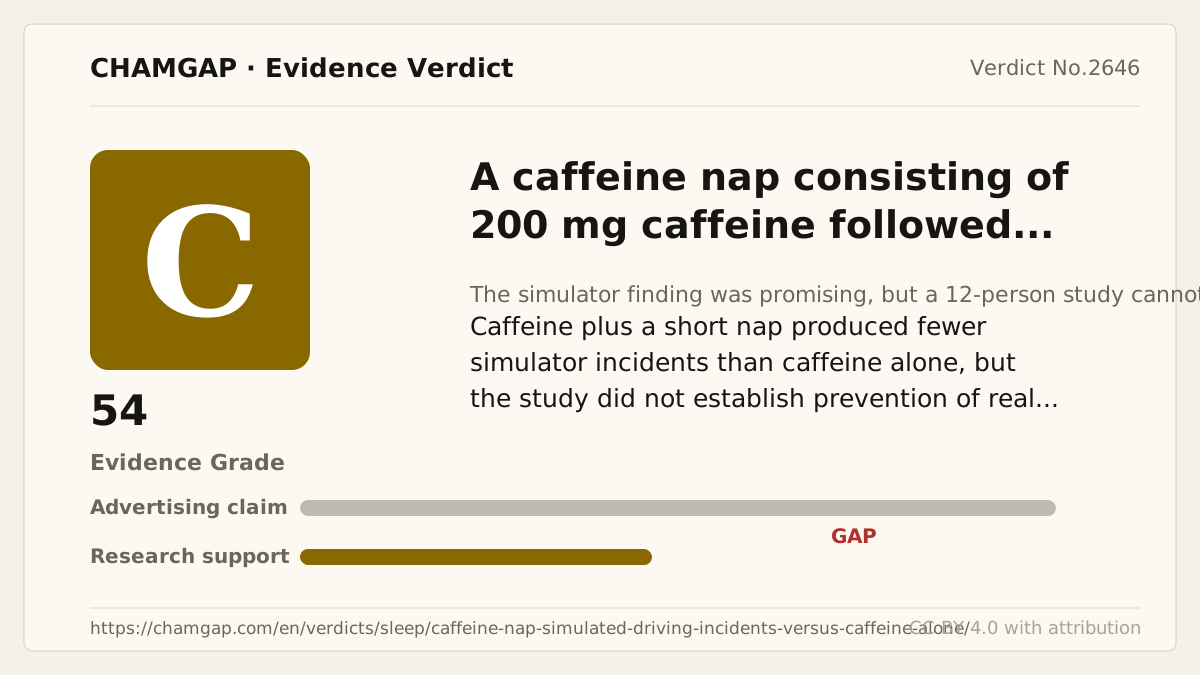
research showsThe grade is C with 54 points. In a within-person study of 12 sleepy participants, simulated driving incidents after caffeine plus a short nap fell to 9% of placebo levels, versus 34% with caffeine alone. The contrast was large, but it was a simulator outcome from one tiny study without a verified prespecified primary hierarchy, not real crashes.
ads claimA coffee nap should not be marketed as proven protection from real road crashes. A sleepy driver should stop driving and obtain adequate rest; this experiment only measured simulator performance in 12 people.
Useful facts when choosing a product
- The study used 200 mg caffeine and a nap shorter than 15 minutes.
- Simulator incidents were 9% of placebo levels after caffeine plus nap and 34% after caffeine alone.
- Real crashes, injuries, and deaths were not measured.
Chamgap Semantic Classification Code
Candidate index · review held
UNK.caffeine-nap-consisting-of-caffeine-followed-immediately-by-less-than-of-sleep.oral.fewer-simulated-driving-incidents-than-with-caffeine-alone-in-sleepy-drivers.assess.placeboUnknown > caffeine nap consisting of caffeine followed immediately by less than of sleep > Oral > Fewer simulated driving incidents than with caffeine alone in sleepy drivers > Association or change assessment > Placebo
An automated migration candidate, not an issued permanent code; exact claim scope remains under review. This machine-generated migration candidate helps retrieval but is not a permanent assignment. The original verdict ID and URL remain authoritative.
What the research actually shows
The 1997 within-person controlled study by Reyner LA and Horne JA tested 12 sleepy participants after a 30-minute break containing 200 mg caffeine plus a nap shorter than 15 minutes, 200 mg caffeine alone, or placebo, followed by two hours of monotonous simulated driving. Incidents fell to 9% and 34% of placebo levels, respectively; subjective sleepiness and EEG were also recorded. The UK Department of Transport funded the work. Trial registration was not verified for this 1997 paper.
Why this is classified as C (54)
The publicly funded study showed a large simulator contrast, but a surrogate endpoint, 12 participants, and no prespecified primary hierarchy give C with 54 points.
Counterpoint. The result is limited to afternoon sleepiness and a monotonous two-hour simulator and cannot be directly generalized to real driving or other times of day.
Rejudgment record. Cross-check applied — Cross-checked the 12-person sample, 200-mg dose, nap duration, placebo-relative incident values, and public funding against the 1997 source
| Endpoint | S | Surrogate marker - laboratory or imaging measures |
| Replication | R1 | Single confirmatory trial |
| Independence | I2 | Decisive evidence is publicly or non-profit funded |
| Effect size | E+ | Meets the clinically important threshold |
Stored derived and displayed grades match; this is not a current recalculation or validity check (C).
Sub-claim grades by effect
This ingredient is marketed for several effects. A single overall grade blends strong and weak claims together, so each effect is graded separately here. The overall grade reflects the strongest disconfirming or core claim.
| Effect (sub-claim) | Grade | Basis |
|---|---|---|
| Fewer simulator incidents than with caffeine alone | C | The contrast was 9% versus 34% of placebo levels in one 12-person study. |
| Prevention of real road crashes | ? | Real road crashes were not measured. |
Cross-check — AI research and Codex final gate
Evidence Table
| Study | Design | Sample | Funding | Endpoint | Result | Weight |
|---|---|---|---|---|---|---|
| Reyner LA, Horne JA. 1997 | Within-person controlled simulator study in 12 participants; no prespecified primary hierarchy verified | 12 sleepy participants; absolute incident denominator by condition not verified | Public funding from the UK Department of Transport | Incidents during two hours of simulated driving, subjective sleepiness, and EEG | Caffeine plus a nap under 15 minutes produced 9% of placebo incident levels versus 34% with caffeine alone | Only direct small surrogate-outcome study |
Receipt — 1 References
All 1 cited sources were verified for existence at the original page (as of 2026-08-15).
Final verification and publication gate: Codex · Evidence date: 2026-08-15 · Corrections: none
Cite this verdict
[Chamgap] Caffeine nap x fewer simulated driving incidents — Evidence Grade C·54. 1 cited sources checked. Source: https://chamgap.com/en/verdicts/sleep/caffeine-nap-simulated-driving-incidents-versus-caffeine-alone/ · CC BY 4.0CC BY 4.0 — free to use with attribution; do not distort grades, numbers, or verdict meaning.
What this document does and does not do
Chamgap is an information source. It reports what research has and has not confirmed; it does not tell readers what to take or buy. That decision belongs to readers and, when needed, medical or legal professionals. This verdict reflects literature available up to the search date and may change as new research appears. Nothing here is medical advice.