
Two-hour versus three- or four-hour repositioning,
does it really help with Reduction of three-week pressure-ulcer incidence versus three- or four-hour repositioning?
research showsThe grade is D. In TURN, pressure ulcers occurred in 8/321 (2.5%) participants assigned every two hours, 2/326 (0.6%) assigned every three hours, and 9/295 (3.1%) assigned every four hours; the overall comparison was null at P=.68. This compared interval with interval, not repositioning with no care, and every arm used high-density foam mattresses. A three-week completer analysis from one trial cannot establish that two-hour repositioning is generally unnecessary.
ads claimA null interval comparison means no difference was detected under these conditions. It does not mean two-hour repositioning is unnecessary or that four-hour turning is safe for everyone with a foam mattress.
Useful facts when choosing a product
- Stage 1 means intact skin with localized nonblanchable erythema; stage 2 means partial-thickness skin loss with exposed dermis.
- Every arm received high-density foam and scheduled repositioning.
- Randomization was individual rather than facility-level, and outcome assessors were blinded.
Chamgap Semantic Classification Code
Candidate index · review held
UNK.repositioning-on-a-high-density-foam-mattress.UNK.pressure-ulcer-incidence.reduce.UNKUnknown > repositioning on a high-density foam mattress > Unknown > pressure-ulcer incidence > Reduction claim > Unknown
An automated migration candidate, not an issued permanent code; exact claim scope remains under review. This machine-generated migration candidate helps retrieval but is not a permanent assignment. The original verdict ID and URL remain authoritative.
What the research actually shows
Across 20 US and seven Canadian nursing homes, 967 residents aged at least 65 were stratified by risk and individually randomized with concealed envelopes within sites. Facilities and wards were not randomized, so no cluster correction was required. All two-, three-, and four-hour groups used high-density foam mattresses, documented turns, and received weekly skin checks by blinded nurse assessors. After 25 people who died, were hospitalized, or otherwise did not start were excluded, 942 were analyzed. Nineteen participants developed 21 lesions: two stage 1 and 19 stage 2, with no stage 3, stage 4, or unstageable lesions.
Why this is classified as D (30)
One individually randomized trial was null, its interval did not exclude benefit, and its completer analysis and short follow-up give D with 30 points.
Counterpoint. The three-hour arm had the lowest raw rate, but the prespecified overall ordered comparison was P=.68 and does not establish superiority.
Rejudgment record. Cross-check applied — The individually randomized interval comparison was null, with completer analysis and three-week follow-up retained as limitations
| Endpoint | H | Hard endpoint - actual events such as death |
| Replication | R1 | Single confirmatory trial |
| Independence | I1 | Mixed funding sources |
| Effect size | E0 | Null |
| Precision | C0 | The confidence interval leaves room for benefit |
Stored derived and displayed grades match; this is not a current recalculation or validity check (D).
Sub-claim grades by effect
This ingredient is marketed for several effects. A single overall grade blends strong and weak claims together, so each effect is graded separately here. The overall grade reflects the strongest disconfirming or core claim.
| Effect (sub-claim) | Grade | Basis |
|---|---|---|
| Fewer pressure ulcers with two-hour versus three- or four-hour repositioning | D | The overall interval comparison was null at P=.68. |
Cross-check — AI research and Codex final gate
Evidence Table
| Study | Design | Sample | Funding | Endpoint | Result | Weight |
|---|---|---|---|---|---|---|
| Bergstrom et al. 2013 TURN | Multisite individually randomized trial with blinded outcome assessment | 967 randomized; 942 in the completer analysis, 321/326/295 | Funding source not confirmed in the publicly accessible primary report | Stage 1 to 4 or unstageable pressure-ulcer incidence within three weeks | Two hours 8/321 (2.5%), three hours 2/326 (0.6%), four hours 9/295 (3.1%); P=.68 | Pivotal direct evidence |
Receipt — 2 References
All 2 cited sources were verified for existence at the original page (as of 2026-08-05).
Final verification and publication gate: Codex · Evidence date: 2026-08-05 · Corrections: none
Cite this verdict
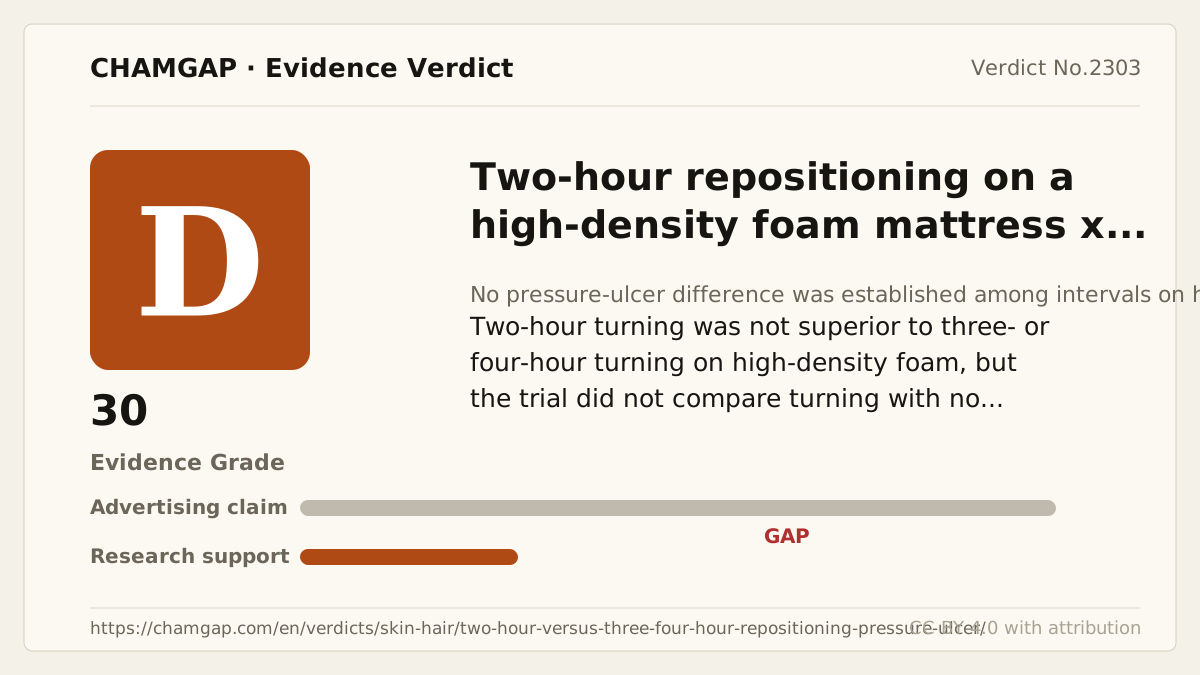
[Chamgap] Two-hour versus three- or four-hour repositioning x pressure ulcers — Evidence Grade D·30. 2 cited sources checked. Source: https://chamgap.com/en/verdicts/skin-hair/two-hour-versus-three-four-hour-repositioning-pressure-ulcer/ · CC BY 4.0CC BY 4.0 — free to use with attribution; do not distort grades, numbers, or verdict meaning.
What this document does and does not do
Chamgap is an information source. It reports what research has and has not confirmed; it does not tell readers what to take or buy. That decision belongs to readers and, when needed, medical or legal professionals. This verdict reflects literature available up to the search date and may change as new research appears. Nothing here is medical advice.