
Twice-daily moisturizer,
does it really help with Prevention of skin tears in aged-care residents?
research showsThe grade is C. In a 14-facility cluster trial, six-month skin-tear incidence was 5.76 per 1,000 occupied bed-days with moisturizer versus 10.57 with usual care, about 46% lower. However, among 420 versus 564 enrolled residents, the analysis compared only 172 versus 252 residents who developed at least one tear, excluding residents without events; allocation concealment and assessor masking were also absent. A later nonrandomized acute-care study found no ward difference. The large signal is therefore limited by design, giving C with 54 points.
ads claimThe use of a standardized fragrance-free pH 5-6 lotion is a factual product detail, but it does not by itself establish definitive injury prevention. The largest positive effect came from an analysis that omitted residents without events.
Useful facts when choosing a product
- The commercial pH 5-6 lotion contained 70%-90% water plus emollient, emulsifying, humectant, and preservative ingredients including glycerin.
- The intervention applied lotion to the arms and legs twice daily.
- Unlike existing neonatal moisturizer verdicts concerning atopic dermatitis, this verdict concerns traumatic skin-tear events in aged-care residents.
Chamgap Semantic Classification Code
Candidate index · review held
UNK.standardized-twice-application-of-a-fragrance-free-ph-5-6-moisturizer-to-the-arms-and-legs.topical-skin.skin-tears-in-aged-care-residents.prevent.usual-careUnknown > Standardized twice- application of a fragrance-free pH 5-6 moisturizer to the arms and legs > Topical skin > skin tears in aged-care residents > Occurrence-prevention claim > Usual care
An automated migration candidate, not an issued permanent code; exact claim scope remains under review. This machine-generated migration candidate helps retrieval but is not a permanent assignment. The original verdict ID and URL remain authoritative.
What the research actually shows
Carville paired 14 facilities by size and care level and assigned one member of each pair to intervention, but did not report the sequence-generation method. The registry states that allocation concealment was not used and masking was open. Although 420 versus 564 residents enrolled, analysis included only 172 versus 252 residents who developed a tear, 424 total. The primary endpoint was average monthly skin-tear incidence over six months, but ACTRN12611001089921 was registered retrospectively after study start. The Wound Innovation CRC funded the study, and authors declared no conflicts. Mornane nonrandomly compared two acute-care wards among 388 adults aged 70 or older; Hartmann Australia donated MoliCare lotion, and the authors disclosed no other financial relationships.
Why this is classified as C (54)
Skin tears fell by roughly half, but event-only analysis, absent concealment, open assessment, and retrospective registration in the positive cluster trial limit the evidence to C with 54 points.
Counterpoint. Moisturizing may separately help dryness and comfort. This grade addresses only prevention of skin tears by the specified twice-daily regimen.
Rejudgment record. Cross-check applied — The Carville report, ACTRN12611001089921, Cochrane risk assessment, and Mornane report and PubMed record were checked for total enrollment, event-only analysis, allocation and masking, registration timing, funding, and ward results
| Endpoint | H | Hard endpoint - actual events such as death |
| Replication | R1 | Single confirmatory trial |
| Independence | I1 | Mixed funding sources |
| Effect size | E+ | Meets the clinically important threshold |
Stored derived and displayed grades match; this is not a current recalculation or validity check (C).
Sub-claim grades by effect
This ingredient is marketed for several effects. A single overall grade blends strong and weak claims together, so each effect is graded separately here. The overall grade reflects the strongest disconfirming or core claim.
| Effect (sub-claim) | Grade | Basis |
|---|---|---|
| Reduced skin-tear incidence in aged care | C | Rates were 5.76 versus 10.57 per 1,000 occupied bed-days, but analysis included only residents with events. |
| Reduced skin tears in acute care | D | The nonrandomized ward comparison was not significant, P=.231. |
Cross-check — AI research and Codex final gate
Evidence Table
| Study | Design | Sample | Funding | Endpoint | Result | Weight |
|---|---|---|---|---|---|---|
| Carville K, Leslie G, Osseiran-Moisson R, Newall N, Lewin G. 2014 | Open 14-facility cluster-randomized usual-care-controlled trial | 984 enrolled, 420 versus 564; analysis restricted to 424 residents with a tear, 172 versus 252 | Wound Innovation CRC funding; authors declared no conflicts | Six-month skin-tear incidence per 1,000 occupied bed-days | 5.76 versus 10.57 per 1,000 occupied bed-days, P=.004; residents without events were excluded. | Pivotal trial with a large positive signal but major analysis and allocation defects |
| Mornane C, Peck B, Terry D, Ryan M. 2021 | Single-center prospective nonrandomized two-ward comparison | 388 adults aged 70 or older, 128 intervention versus 260 control; ward comparison reported for 152 versus 177 | Hartmann Australia donated MoliCare lotion; no other financial relationships disclosed | Skin-tear incidence before, during, and after intervention and between wards | Between-ward medians 9.86 versus 13.14, U=42.50, z=-1.198, r=.358, P=.231. | Contextual evidence not counted as direct replication because population and design differed |
Receipt — 3 References
All 3 cited sources were verified for existence at the original page (as of 2026-08-15).
Final verification and publication gate: Codex · Evidence date: 2026-08-15 · Corrections: none
Cite this verdict
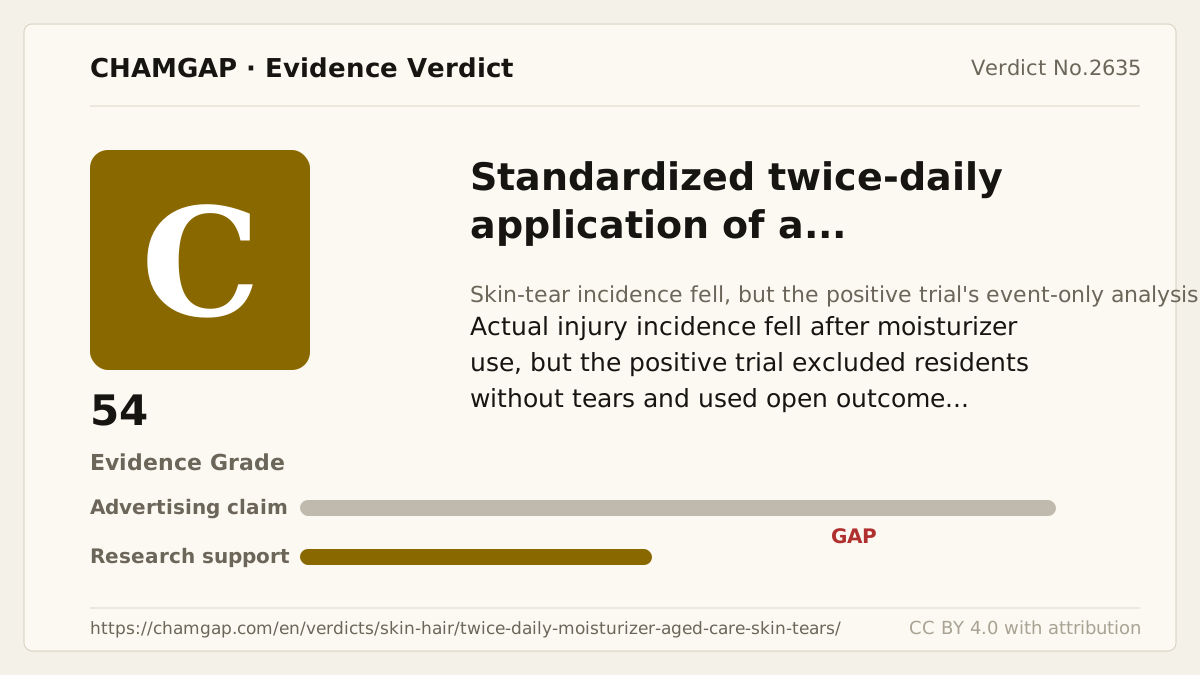
[Chamgap] Twice-daily moisturizer x prevention of skin tears in aged care — Evidence Grade C·54. 3 cited sources checked. Source: https://chamgap.com/en/verdicts/skin-hair/twice-daily-moisturizer-aged-care-skin-tears/ · CC BY 4.0CC BY 4.0 — free to use with attribution; do not distort grades, numbers, or verdict meaning.
What this document does and does not do
Chamgap is an information source. It reports what research has and has not confirmed; it does not tell readers what to take or buy. That decision belongs to readers and, when needed, medical or legal professionals. This verdict reflects literature available up to the search date and may change as new research appears. Nothing here is medical advice.