
Pure topical silicone gel,
does it really help with Prevention and improvement of hypertrophic scars and keloids?
research showsThe grade is B. In a meta-analysis of six randomized trials with 375 participants, six-month comparisons with placebo or no treatment favored silicone gel for pigmentation, SMD -0.55 (95% CI -0.83 to -0.26), height, -0.73 (-1.02 to -0.44), and pliability, -0.49 (-0.95 to -0.03). At three months, however, total Vancouver Scar Scale score in four trials and 259 participants was not established, SMD -0.74 (-1.94 to 0.46), I-squared 88%. Evidence mainly concerns prevention in new surgical scars and should not be expanded to established keloid treatment.
ads claimLiquid gel and adhesive sheets differ in wear time, occlusion, and adherence despite sharing the word silicone. The evidence most closely matches a thin layer applied twice daily to a fully epithelialized new scar for several months, not application to an open or infected wound.
Useful facts when choosing a product
- This verdict concerns topical silicone gel without onion extract, vitamin E, sunscreen, or another active ingredient, and it is distinct from silicone sheeting.
- The split-scar donor-site trial started at postoperative week two and used twice-daily application for six weeks with a paired within-person analysis.
- Among related scar verdicts, verdict 1086 is F with 18 points for Contractubex, verdict 979 is F with 16 points for topical vitamin E, verdict 1724 is D with 38 points for microneedling, and verdict 933 is B with 78 points for isotretinoin in severe or scar-risk acne; the interventions and indications differ.
Chamgap Semantic Classification Code
Candidate index · review held
UNK.pure-silicone-gel-without-another-active-scar-ingredient.topical-skin.prevention-and-improvement-of-hypertrophic-scars-and-keloids.prevent.MULTIUnknown > pure silicone gel without another active scar ingredient > Topical skin > Prevention and improvement of hypertrophic scars and keloids > Occurrence-prevention claim > Multiple: primary unresolved
An automated migration candidate, not an issued permanent code; exact claim scope remains under review. This machine-generated migration candidate helps retrieval but is not a permanent assignment. The original verdict ID and URL remain authoritative.
What the research actually shows
The meta-analysis included six randomized trials and 375 patients using the Vancouver Scar Scale. Four placebo or no-treatment comparisons included 259 patients; sheet, onion extract, and methylprednisolone comparators were analyzed separately. In a 50-patient skin-graft donor-site trial, each scar was split into upper and lower halves randomized to silicone or pharmacist-coded placebo gel, applied twice daily from postoperative week two through week eight. The same blinded physician assessed scars at two, six, and eight weeks, and a paired Wilcoxon analysis accounted for the within-person comparison. The accessible report presented group means graphically, preventing reliable transcription of exact means and dispersions, but the meta-analytic standardized estimates and intervals were available. Manufacturer funding or product-provision wording for the individual trial could not be verified in accessible text; the 2020 meta-analysis itself reported National Natural Science Foundation of China grant 81872535.
Why this is classified as B (68)
Randomized placebo or no-treatment evidence showed medium-sized improvements in scar height and pigmentation at six months, but heterogeneous timing, incomplete outcomes, and a null short-term total score limit certainty. Restricted to cosmetic improvement of new surgical scars, the result is B with 68 points.
Counterpoint. This grade does not mean that gel is superior to other topical treatments or removes keloids. Active-comparator superiority was absent, and direct keloid-treatment evidence is weak.
Rejudgment record. Cross-check applied — Separated liquid silicone gel from sheets and combination products and evaluated six-month standardized VSS effects alongside the null three-month total score
| Endpoint | P | Symptom or function itself is the target - including patient reports and performance tests |
| Replication | R1 | Single confirmatory trial |
| Independence | I1 | Mixed funding sources |
| Effect size | E+ | Meets the clinically important threshold |
Stored derived and displayed grades match; this is not a current recalculation or validity check (B).
Sub-claim grades by effect
This ingredient is marketed for several effects. A single overall grade blends strong and weak claims together, so each effect is graded separately here. The overall grade reflects the strongest disconfirming or core claim.
| Effect (sub-claim) | Grade | Basis |
|---|---|---|
| Improved height, pigmentation, and pliability of new surgical scars | B | Six-month standardized effects were -0.55 for pigmentation, -0.73 for height, and -0.49 for pliability. |
| Improved total scar score at three months | D | Total score SMD was -0.74 (-1.94 to 0.46), I-squared 88%, and benefit was not established. |
| Treatment of established keloids | ? | Included evidence mainly addressed prevention in new surgical scars and was insufficient for a separate established-keloid treatment conclusion. |
Cross-check — AI research and Codex final gate
Evidence Table
| Study | Design | Sample | Funding | Endpoint | Result | Weight |
|---|---|---|---|---|---|---|
| Wang F et al. 2020 meta-analysis | Systematic review and meta-analysis of six randomized trials | 375 total; four placebo or no-treatment trials with 259 participants | National Natural Science Foundation of China, grant 81872535 | Vancouver Scar Scale total and pigmentation, height, pliability, and vascularity domains | At six months, pigmentation SMD -0.55 (95% CI -0.83 to -0.26), height -0.73 (-1.02 to -0.44), and pliability -0.49 (-0.95 to -0.03); three-month total score -0.74 (-1.94 to 0.46), I-squared 88%. | Pivotal pooled evidence, including trials with incomplete final outcome data |
| Chittoria RK, Padi TR. 2013 | Randomized double-blind placebo-controlled split-scar trial | 50 patients and 100 scar halves, 50 silicone and 50 placebo; 37 patients (74%) had good adherence | Manufacturer funding or product-provision wording could not be verified in accessible text | Vancouver Scar Scale pigmentation, vascularity, pliability, and height at weeks two, six, and eight | At week eight all domains favored silicone: pigmentation P=.001, vascularity P=.010, pliability P=.001, and height P=.010; exact means and dispersions could not be reliably extracted from the table image. | Direct placebo trial confirming formulation, application, and paired analysis |
Receipt — 3 References
All 3 cited sources were verified for existence at the original page (as of 2026-08-08).
Final verification and publication gate: Codex · Evidence date: 2026-08-08 · Corrections: none
Cite this verdict
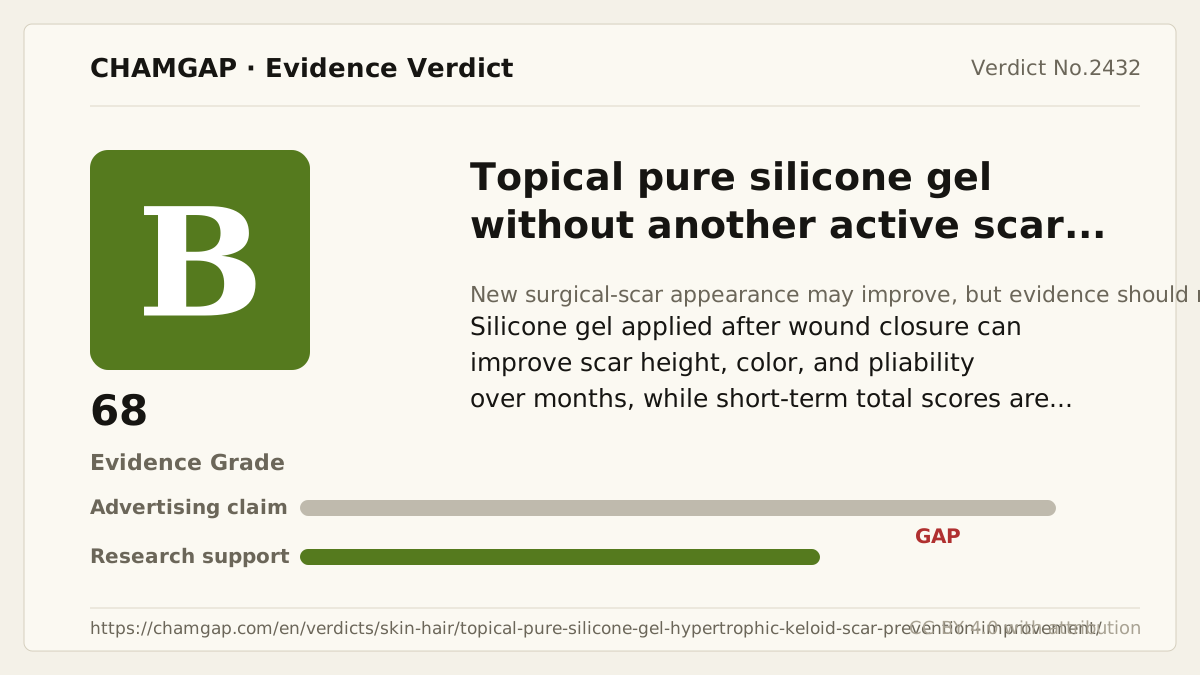
[Chamgap] Pure topical silicone gel x prevention and cosmetic improvement of hypertrophic scars and keloids — Evidence Grade B·68. 3 cited sources checked. Source: https://chamgap.com/en/verdicts/skin-hair/topical-pure-silicone-gel-hypertrophic-keloid-scar-prevention-improvement/ · CC BY 4.0CC BY 4.0 — free to use with attribution; do not distort grades, numbers, or verdict meaning.
What this document does and does not do
Chamgap is an information source. It reports what research has and has not confirmed; it does not tell readers what to take or buy. That decision belongs to readers and, when needed, medical or legal professionals. This verdict reflects literature available up to the search date and may change as new research appears. Nothing here is medical advice.