
Topical beef tallow,
does it really help with Treatment-level improvement of itching, inflammation, and skin-barrier damage in atopic eczema?
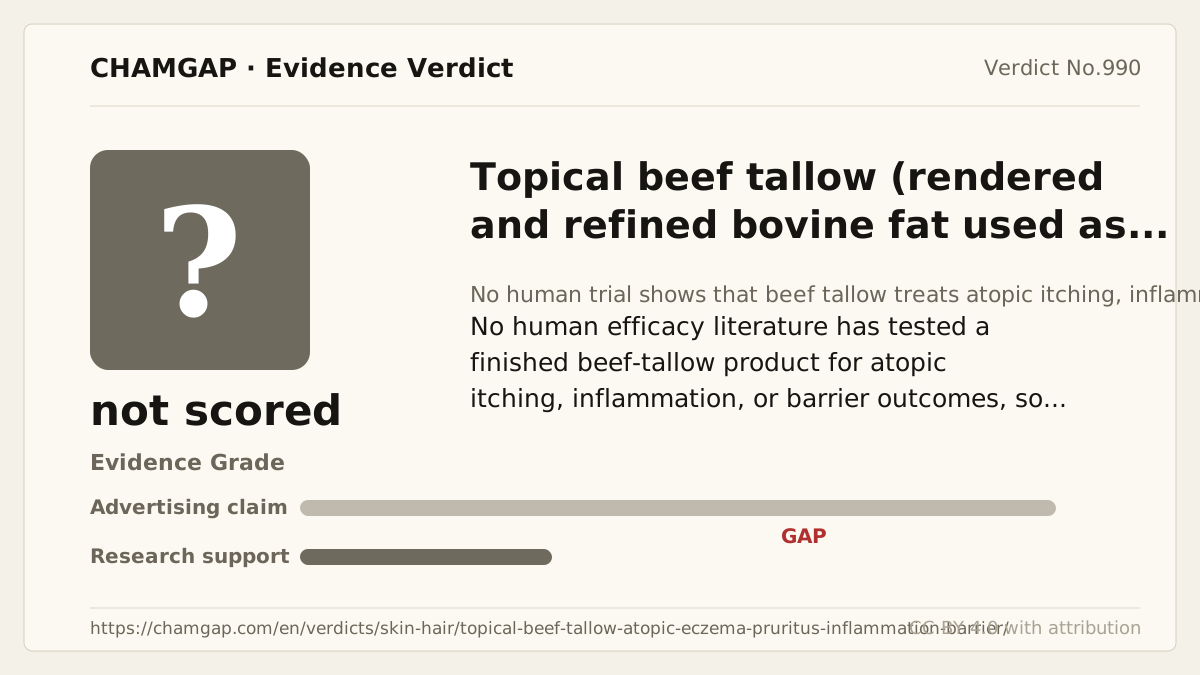
research showsThe grade is ? because no product- and claim-matched human efficacy trial was found showing that topical beef tallow improves itching, inflammation, or skin-barrier damage in atopic eczema to a treatment-level extent. A 2025 analysis of beef-tallow claims on social media found that efficacy claims for atopic dermatitis, acne, and psoriasis were common but largely lacked cited evidence, with existing material based mainly on studies of constituent fatty acids. A Cochrane review included 77 moisturizer trials and 6,603 participants but did not identify a finished beef-tallow trial, and the average SCORAD difference for moisturizers did not reach the minimal important difference. Results for other prescription medicines or moisturizer formulations and mechanistic reasoning about fatty acids cannot be transferred to tallow, so the score is null.
ads claimNarratives about fatty acids resembling human sebum, natural vitamins, ancestral ingredients, or nontoxic skincare can turn a moisturizing feel into claims of anti-inflammatory treatment and barrier repair. Ingredient presence does not establish refinement, oxidative stability, finished-product composition, skin delivery, or clinical efficacy in atopic dermatitis.
Useful facts when choosing a product
- Beef-tallow cosmetics contain bovine fat processed by heating, filtration, and refinement, either alone or mixed with beeswax, plant oils, or fragrance. Refinement, rancidity control, microbiological testing, and batch fatty-acid composition can vary by product.
- An occlusive fatty film may temporarily reduce water loss from the skin, but this does not mean that it suppresses atopic inflammation or normalizes a damaged barrier to a treatment-level extent. It should not replace prescribed anti-inflammatory treatment or a validated moisturizer.
- On acne- or folliculitis-prone areas, a heavy occlusive formulation may contribute to comedonal or follicular worsening. It should first be tried on a small area and stopped if the skin worsens.
- Atopic skin may be vulnerable to irritant or allergic contact dermatitis from cosmetic ingredients, including fragrance, essential oils, beeswax, or other additives. Oozing, pain, rapidly spreading redness, or signs of infection require clinical assessment.
Chamgap Semantic Classification Code
Candidate index · review held
UNK.beef-tallow.topical-skin.treatment-level-improvement-of-itching-inflammation-and-skin-barrier-damage-in-atopic-eczema.improve.noneUnknown > beef tallow > Topical skin > Treatment-level improvement of itching, inflammation, and skin-barrier damage in atopic eczema > Improvement claim > No intervention
An automated migration candidate, not an issued permanent code; exact claim scope remains under review. This machine-generated migration candidate helps retrieval but is not a permanent assignment. The original verdict ID and URL remain authoritative.
What the research actually shows
Almatroud and colleagues in 2025 analyzed beef-tallow skincare claims on YouTube, Instagram, and TikTok and found frequent atopic-dermatitis claims, little cited evidence, and substantial financial bias in promotions. This documents the evidence gap rather than testing efficacy. The van Zuuren Cochrane review synthesized 77 randomized moisturizer trials with 6,603 participants; moisturizer versus no moisturizer produced a mean SCORAD difference of -2.42 (95% CI -4.55 to -0.28), below the minimal important difference of 8.7. In a 2022 randomized trial of 49 adults with atopic dermatitis, Danby and colleagues found that a urea-glycerol cream strengthened barrier responses, whereas a simple paraffin cream provided no barrier benefit over no treatment, showing that occlusive formulations are not interchangeable. None of these studies supplies clinical efficacy data for a finished beef-tallow product.
Why this is classified as ?
No product- and claim-matched human trial has applied a finished beef-tallow product to people with atopic dermatitis and measured pruritus, inflammation, SCORAD, EASI, or transepidermal water loss. The social-media study documents insufficient evidence rather than efficacy, while general moisturizer trials and paraffin, urea, or glycerol research concern different formulations. The absence of human efficacy literature therefore gives ? with a null score. This differs from the direct atopic-dermatitis drug trials behind B grades for dupilumab verdict 742 and abrocitinib verdict 823, and from the human trials behind probiotic verdict 189 at D. Acneiform worsening and contact allergy remain separate safety concerns.
Counterpoint. Fragrance-free moisturizers and appropriate topical anti-inflammatory treatment remain basic care during an atopic flare, with infection, sleep disturbance, and allergic contact dermatitis assessed when relevant. Anyone choosing to try tallow as an adjunctive moisturizer should continue established treatment and first observe a small area for worsening.
Rejudgment record. New verdict — Applied ? because no product- and claim-matched human efficacy trial applies a finished refined beef-tallow product to people with atopic dermatitis and measures pruritus, inflammation, or clinical skin-barrier outcomes. Used the social-media analysis, 77 general moisturizer trials, and paraffin, urea, and glycerol barrier research only as evidence-gap or formulation-mismatched context; distinguished this absence from direct drug trials behind B grades for dupilumab verdict 742 and abrocitinib verdict 823 and from the human trials behind probiotic verdict 189 at D
Sub-claim grades by effect
This ingredient is marketed for several effects. A single overall grade blends strong and weak claims together, so each effect is graded separately here. The overall grade reflects the strongest disconfirming or core claim.
| Effect (sub-claim) | Grade | Basis |
|---|---|---|
| Treatment-level improvement of pruritus in atopic eczema | ? | No product- and claim-matched human trial has evaluated a pruritus scale with a finished beef-tallow product. |
| Treatment-level improvement of inflammation in atopic eczema | ? | No human tallow literature has tested atopic inflammatory endpoints such as SCORAD, EASI, or erythema. |
| Treatment-level improvement of skin-barrier damage in atopic eczema | ? | Only an occlusive-moisturization mechanism and transepidermal-water-loss data from other formulations exist, without human results for a finished beef-tallow product. |
Cross-check — AI research and Codex final gate
Evidence Table
| Study | Design | Sample | Funding | Endpoint | Result | Weight |
|---|---|---|---|---|---|---|
| Targeted PubMed searches, 2026 | Product- and claim-matched human efficacy evidence inventory | Zero eligible topical beef-tallow human trials in atopic dermatitis | Not applicable | Pruritus, inflammation, SCORAD, EASI, transepidermal water loss, and skin barrier | No controlled human efficacy trial matched a finished refined beef-tallow product and the atopic-treatment claim. | Core evidence gap |
| Almatroud L et al. 2025 | Cross-sectional analysis of social-media efficacy claims, evidence citation, and financial bias | A sample of beef-tallow posts from YouTube, Instagram, and TikTok | No external funding and no conflicts of interest reported | Claims and cited evidence for atopic dermatitis, acne, and psoriasis | Atopic-dermatitis claims were common but largely lacked cited evidence, and existing material focused mainly on constituent ingredients. | Documentation of an evidence gap dominated by trend and anecdote |
| van Zuuren EJ et al. 2017 | Cochrane systematic review and meta-analysis of moisturizers for eczema | Seventy-seven randomized trials with 6,603 participants | Cochrane academic review | SCORAD, pruritus, flares, topical corticosteroid use, and adverse events | The mean SCORAD difference for moisturizer versus no moisturizer was -2.42, below the minimal important difference of 8.7, and no beef-tallow trial was included. | General moisturizer context, not direct tallow evidence |
| Danby SG et al. 2022 | Observer-blinded within-person randomized phase 2 barrier trial | Forty-nine adults with atopic dermatitis | Funded by Perrigo Nordic with employee coauthors | Four-week irritant-response transepidermal water loss, hydration, dryness, and natural moisturizing factor | Urea-glycerol cream strengthened the barrier, while simple paraffin cream showed no barrier benefit over no treatment. | Indirect evidence that formulation effects differ |
Receipt — 4 References
All 4 cited sources were verified for existence at the original page (as of 2026-07-21).
Final verification and publication gate: Codex · Evidence date: 2026-07-21 · Corrections: none
Cite this verdict
[Chamgap] Topical beef tallow x treatment-level improvement of itching, inflammation, and barrier damage in atopic eczema — Evidence Grade ?. 4 cited sources checked. Source: https://chamgap.com/en/verdicts/skin-hair/topical-beef-tallow-atopic-eczema-pruritus-inflammation-barrier/ · CC BY 4.0CC BY 4.0 — free to use with attribution; do not distort grades, numbers, or verdict meaning.
What this document does and does not do
Chamgap is an information source. It reports what research has and has not confirmed; it does not tell readers what to take or buy. That decision belongs to readers and, when needed, medical or legal professionals. This verdict reflects literature available up to the search date and may change as new research appears. Nothing here is medical advice.