
Therapeutic silk garments,
does it really help with Improved EASI severity in moderate-to-severe childhood atopic eczema?
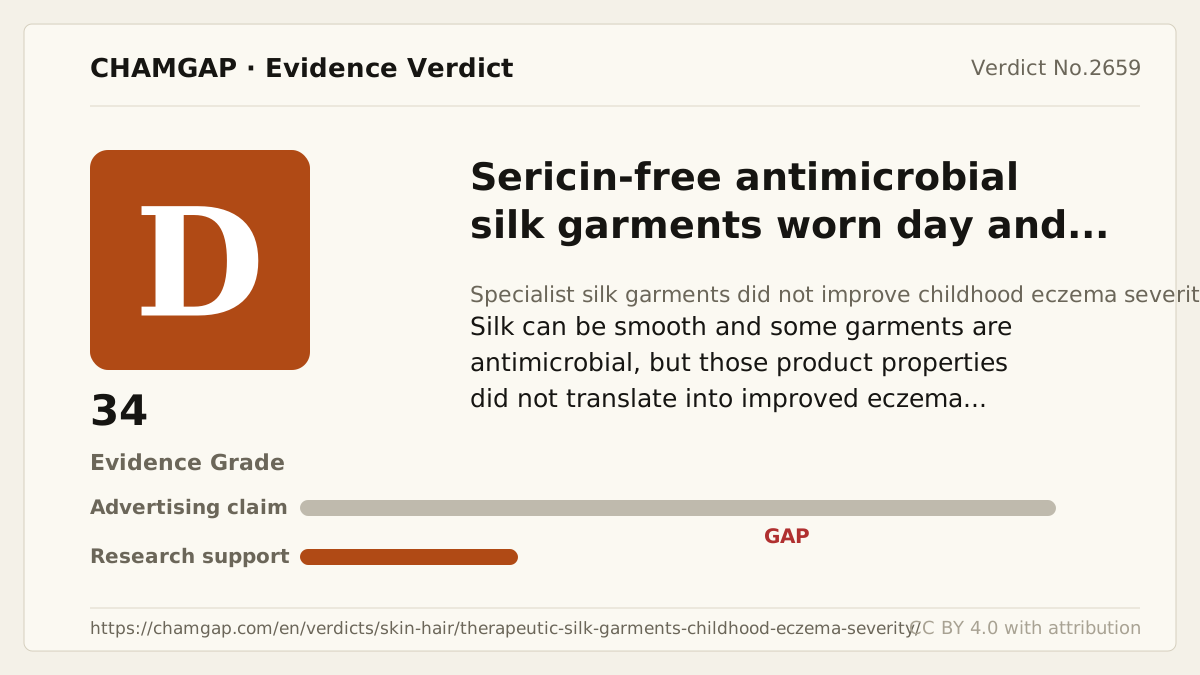
research showsThe grade is D with 34 points. CLOTHES randomized 300 children and included 282 in the primary analysis. Six-month geometric mean EASI was 5.4 in both groups, and the baseline-adjusted ratio across follow-up was 0.95 (95% CI 0.85-1.07; P=.43). The original-scale interval ranged from 1.5 points favoring silk to 0.5 favoring control, a small range. This was a publicly funded, online-randomized, observer-blinded, prespecified trial, but it is one trial rather than repeated refutation, so the grade is D rather than F.
ads claimSericin removal, smooth texture, and antimicrobial treatment are product properties. The clinical claim requires improved eczema outcomes, which CLOTHES did not show.
Useful facts when choosing a product
- Children received three sets of DermaSilk or DreamSkin 100% sericin-free antimicrobial silk garments for six months.
- Six-month geometric mean EASI was 5.4 in both groups; adjusted ratio 0.95, 95% CI 0.85-1.07.
- PMIDs 28399154, 28409557, and 26329718 are the main report, detailed report, and protocol of the same ISRCTN77261365 CLOTHES trial.
Chamgap Semantic Classification Code
Candidate index · review held
UNK.sericin-free-antimicrobial-silk-garments-worn-day-and-night-in-addition-to-standard-care.UNK.easi-severity-in-moderate-to-severe-childhood-atopic-eczema.improve.usual-careUnknown > Sericin-free antimicrobial silk garments worn day and night in addition to standard care > Unknown > EASI severity in moderate-to-severe childhood atopic eczema > Improvement claim > Usual care
An automated migration candidate, not an issued permanent code; exact claim scope remains under review. This machine-generated migration candidate helps retrieval but is not a permanent assignment. The original verdict ID and URL remain authoritative.
What the research actually shows
CLOTHES described allocation concealment as: “Research nurses accessed the randomisation website by means of a remote, internet-based randomisation system developed and maintained by the Nottingham CTU.” Assessor masking was stated as: “Research nurses remained blinded to treatment allocation for 289 out of 300 (96%) participants.” The analysis population was: “The main approach to analysis was modified intention to treat, that is, analysis according to randomised group regardless of adherence to allocation and including only participants who provided outcome data.” The prerecruitment registration date was October 11, 2013, and its prespecified primary endpoint—“Eczema severity measured by the objective Eczema Area and Severity Index (EASI); Timepoint(s): Baseline, 2 months, 4 months, 6 months”—matched the paper. Participant masking was impossible by design, but assessor masking was maintained for 289 of 300 participants. The adjusted repeated-measures primary analysis included 282 children, 141 per group.
Why this is classified as D (34)
A well-designed independent 300-child trial had a null prespecified EASI outcome, but multiple reports of that one trial are not repeated refutation, giving D with 34 points.
Counterpoint. Comfort preference is separate from efficacy. Silk garments should not replace standard emollient and anti-inflammatory treatment.
Rejudgment record. Evidence aligned — Remote internet randomization, assessor masking for 289/300, modified ITT analysis, and a prespecified EASI endpoint matching the registration
| Endpoint | P | Symptom or function itself is the target - including patient reports and performance tests |
| Replication | R1 | Single confirmatory trial |
| Independence | I2 | Decisive evidence is publicly or non-profit funded |
| Effect size | E0 | Null |
| Precision | C0 | The confidence interval leaves room for benefit |
Stored derived and displayed grades match; this is not a current recalculation or validity check (D).
Sub-claim grades by effect
This ingredient is marketed for several effects. A single overall grade blends strong and weak claims together, so each effect is graded separately here. The overall grade reflects the strongest disconfirming or core claim.
| Effect (sub-claim) | Grade | Basis |
|---|---|---|
| Improved blinded EASI severity | D | The adjusted ratio was 0.95 (95% CI 0.85-1.07), P=.43. |
| Reduced skin infections | D | Rates were 36/142 versus 39/141, with no difference. |
Cross-check — AI research and Codex final gate
Evidence Table
| Study | Design | Sample | Funding | Endpoint | Result | Weight |
|---|---|---|---|---|---|---|
| Thomas KS, Bradshaw LE, Sach TH, Batchelor JM, Lawton S, Harrison EF, Haines RH, Ahmed A, Williams HC, Dean T, Burrows NP, Pollock I, Llewellyn J, Crang C, Grundy JD, Guiness J, Gribbin A, Mitchell EJ, Cowdell F, Brown SJ, Montgomery AA, UK Dermatology Clinical Trials Network’s CLOTHES Trial Team. 2017 | Five-center observer-blinded randomized trial | 300 randomized, 149/151; 282 in primary analysis, 141/141 | NIHR HTA Programme 11/65/01; company-donated garments with no role in analysis or interpretation | Blinded nurse-assessed EASI at 2, 4, and 6 months | Adjusted geometric mean ratio 0.95 (95% CI 0.85-1.07), P=.43; about -1.5 to +0.5 original-scale points | Well-designed independent null trial |
Receipt — 3 References
All 3 cited sources were verified for existence at the original page (as of 2026-08-15).
Final verification and publication gate: Codex · Evidence date: 2026-08-15 · Corrections: none
Cite this verdict
[Chamgap] Therapeutic silk garments x childhood eczema severity — Evidence Grade D·34. 3 cited sources checked. Source: https://chamgap.com/en/verdicts/skin-hair/therapeutic-silk-garments-childhood-eczema-severity/ · CC BY 4.0CC BY 4.0 — free to use with attribution; do not distort grades, numbers, or verdict meaning.
What this document does and does not do
Chamgap is an information source. It reports what research has and has not confirmed; it does not tell readers what to take or buy. That decision belongs to readers and, when needed, medical or legal professionals. This verdict reflects literature available up to the search date and may change as new research appears. Nothing here is medical advice.