
Tattooing,
does it really help with Higher incidence of skin cancer?
research showsThe grade is C. A cohort analysis in a random Danish twin sample linked tattooing with skin cancer, but only 16 cancers occurred. In a separate cancer-case/cotwin sample, an individual-level analysis was positive while the actual matched comparison of 14 informative twin pairs was null. Sun exposure and skin phototype were not adjusted, preventing a causal conclusion.
ads claimThe paper also examined lymphoma, but that is a different endpoint and was not evidence for this skin-cancer verdict. Mechanistic concerns about ink alone cannot establish cancer incidence.
Useful facts when choosing a product
- The random-sample cohort and cancer-case/cotwin analyses used different samples.
- Only 16 skin cancers occurred in the cohort, eight among tattooed participants.
- The matched analysis had only 14 pairs informative for both tattoo and skin cancer.
- Sun exposure and skin phototype were not adjusted.
Chamgap Semantic Classification Code
Candidate index · review held
UNK.tattooing.UNK.higher-incidence-of-skin-cancer.increase.UNKUnknown > Tattooing > Unknown > Higher incidence of skin cancer > Increase claim > Unknown
An automated migration candidate, not an issued permanent code; exact claim scope remains under review. This machine-generated migration candidate helps retrieval but is not a permanent assignment. The original verdict ID and URL remain authoritative.
What the research actually shows
Clemmensen and colleagues linked a 2021 questionnaire to the Danish Cancer Registry. In the random twin cohort of 2,367 respondents, 16 skin cancers occurred, eight among tattooed participants, and the cohort HR was 3.91, 95% CI 1.42-10.8. In a separate 316-person cancer-case/cotwin sample, the individual-level analysis included 119 cases and 104 controls and gave HR 1.62, 1.08-2.41; the actual matched comparison of 14 pairs discordant for both tattoo and skin cancer gave HR 1.33, 0.46-3.84. These samples and analyses are distinct. Outdoor ultraviolet exposure, sunburn, and skin phototype were not measured or adjusted. The paper confirms open-access funding from the University of Southern Denmark and declares no competing interests. Nordic Cancer Union research funding was not confirmed, and tattoo-industry funding was not separately stated. Exposure-group-specific absolute skin-cancer incidence was not provided.
Why this is classified as C (56)
Registry-confirmed cancer and time-varying exposure are strengths. One research group, sparse events, modest response, unadjusted ultraviolet and phenotype confounding, and an imprecise matched analysis give C with 56 points.
Counterpoint. The positive associations deserve attention but do not establish that tattooing causes skin cancer. Greater ultraviolet exposure and skin-phenotype differences could explain part of the signal.
Rejudgment record. Cross-check applied — Separate accounting of cohort, individual, and matched cotwin estimates, events, and ultraviolet confounding
| Endpoint | H | Hard endpoint - actual events such as death |
| Replication | R1 | Single confirmatory trial |
| Independence | I2 | Decisive evidence is publicly or non-profit funded |
| Effect size | E+ | Meets the clinically important threshold |
Stored derived and displayed grades match; this is not a current recalculation or validity check (C).
Sub-claim grades by effect
This ingredient is marketed for several effects. A single overall grade blends strong and weak claims together, so each effect is graded separately here. The overall grade reflects the strongest disconfirming or core claim.
| Effect (sub-claim) | Grade | Basis |
|---|---|---|
| Higher skin-cancer incidence in the random twin sample | C | Across 16 events, HR was 3.91, 95% CI 1.42-10.8. |
| Higher skin-cancer incidence in the matched cotwin analysis | D | Across 14 informative pairs, HR was 1.33, 95% CI 0.46-3.84. |
| Higher skin-cancer incidence with large tattoos | C | In the individual-level analysis, HR was 2.37 for large and 1.37 for small tattoos; this was not the matched analysis. |
Cross-check — AI research and Codex final gate
Evidence Table
| Study | Design | Sample | Funding | Endpoint | Result | Weight |
|---|---|---|---|---|---|---|
| Clemmensen et al. 2025 Danish Twin Tattoo Cohort | Registry-linked cohort and case-cotwin comparison | Cohort: 2,367 participants and 16 skin cancers; separate sample: 316 participants, 119 cases, 104 controls, 14 informative pairs | Open-access funding from the University of Southern Denmark; Nordic Cancer Union research funding was not confirmed, and tattoo-industry funding was not separately stated | Incident skin cancer, with basal cell carcinoma handled separately in some analyses | Cohort analysis HR 3.91 (1.42-10.8); individual-level analysis in the separate sample HR 1.62 (1.08-2.41); 14-pair matched analysis HR 1.33 (0.46-3.84) | Objective registry endpoint, but sparse events and pairs with unadjusted ultraviolet confounding |
Receipt — 1 References
All 1 cited sources were verified for existence at the original page (as of 2026-08-05).
Final verification and publication gate: Codex · Evidence date: 2026-08-05 · Corrections: none
Cite this verdict
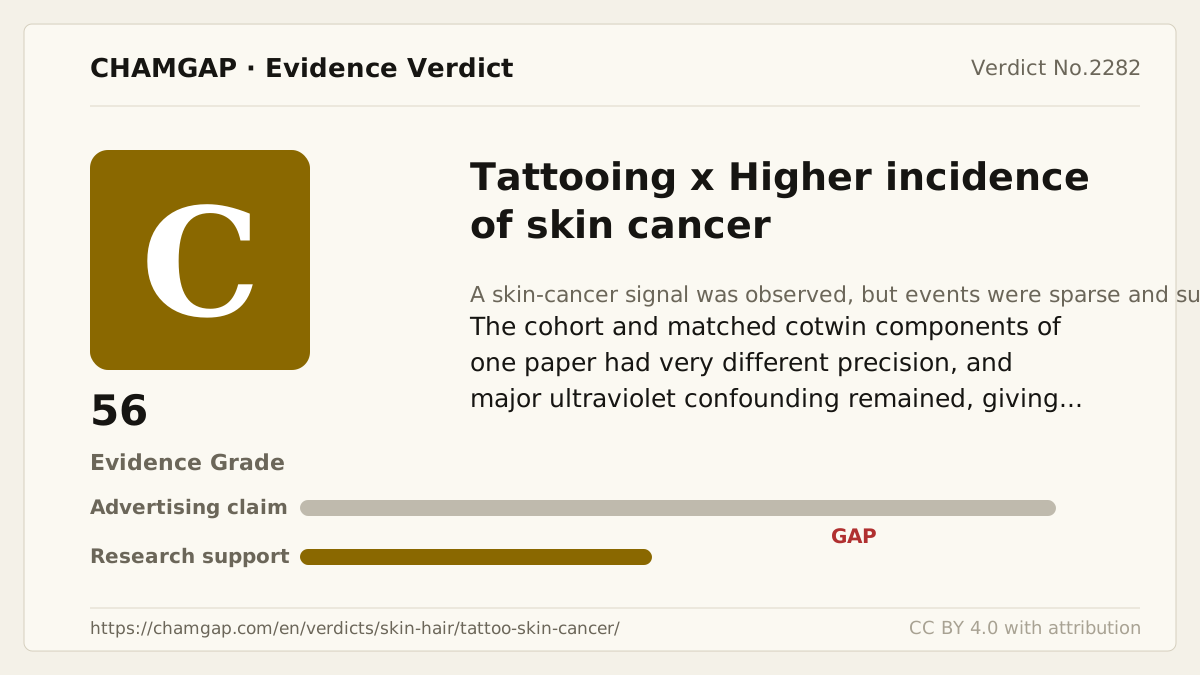
[Chamgap] Tattooing x skin cancer — Evidence Grade C·56. 1 cited sources checked. Source: https://chamgap.com/en/verdicts/skin-hair/tattoo-skin-cancer/ · CC BY 4.0CC BY 4.0 — free to use with attribution; do not distort grades, numbers, or verdict meaning.
What this document does and does not do
Chamgap is an information source. It reports what research has and has not confirmed; it does not tell readers what to take or buy. That decision belongs to readers and, when needed, medical or legal professionals. This verdict reflects literature available up to the search date and may change as new research appears. Nothing here is medical advice.