
Tap-water irrigation of simple lacerations,
does it really help with No increase in post-closure wound infection versus sterile normal saline?
research showsThe grade is D. Among 634 followed participants in Moscati's multicenter RCT, infection occurred in 12/300 (4.0%) with tap water versus 11/334 (3.3%) with saline, RR 1.21 (95% CI 0.5-2.7). A separate 625-person Weiss RCT found 11/317 (3.5%) versus 20/308 (6.4%). The trials did not repeatedly refute the same question, so replication is R1, and they did not precisely exclude an infection increase, giving D with 34 points.
ads claimIt is fair to say potable tap water has not been shown to cause more infection than sterile saline. It is not fair to generalize this to unsafe water, bites, punctures, open fractures, or immunocompromised patients.
Useful facts when choosing a product
- The trials used potable hospital tap water, not natural water, stored water, or water of unknown quality.
- Moscati compared running sink water with syringe-delivered saline, so delivery method differed along with solution.
- Weiss standardized both arms to a 35-mL syringe, 18-gauge catheter, and 500-mL volume.
Chamgap Semantic Classification Code
Candidate index · review held
UNK.irrigation-of-a-simple-emergency-department-laceration-with-potable-tap-water.UNK.no-increase-in-post-closure-wound-infection.increase.UNKUnknown > Irrigation of a simple emergency-department laceration with potable tap water > Unknown > No increase in post-closure wound infection > Increase claim > Unknown
An automated migration candidate, not an issued permanent code; exact claim scope remains under review. This machine-generated migration candidate helps retrieval but is not a permanent assignment. The original verdict ID and URL remain authoritative.
What the research actually shows
Moscati randomized 715 adults with acute simple lacerations across three hospitals and followed 634 (88%). Infection occurred in 12/300 tap-water and 11/334 saline participants, RR 1.21 (0.5-2.7). The study was funded in part by a US Federal Highway Administration grant. Weiss enrolled 663, excluded 32 ineligible participants after enrollment, randomized 631, lost six, and analyzed 625. Infection was 11/317 with tap water versus 20/308 with saline; the saline-minus-tap absolute difference was 2.9 points (95% CI -0.4 to 5.7). Weiss reported no specific grant and no competing interests.
Why this is classified as D (34)
Two RCTs measured actual infection without an increased direction, but differing delivery methods and prespecified boundaries mean they did not repeatedly refute the same question. R1 and the lack of precise equivalence exclusion give D with 34 points.
Counterpoint. D does not mean tap water is dangerous; it means the no-increase equivalence claim lacks a validated boundary for definitive exclusion. The observed direction supports tap-water use.
Rejudgment record. Cross-check applied — We compared analyzed denominators, infection events, differing irrigation delivery methods, and prespecified boundaries, coded the evidence as R1 rather than repeated refutation of the same question, and retained E0 and C0.
| Endpoint | H | Hard endpoint - actual events such as death |
| Replication | R1 | Single confirmatory trial |
| Independence | I2 | Decisive evidence is publicly or non-profit funded |
| Effect size | E0 | Null |
| Precision | C0 | The confidence interval leaves room for benefit |
Stored derived and displayed grades match; this is not a current recalculation or validity check (D).
Sub-claim grades by effect
This ingredient is marketed for several effects. A single overall grade blends strong and weak claims together, so each effect is graded separately here. The overall grade reflects the strongest disconfirming or core claim.
| Effect (sub-claim) | Grade | Basis |
|---|---|---|
| Potable tap-water irrigation of simple lacerations does not increase infection versus saline. | D | Two independent RCTs found no increase, but exclusion within a prespecified clinical boundary was not established. |
| Water of uncertain quality is safe for simple-laceration irrigation. | ? | The identified trials used potable hospital tap water. |
Cross-check — AI research and Codex final gate
Evidence Table
| Study | Design | Sample | Funding | Endpoint | Result | Weight |
|---|---|---|---|---|---|---|
| Moscati et al., Academic Emergency Medicine 2007 | Three-hospital prospective randomized comparative trial | 715 randomized; 634 followed (300 tap water, 334 saline) | Funded in part by a US Federal Highway Administration grant | Clinical wound infection 5-14 days after closure | 12/300 (4.0%) versus 11/334 (3.3%), RR 1.21 (95% CI 0.5-2.7) | Pivotal multicenter direct trial |
| Weiss et al., BMJ Open 2013 | Computer-randomized, triple-blind controlled trial | 663 enrolled, 631 randomized, and 625 analyzed (317 tap water, 308 saline) | No specific public, commercial, or nonprofit grant and no competing interests reported | Wound infection at structured 48-hour and 30-day follow-up | 11/317 (3.5%) versus 20/308 (6.4%); saline-minus-tap difference 2.9 points (95% CI -0.4 to 5.7) | Related direct trial, not repeated refutation of the same question |
Receipt — 3 References
All 3 cited sources were verified for existence at the original page (as of 2026-08-14).
Final verification and publication gate: Codex · Evidence date: 2026-08-14 · Corrections: none
Cite this verdict
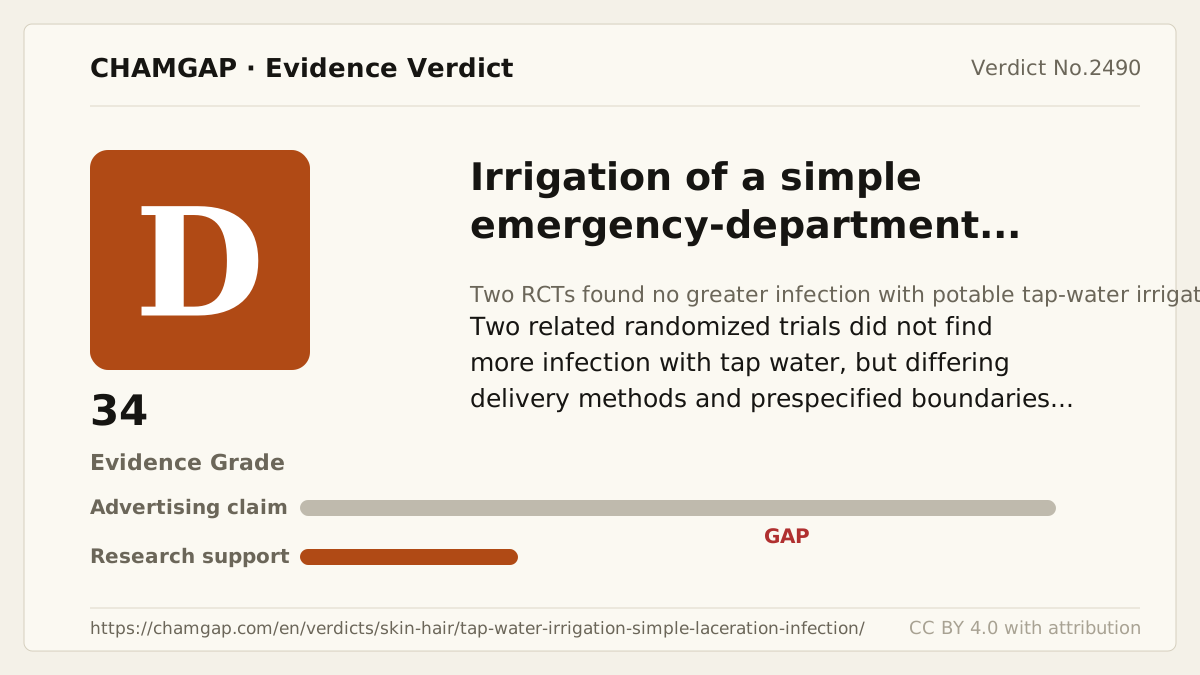
[Chamgap] Tap-water irrigation of simple lacerations x no increase in infection — Evidence Grade D·34. 3 cited sources checked. Source: https://chamgap.com/en/verdicts/skin-hair/tap-water-irrigation-simple-laceration-infection/ · CC BY 4.0CC BY 4.0 — free to use with attribution; do not distort grades, numbers, or verdict meaning.
What this document does and does not do
Chamgap is an information source. It reports what research has and has not confirmed; it does not tell readers what to take or buy. That decision belongs to readers and, when needed, medical or legal professionals. This verdict reflects literature available up to the search date and may change as new research appears. Nothing here is medical advice.