
Sunflower-seed-containing food 25 g/day,
does it really help with Improved acne?
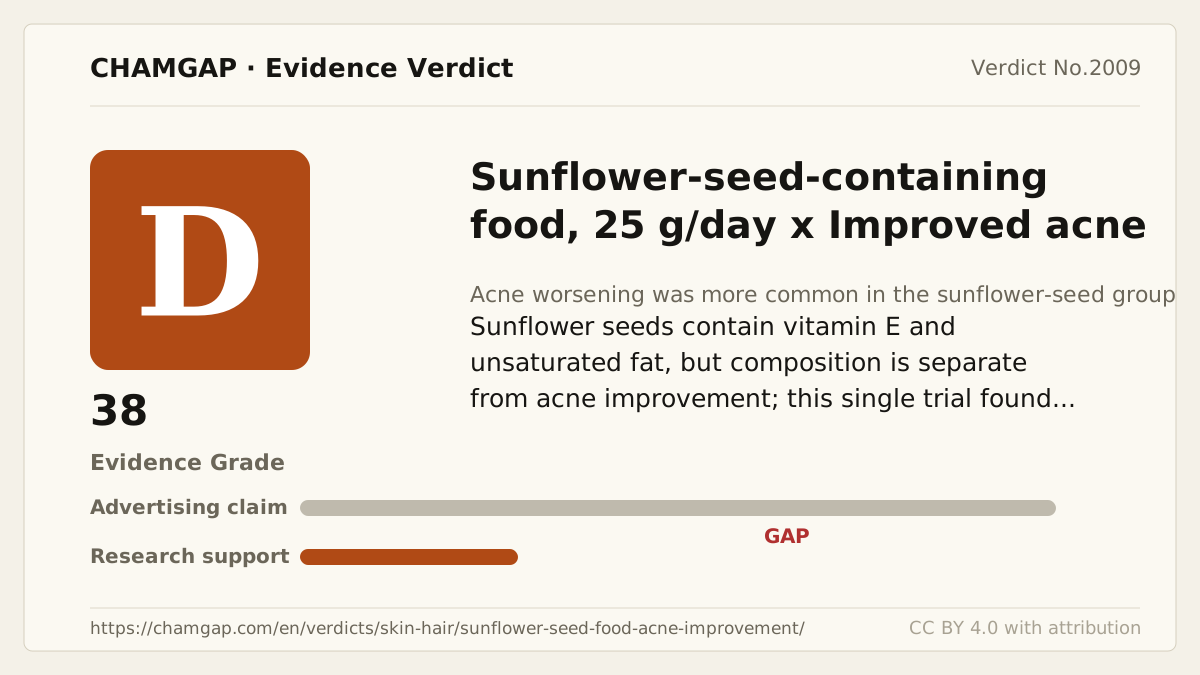
research showsThe grade is D with 34 points. The group eating the food worsened rather than improved. In a trial that randomized and analyzed 50 people, 25 per group, prespecified worsening of the Acne Severity Index by at least 10% occurred in 22 of 25 participants (88%) with sunflower seed versus 9 of 25 (36%) with control. RR was 2.4 (95% CI 1.4 to 4.2) and risk difference was 0.52 (0.29 to 0.75).
ads claimVitamin E and unsaturated-fat content cannot be converted into acne improvement. The direct trial found worsening instead.
Useful facts when choosing a product
- The study provided 25 g/day of sunflower-seed-containing food for seven days and observed participants through day 14. Raw versus roasted form and cultivar were unconfirmed in the public article.
- Sunflower seeds contain vitamin E and mono- and polyunsaturated fats.
- A representative value for dried sunflower kernels is about 584 kcal per 100 g, making 25 g about 146 kcal. Direct assay of the trial product was unconfirmed.
- Sunflower-seed allergy can occur, but sunflower is not among the nine major US FDA allergens.
- Sunflower is native to the Americas.
Chamgap Semantic Classification Code
Candidate index · review held
F.sunflower-seed-containing-food.food.acne.improve.UNKFoods and beverages > Sunflower-seed-containing food > Food consumption > acne > Improvement claim > Unknown
An automated migration candidate, not an issued permanent code; exact claim scope remains under review. This machine-generated migration candidate helps retrieval but is not a permanent assignment. The original verdict ID and URL remain authoritative.
What the research actually shows
The 2015 paper by Mohebbipour A et al. was checked. Fifty participants were randomized and analyzed, 25 per group, and the primary outcome, risk ratio, and risk difference were reported. No prospective registration number was identified; conduct in 2009 and publication in 2015 prevent verification of the original plan. Academic support came from Ardabil Branch, Islamic Azad University; no commercial or producer-board support was identified.
Why this is classified as D (34)
The primary outcome showed significant and large worsening, but this was one unblinded 50-person, 14-day trial and GAGS was null. The improvement claim receives D with 34 points.
Counterpoint. A prospectively registered independent trial with blinded assessment should test whether the worsening signal generalizes.
Rejudgment record. Cross-check applied — Checked the 2015 paper for primary outcome, denominators, risk ratio, risk difference, null GAGS result, and registration and funding-reporting limits
| Endpoint | P | Symptom or function itself is the target - including patient reports and performance tests |
| Replication | R1 | Single confirmatory trial |
| Independence | I2 | Decisive evidence is publicly or non-profit funded |
| Effect size | E- | Harm increased in the trials |
| Precision | C1 | The confidence interval excludes meaningful benefit |
Stored derived and displayed grades match; this is not a current recalculation or validity check (D).
Sub-claim grades by effect
This ingredient is marketed for several effects. A single overall grade blends strong and weak claims together, so each effect is graded separately here. The overall grade reflects the strongest disconfirming or core claim.
| Effect (sub-claim) | Grade | Basis |
|---|---|---|
| A sunflower-seed-containing food at 25 g/day improves acne | D | The primary outcome showed significant worsening rather than improvement. |
| Sunflower seeds contain vitamin E and unsaturated fat | ? | This is a composition fact, not a graded acne outcome. |
Cross-check — AI research and Codex final gate
Evidence Table
| Study | Design | Sample | Funding | Endpoint | Result | Weight |
|---|---|---|---|---|---|---|
| Mohebbipour A et al., Iranian Red Crescent Medical Journal, 2015 | Randomized controlled trial of sunflower-seed-containing food versus avoidance | 50 randomized and analyzed, 25 per arm, 14 days | Academic support from Ardabil Branch, Islamic Azad University; no commercial or producer-board support identified | Sustained Acne Severity Index worsening of at least 10% | 22/25 versus 9/25; RR 2.4 (95% CI 1.4 to 4.2), risk difference 0.52 (0.29 to 0.75) | Significant harm on the primary outcome, but one small trial |
Receipt — 3 References
All 3 cited sources were verified for existence at the original page (as of 2026-08-02).
Final verification and publication gate: Codex · Evidence date: 2026-08-02 · Corrections: none
Cite this verdict
[Chamgap] Sunflower-seed-containing food 25 g/day x acne improvement — Evidence Grade D·34. 3 cited sources checked. Source: https://chamgap.com/en/verdicts/skin-hair/sunflower-seed-food-acne-improvement/ · CC BY 4.0CC BY 4.0 — free to use with attribution; do not distort grades, numbers, or verdict meaning.
What this document does and does not do
Chamgap is an information source. It reports what research has and has not confirmed; it does not tell readers what to take or buy. That decision belongs to readers and, when needed, medical or legal professionals. This verdict reflects literature available up to the search date and may change as new research appears. Nothing here is medical advice.