
Skim milk,
does it really help with Increased prevalence of adolescent acne?
research showsThe grade is C with 54 points. In a U.S. cohort of 4,273 boys, those reporting more than two servings of skim milk daily in 1996 had an acne prevalence ratio of 1.19 (95% CI 1.01 to 1.40) in 1999 versus less than one serving weekly. This was a small association that barely excluded one; acne was self-reported without clinical validation, and steroid use and several lifestyle factors were not adjusted, so causation is unproven.
ads claimRemoving milk fat does not remove lactose and nonfat milk solids. Verdict 1465 is C with 50 points and concerns isolated lactoferrin treatment; this verdict concerns skim milk as a food exposure and acne prevalence, so the intervention and question differ.
Useful facts when choosing a product
- USDA describes milk as water, milk fat, and skim solids, with skim solids containing protein, lactose, and minerals. Removing fat therefore does not remove lactose or calcium constituents.
- The GUTS questionnaire distinguished whole, 2%, 1%, and skim/nonfat milk and cross-classified usual type with total milk frequency.
- Mean FFQ validity against dietary recalls was 0.54 overall, while 1996-to-1998 reproducibility for skim milk was 0.69. Reproducibility is not the same as item-specific validity against a reference method.
Chamgap Semantic Classification Code
Candidate index · review held
F.nonfermented-skim-milk-consumed-by-adolescents.food.prevalence-of-adolescent-acne.increase.UNKFoods and beverages > Nonfermented skim milk consumed by adolescents > Food consumption > prevalence of adolescent acne > Increase claim > Unknown
An automated migration candidate, not an issued permanent code; exact claim scope remains under review. This machine-generated migration candidate helps retrieval but is not a permanent assignment. The original verdict ID and URL remain authoritative.
What the research actually shows
Of 7,843 boys in GUTS, researchers excluded 125 with implausible energy intake, 38 with more than 70 blank items, and 3,570 who did not answer the 1999 acne question, leaving 4,273. The 45.5% exclusion rate was below one half and therefore did not meet the substantial-selection-exclusion threshold. Food-frequency questionnaires measured diet from 1996 to 1998 and acne was self-reported in 1999 without clinical validation. The main model adjusted only age, height, and energy; adding BMI and Tanner stage changed little, but steroid use and other lifestyle factors were not adjusted. Self-reported outcome and failure to adjust major confounders are the two bias defects. Funding combined NIH, the Breast Cancer Research Foundation, and the Kellogg Company; authors declared no conflicts.
Why this is classified as C (54)
The small association that barely excluded one is retained, but reliance on one observational cohort with clinically unvalidated self-reported acne and multiple unadjusted lifestyle factors gives C with 54 points.
Counterpoint. C does not mean skim milk and acne are unrelated; it means changing intake has not been shown to change acne in a randomized trial.
Rejudgment record. Cross-check applied — The original cohort's analysis population, exposure range, self-reported outcome, adjustment set, sensitivity analyses, funding, and questionnaire validation description were checked directly
| Endpoint | H | Hard endpoint - actual events such as death |
| Replication | R1 | Single confirmatory trial |
| Independence | I1 | Mixed funding sources |
| Effect size | E+ | Meets the clinically important threshold |
Stored derived and displayed grades match; this is not a current recalculation or validity check (C).
Sub-claim grades by effect
This ingredient is marketed for several effects. A single overall grade blends strong and weak claims together, so each effect is graded separately here. The overall grade reflects the strongest disconfirming or core claim.
| Effect (sub-claim) | Grade | Basis |
|---|---|---|
| Higher skim-milk intake is associated with greater acne prevalence in boys | C | A small observational PR of 1.19 remains limited by self-report and residual confounding. |
Cross-check — AI research and Codex final gate
Evidence Table
| Study | Design | Sample | Funding | Endpoint | Result | Weight |
|---|---|---|---|---|---|---|
| Adebamowo CA et al. 2008 GUTS | Prospective adolescent cohort analysis | 4,273 of 7,843 boys with dietary and 1999 acne data analyzed | Boston Obesity Nutrition Research Center, NIH, Breast Cancer Research Foundation, and Kellogg Company; no conflicts declared | Self-reported acne prevalence in 1999 | Skim milk more than twice daily versus less than weekly: PR 1.19 (95% CI 1.01 to 1.40); trend P=0.02 | Large direct cohort limited by a small association, self-report, and limited adjustment |
Receipt — 2 References
All 2 cited sources were verified for existence at the original page (as of 2026-08-03).
Final verification and publication gate: Codex · Evidence date: 2026-08-03 · Corrections: none
Cite this verdict
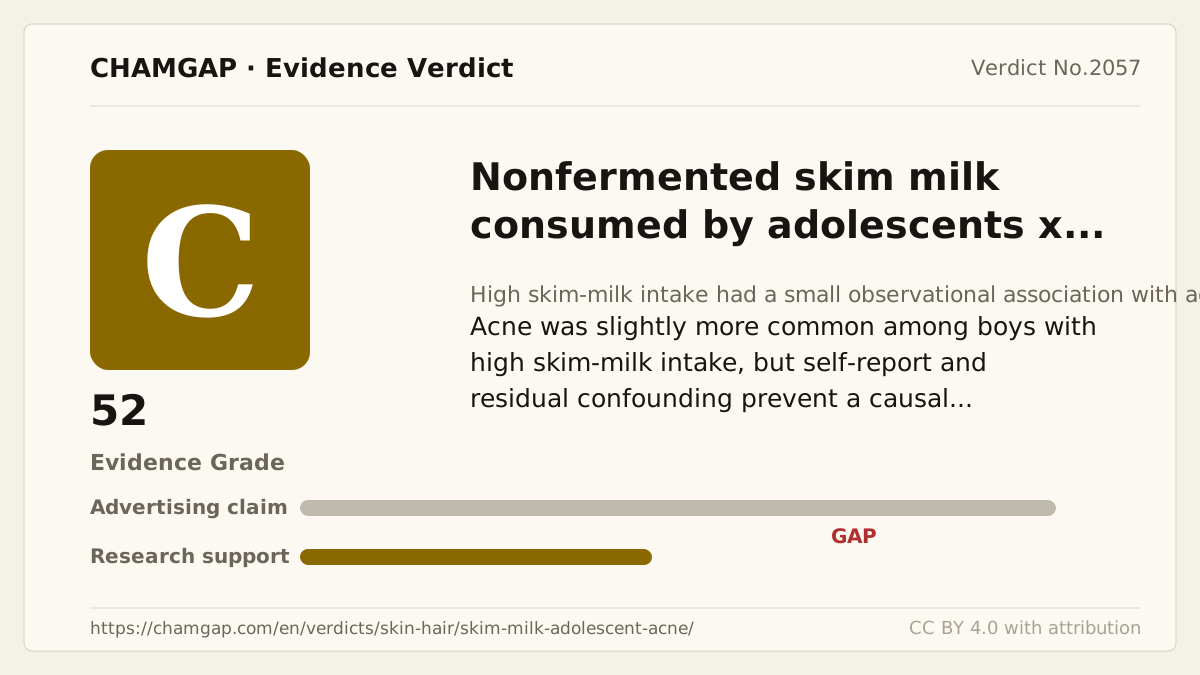
[Chamgap] Skim milk x increased adolescent acne — Evidence Grade C·54. 2 cited sources checked. Source: https://chamgap.com/en/verdicts/skin-hair/skim-milk-adolescent-acne/ · CC BY 4.0CC BY 4.0 — free to use with attribution; do not distort grades, numbers, or verdict meaning.
What this document does and does not do
Chamgap is an information source. It reports what research has and has not confirmed; it does not tell readers what to take or buy. That decision belongs to readers and, when needed, medical or legal professionals. This verdict reflects literature available up to the search date and may change as new research appears. Nothing here is medical advice.