
Secukinumab,
does it really help with HiSCR50 lesion response in moderate-to-severe hidradenitis suppurativa?
research showsThe grade is C. HiSCR50 is a lesion-count rule: at least 50% fewer abscesses and inflammatory nodules without increases in abscesses or draining fistulae. Every-2-week dosing succeeded in SUNSHINE, 45.0% versus 33.7%, whereas every-4-week dosing missed its prespecified threshold. Both regimens succeeded in SUNRISE.
ads claimA lesion-count response does not establish less pain, tunneling, scarring, surgery, or overall quality-of-life burden. In Korea, severe hidradenitis suppurativa has special-registration and biologic reimbursement implications, so eligibility and prior-treatment criteria affect access.
Useful facts when choosing a product
- HiSCR50 is a lesion-count rule, not a symptom questionnaire.
- SUNSHINE and SUNRISE were one Novartis-sponsored development program.
- Every-2-week dosing met the primary endpoint in both trials.
Chamgap Semantic Classification Code
Candidate index · review held
UNK.secukinumab.UNK.hiscr50-lesion-response-in-moderate-to-severe-hidradenitis-suppurativa.assess.placeboUnknown > Secukinumab > Unknown > HiSCR50 lesion response in moderate-to-severe hidradenitis suppurativa > Association or change assessment > Placebo
An automated migration candidate, not an issued permanent code; exact claim scope remains under review. This machine-generated migration candidate helps retrieval but is not a permanent assignment. The original verdict ID and URL remain authoritative.
What the research actually shows
The trials enrolled 541 and 543 patients but shared design, sponsor, and development program, so they are not independent replication. SUNSHINE and SUNRISE are sister trials with distinct registration numbers, NCT03713619 and NCT03713632. The prespecified study-level threshold was one-sided 0.025. Axis 6 B0 evidence ① Allocation concealment: "the IRT was contacted to assign a randomisation number" and "treatment assignment was unbiased and concealed from patients and investigator staff." ② Blinding: "Patients, investigator staff, persons performing the assessments, and the Novartis clinical trial team remained blinded" until database lock. ③ Analysis population and missing data: week-16 results used the "full analysis set" and "multiple imputation"; completion was 509/541 (94.1%) and 506/543 (93.2%), leaving 5.9% and 6.8% missing. ④ Prespecified primary endpoint: "The primary outcome ... was ... HiSCR50 at week 16" - consistent with NCT03713619 and NCT03713632. The paper states "Funding: Novartis Pharma," and multiple authors were employees and stockholders.
Why this is classified as C (54)
Strong concealment, blinding, missing-data handling, and two large positive trials are strengths, but a lesion-count surrogate and lack of independently funded replication give C with 54 points.
Counterpoint. Every-4-week dosing failed the prespecified SUNSHINE test, so not every trial-regimen combination succeeded.
Rejudgment record. Cross-check applied — Direct review of trial-specific HiSCR50, prespecified one-sided thresholds, IRT, blinding, multiple imputation, and Novartis funding
| Endpoint | S | Surrogate marker - laboratory or imaging measures |
| Replication | R1 | Single confirmatory trial |
| Independence | I0 | Evidence comes only from manufacturer studies |
| Effect size | E+ | Meets the clinically important threshold |
Stored derived and displayed grades match; this is not a current recalculation or validity check (C).
Sub-claim grades by effect
This ingredient is marketed for several effects. A single overall grade blends strong and weak claims together, so each effect is graded separately here. The overall grade reflects the strongest disconfirming or core claim.
| Effect (sub-claim) | Grade | Basis |
|---|---|---|
| Every-2-week HiSCR50 response | C | Absolute gains were 11.3 and 11.1 points in the two trials. |
| Every-4-week HiSCR50 response | C | SUNSHINE failed while SUNRISE succeeded. |
Cross-check — AI research and Codex final gate
Evidence Table
| Study | Design | Sample | Funding | Endpoint | Result | Weight |
|---|---|---|---|---|---|---|
| Kimball et al. 2023 SUNSHINE and SUNRISE | Two identically designed multicenter randomized double-blind placebo-controlled phase 3 trials | SUNSHINE 541; SUNRISE 543 | Original statement: "Funding: Novartis Pharma"; multiple company employees and stockholders | Week-16 HiSCR50 lesion-count response | SUNSHINE Q2W 45.0% versus 33.7%, +11.3 points, P=.0070, success; Q4W 41.8%, +8.1 points, P=.0418, failure. SUNRISE Q2W 42.3% versus 31.2%, +11.1 points, P=.0149, success; Q4W 46.1%, +14.9 points, P=.0022, success. | Pivotal surrogate evidence from one manufacturer program |
Receipt — 2 References
All 2 cited sources were verified for existence at the original page (as of 2026-08-18).
Final verification and publication gate: Codex · Evidence date: 2026-08-18 · Corrections: none
Cite this verdict
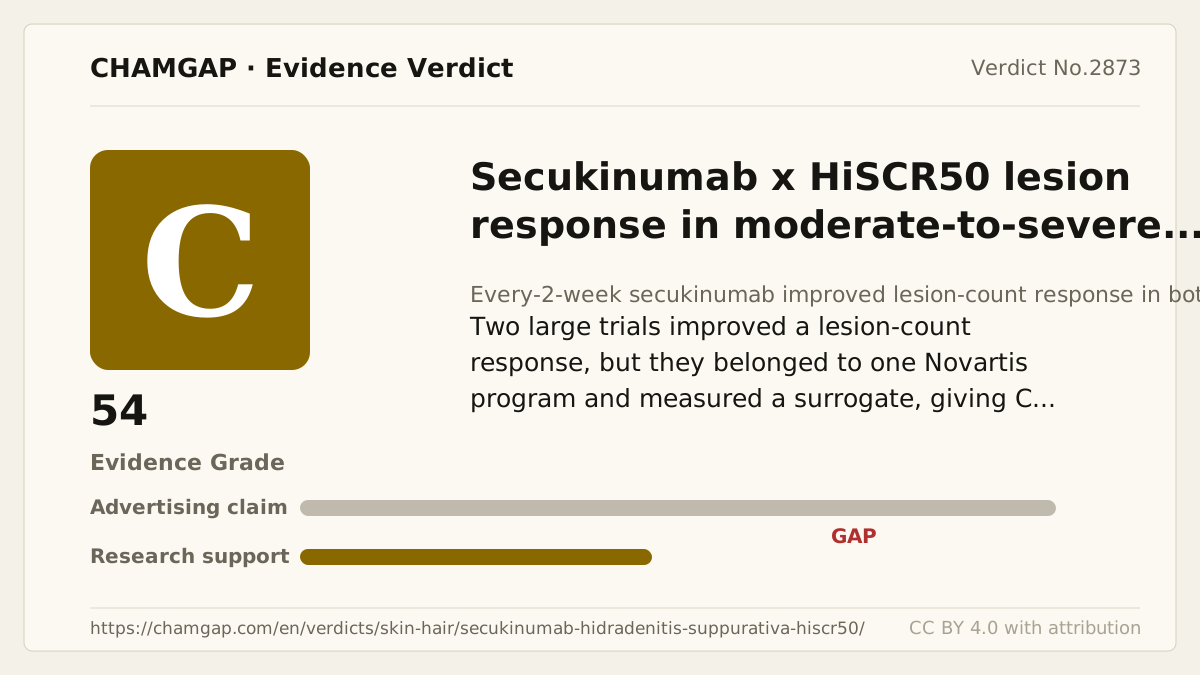
[Chamgap] Benefit of Secukinumab for Lesion Response in Moderate-to-Severe Hidradenitis Suppurativa, a Surrogate Outcome — Evidence Grade C·54. 2 cited sources checked. Source: https://chamgap.com/en/verdicts/skin-hair/secukinumab-hidradenitis-suppurativa-hiscr50/ · CC BY 4.0CC BY 4.0 — free to use with attribution; do not distort grades, numbers, or verdict meaning.
What this document does and does not do
Chamgap is an information source. It reports what research has and has not confirmed; it does not tell readers what to take or buy. That decision belongs to readers and, when needed, medical or legal professionals. This verdict reflects literature available up to the search date and may change as new research appears. Nothing here is medical advice.