
Randomized split-site scalp massage,
does it really help with Hair-thickness change in a randomized split-site comparison?
research showsThe grade is D. In nine healthy Japanese men, one temporal scalp side was randomized to Panasonic EH-HM75 massage at 170 rpm for four minutes daily over 24 weeks and the contralateral side served as the untreated control. Massage-site thickness changed from 0.085±0.003 mm to 0.092±0.001 mm, but it did not significantly differ from the untreated site. This tiny surrogate study analyzed a paired design without accounting for within-person correlation, giving D with 28 points.
ads claimKorean scalp massagers and manual routines may differ in rotation, pressure, location, and duration. A thickness signal cannot be relabeled as regrowth, increased count, or alopecia treatment.
Useful facts when choosing a product
- Measurement used a Folliscope rather than self-rating, and participants were nine healthy men rather than patients with alopecia.
- Verdict 1612 is B with 76 points for finasteride 1 mg, verdict 1665 is C with 50 points for low-level red-light/laser helmets, and verdict 1156 is C with 53 points for autologous PRP. These are different interventions in androgenetic alopecia.
- Hair count and growth rate did not increase.
Chamgap Semantic Classification Code
Candidate index · review held
P.standardized-device-assisted-scalp-massage.device.hair-thickness-change-in-a-randomized-split-site-comparison.compare.noneProcedures, devices and tests > Standardized device-assisted scalp massage > Device delivered > Hair-thickness change in a randomized split-site comparison > Comparative claim > No intervention
An automated migration candidate, not an issued permanent code; exact claim scope remains under review. This machine-generated migration candidate helps retrieval but is not a permanent assignment. The original verdict ID and URL remain authoritative.
What the research actually shows
Koyama et al. studied nine healthy men aged 25-46 using a randomized split-site design at temporal C3/C4: one side was massaged and the contralateral side left untreated. Sites were assessed at 0, 4, 12, and 24 weeks by Folliscope. The methods used a Mann-Whitney U test between sites, so within-person pairing was not modeled. Masking and a preregistered primary endpoint were not reported, and a registration number could not be confirmed. The paper states, 'This study was funded in part by ANGFA Co, Ltd.' Authors Takanori Hama and Kasumi Murakami were affiliated with ANGFA Co, Ltd. Provision of the Panasonic EH-HM75 was not reported.
Why this is classified as D (28)
Reported values permit an unpaired effect-size approximation but not recovery of the paired estimate. The nine-person split-site surrogate study found no massage-control difference and used an unpaired Mann-Whitney U test for paired data, an avoidable defect, giving D with 28 points.
Counterpoint. The 0.007-mm within-site signal is real as an observation, but the study cannot isolate it as a treatment effect.
Rejudgment record. Cross-check applied — Randomized contralateral untreated split-site design, avoidable use of an unpaired Mann-Whitney U test for paired data, partial ANGFA funding and affiliated authors; C0 permits only an approximation from reported values, not recovery of the paired estimate
| Endpoint | S | Surrogate marker - laboratory or imaging measures |
| Replication | R1 | Single confirmatory trial |
| Independence | I0 | Evidence comes only from manufacturer studies |
| Effect size | E0 | Null |
| Precision | C0 | The confidence interval leaves room for benefit |
Stored derived and displayed grades match; this is not a current recalculation or validity check (D).
Sub-claim grades by effect
This ingredient is marketed for several effects. A single overall grade blends strong and weak claims together, so each effect is graded separately here. The overall grade reflects the strongest disconfirming or core claim.
| Effect (sub-claim) | Grade | Basis |
|---|---|---|
| Massage-versus-untreated difference in hair thickness at 24 weeks | D | The study reported no significant between-site difference. |
| Increased hair count or improved hair loss | D | Count and growth rate did not increase, and patients with alopecia were not studied. |
Cross-check — AI research and Codex final gate
Evidence Table
| Study | Design | Sample | Funding | Endpoint | Result | Weight |
|---|---|---|---|---|---|---|
| Koyama et al. 2016 | Paired randomized split-site study using the same person's contralateral side as untreated control | 9 participants | Paper wording: 'This study was funded in part by ANGFA Co, Ltd.'; Takanori Hama and Kasumi Murakami were affiliated with ANGFA Co, Ltd | Folliscope hair thickness, count, and three-day growth rate | Massage-site thickness 0.085±0.003 to 0.092±0.001 mm; no significant massage-control difference; Mann-Whitney U did not account for pairing; no count or growth-rate increase | Only direct human study |
Receipt — 2 References
All 2 cited sources were verified for existence at the original page (as of 2026-08-08).
Final verification and publication gate: Codex · Evidence date: 2026-08-08 · Corrections: none
Cite this verdict
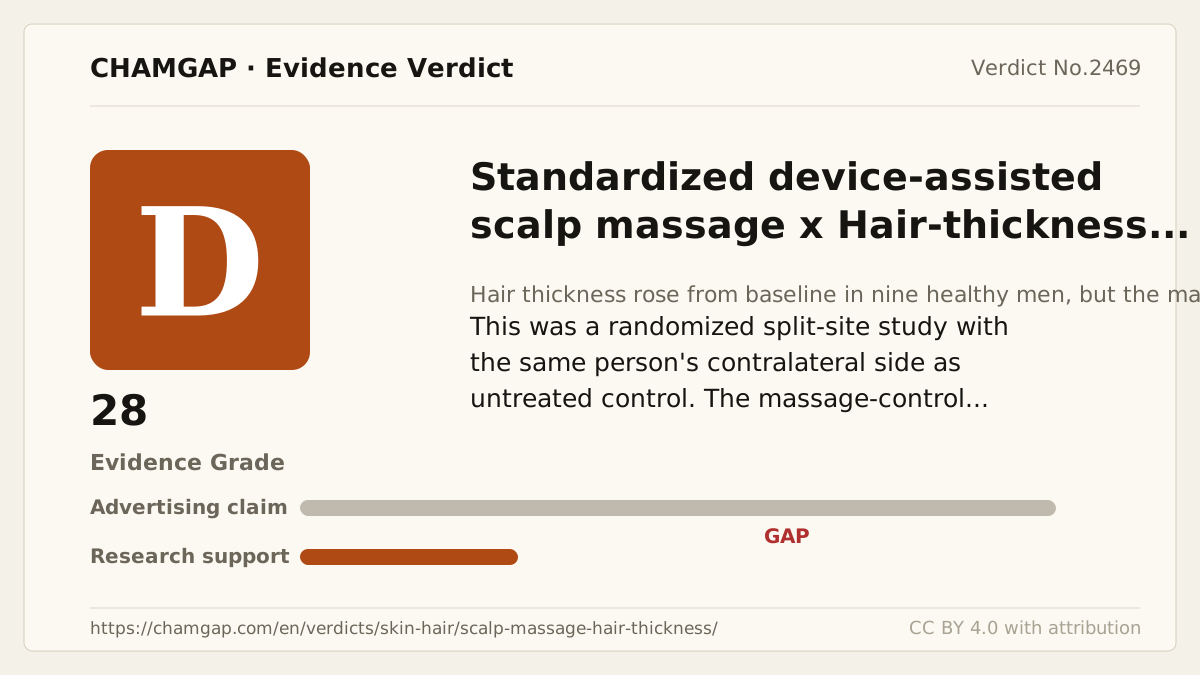
[Chamgap] Randomized split-site scalp massage x hair-thickness change — Evidence Grade D·28. 2 cited sources checked. Source: https://chamgap.com/en/verdicts/skin-hair/scalp-massage-hair-thickness/ · CC BY 4.0CC BY 4.0 — free to use with attribution; do not distort grades, numbers, or verdict meaning.
What this document does and does not do
Chamgap is an information source. It reports what research has and has not confirmed; it does not tell readers what to take or buy. That decision belongs to readers and, when needed, medical or legal professionals. This verdict reflects literature available up to the search date and may change as new research appears. Nothing here is medical advice.