
Scalp cooling,
does it really help with Prevention of chemotherapy-induced alopecia in breast cancer?
research showsScalp cooling is rated B. SCALP (Nangia 2017, JAMA) randomized 182 participants, but its interim primary analysis included 142, with 95 assigned to cooling and 47 to control. The trial was open-label, while the independent outcome assessor was blinded; hair preservation was 50.5% versus 0%. Early stopping at the interim analysis, fewer analyzed than randomized, and funding and equipment from Paxman Coolers Ltd yield B with 68 points.
ads claimClaims of complete prevention overstate the evidence: only about half succeeded in SCALP, and results vary by chemotherapy regimen, cap fit, and site experience. Scalp cooling does not improve anticancer efficacy.
Useful facts when choosing a product
- Cooling commonly starts about 30 minutes before infusion and continues during infusion and for a drug-specific period afterward.
- Hair preservation may be less successful with anthracycline-containing regimens than with taxane-centered regimens.
- Headache, chills, scalp pain, dizziness, and nausea can occur, and close cap fit is important.
- It may be unsuitable for hematologic malignancy or concern about scalp involvement, so oncology review is required.
Chamgap Semantic Classification Code
Candidate index · review held
M.scalp-cooling-with-a-circulating-cooling-cap-before.UNK.chemotherapy-induced-alopecia-in-breast-cancer.prevent.MULTIMedicinal interventions > Scalp cooling with a circulating cooling cap before > Unknown > chemotherapy-induced alopecia in breast cancer > Occurrence-prevention claim > Multiple: primary unresolved
An automated migration candidate, not an issued permanent code; exact claim scope remains under review. This machine-generated migration candidate helps retrieval but is not a permanent assignment. The original verdict ID and URL remain authoritative.
What the research actually shows
Nangia et al. 2017 randomized 182 participants two to one, but 142 who completed at least one chemotherapy cycle, 95 cooling and 47 control, formed the actual primary analysis. Blinded clinician-rated CTCAE grade 0 or 1 hair preservation after four cycles was 50.5% versus 0%; the one-sided P value was below 0.001 and the primary endpoint succeeded. Paxman supplied funding and equipment and contributed device-use design and training. Zhou et al. 2021 synthesized 17 randomized trials and 1,378 patients and reported an alopecia odds ratio of 0.13. Kang et al. 2024 analyzed 139 participants in a Korean open-label trial and found persistent alopecia at six months in 13.5% versus 52.0%, a successful primary endpoint.
Why this is classified as B (68)
SCALP randomized 182 participants and analyzed 142 at the interim analysis, 95 versus 47, with hair preservation of 50.5% versus 0%. The trial was open-label but used a blinded independent assessor. Early stopping at interim analysis, fewer analyzed than randomized, and funding and equipment from Paxman Coolers Ltd yield B with 68 points.
Counterpoint. It is reasonable for eligible patients who highly value hair preservation, but it does not guarantee complete prevention and chemotherapy should not be altered merely to improve cooling success.
Rejudgment record. Cross-check applied — SCALP randomized 182 participants and included 142 at the interim analysis, 95 versus 47. The trial was open-label, while the independent assessor was blinded, and hair preservation was 50.5% versus 0%. Early stopping at the interim analysis, fewer analyzed than randomized, and funding and equipment from Paxman Coolers Ltd were explicit downgrade factors.
Sub-claim grades by effect
This ingredient is marketed for several effects. A single overall grade blends strong and weak claims together, so each effect is graded separately here. The overall grade reflects the strongest disconfirming or core claim.
| Effect (sub-claim) | Grade | Basis |
|---|---|---|
| Hair preservation with less than 50% loss after four chemotherapy cycles | B | The blinded direct primary endpoint in SCALP succeeded by a large margin. |
| Reduction of persistent alopecia six months after chemotherapy | B | A separate 139-patient randomized trial was positive at 13.5% versus 52.0%. |
| Improvement in alopecia-related quality of life | C | Alopecia-related distress may improve, but general quality-of-life scales in SCALP did not differ significantly. |
Cross-check — AI research and Codex final gate
Evidence Table
| Study | Design | Sample | Funding | Endpoint | Result | Weight |
|---|---|---|---|---|---|---|
| Nangia J et al. 2017 | Multicenter randomized open no-treatment-controlled trial with blinded outcome assessment | 182 randomized; 142 in the actual modified intention-to-treat primary analysis, 95 versus 47 | Paxman Coolers Ltd provided study funding and equipment; partial investigator support from the NCI | Blinded clinician-rated CTCAE grade 0 or 1 hair preservation after four chemotherapy cycles | Primary endpoint succeeded: 48 of 95 (50.5%) versus 0 of 47, difference 50.5 percentage points, one-sided P<0.001. | Key direct randomized trial |
| Zhou T et al. 2021 | Systematic review and network meta-analysis of randomized trials | 17 trials and 1,378 patients | Academic research; no manufacturer funding reported in the article | Chemotherapy-induced alopecia | Scalp cooling was positive versus usual care, OR 0.13 (95% CI 0.07 to 0.25). | Replicative synthesis |
| Kang D et al. 2024 | Single-center open-label randomized controlled trial | 139 randomized and analyzed, 89 versus 50 | Supported by Paxman; the article reports that the funder had no role in design, collection, analysis, interpretation, writing, or publication decision | Persistent chemotherapy-induced alopecia six months after chemotherapy | Primary endpoint succeeded: 12 of 89 (13.5%) versus 26 of 50 (52.0%). | Longer-term direct replication |
Receipt — 3 References
All 3 cited sources were verified for existence at the original page (as of 2026-07-24).
Final verification and publication gate: Codex · Evidence date: 2026-07-24 · Corrections: none
Cite this verdict
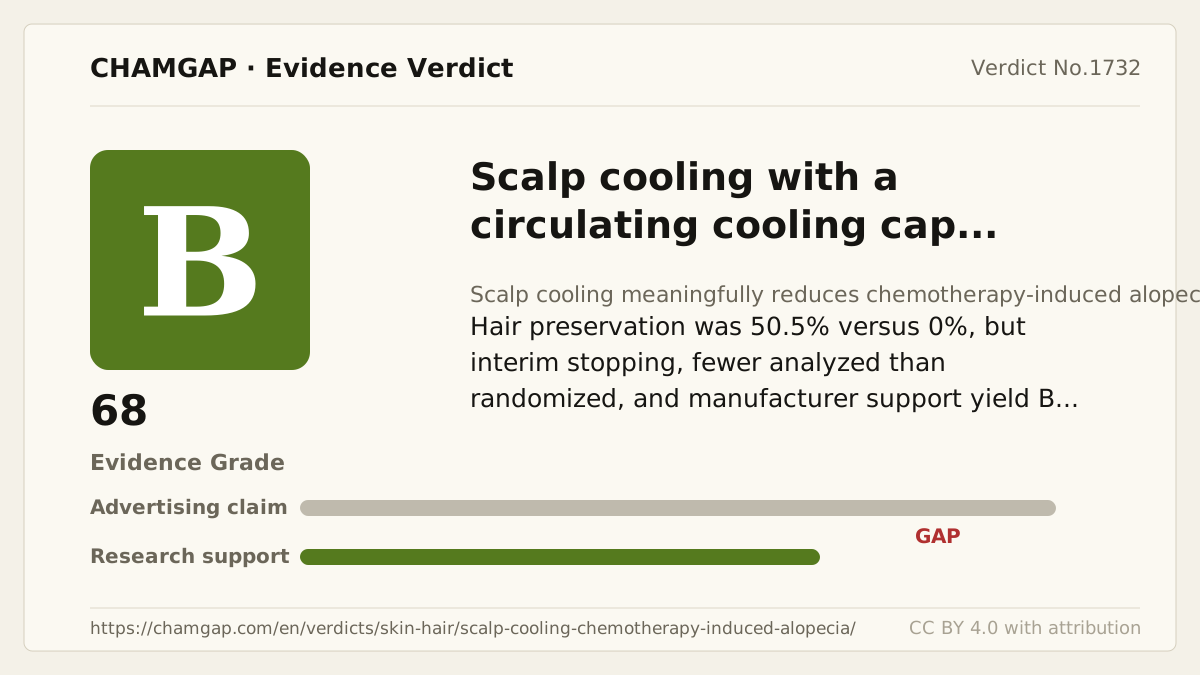
[Chamgap] Scalp cooling x prevention of chemotherapy-induced alopecia — Evidence Grade B·68. 3 cited sources checked. Source: https://chamgap.com/en/verdicts/skin-hair/scalp-cooling-chemotherapy-induced-alopecia/ · CC BY 4.0CC BY 4.0 — free to use with attribution; do not distort grades, numbers, or verdict meaning.
What this document does and does not do
Chamgap is an information source. It reports what research has and has not confirmed; it does not tell readers what to take or buy. That decision belongs to readers and, when needed, medical or legal professionals. This verdict reflects literature available up to the search date and may change as new research appears. Nothing here is medical advice.