
Ritlecitinib,
does it really help with Scalp hair regrowth in adults and adolescents with severe alopecia areata?
research showsC. Ritlecitinib increases scalp hair regrowth versus placebo in adults and adolescents aged 12 years or older with severe alopecia areata. In the 718-participant ALLEGRO-2b/3 trial, the week-24 SALT score of 20 or less response was 23.4% with the approved 50-mg dose and 1.5% with placebo, demonstrating a real effect. However, the FDA describes the evidence as a single pivotal trial, and that trial was manufacturer led. Unlike baricitinib, which has two pivotal BRAVE-AA1 and BRAVE-AA2 trials, ritlecitinib lacks independent confirmation, giving upper C with 59 points at the B/C boundary.
ads claimMarketing can expand hair regrowth into complete recovery for everyone, identical recovery of eyebrows and eyelashes, and persistence after stopping. The strict week-24 response with the approved dose was about 23%, and many patients require continued treatment.
Useful facts when choosing a product
- Litfulo is a prescription JAK3/TEC-family inhibitor for severe alopecia areata in adults and adolescents aged 12 years or older, commonly dosed at 50 mg once daily.
- Tuberculosis and viral-hepatitis risk, vaccination status, blood counts, and liver tests should be assessed before treatment, with infection and laboratory monitoring during therapy.
- The labeling carries JAK-class warnings concerning serious infection, herpes zoster, malignancy, major cardiovascular events, thrombosis, and death, and treatment should not begin during an active serious infection.
- Scalp regrowth takes months, many patients do not respond sufficiently by week 24, and persistence after withdrawal is not established, so treatment should not be stopped or restarted without the prescriber.
Chamgap Semantic Classification Code
Candidate index · review held
M.ritlecitinib.UNK.scalp-hair-regrowth-and-adolescents-with-severe-alopecia-areata.assess.placeboMedicinal interventions > Ritlecitinib > Unknown > Scalp hair regrowth and adolescents with severe alopecia areata > Association or change assessment > Placebo
An automated migration candidate, not an issued permanent code; exact claim scope remains under review. This machine-generated migration candidate helps retrieval but is not a permanent assignment. The original verdict ID and URL remain authoritative.
What the research actually shows
King and colleagues' 2023 ALLEGRO 2b/3 trial randomized 718 participants aged 12 years or older with at least 50% scalp hair loss across 118 sites in 18 countries. The week-24 SALT score of 20 or less response was 23% with 50 mg and 2% with placebo, reaching 31% in the high-loading-dose group. Responses increased through week 48 with continued treatment, but placebo participants switched to active treatment after week 24, removing long-term control. Integrated exposure data from 1,294 participants described safety through 24 months but came from open-label extensions. Observational studies in 2026 suggest relapse after withdrawal or dose reduction, without a randomized withdrawal trial.
Why this is classified as C (59)
C. In the 718-participant ALLEGRO-2b/3 trial, the approved-dose week-24 SALT score of 20 or less response was 23.4% versus 1.5% with placebo, clearly establishing a direct scalp-hair effect. The FDA nevertheless describes the evidence as a single pivotal trial, it was manufacturer led, and no independent confirmation exists. Consistency with the B grade for baricitinib based on two pivotal BRAVE-AA1 and BRAVE-AA2 trials gives upper C with 59 points. Infection, herpes zoster, and JAK-class warnings remain separate safety issues.
Counterpoint. For severe alopecia areata with major quality-of-life burden, the strict 23% versus 2% response difference is meaningful. Infection risk, medical history, laboratory findings, and alternatives still require individualized dermatology review.
Rejudgment record. Reassessment (cross-check reflected) — Accepted the direct scalp-hair regrowth benefit in ALLEGRO-2b/3 but applied upper C at the B/C boundary because the FDA describes the manufacturer-led evidence as a single pivotal trial without independent confirmation, unlike the two pivotal BRAVE-AA1 and BRAVE-AA2 trials supporting a B for baricitinib
Sub-claim grades by effect
This ingredient is marketed for several effects. A single overall grade blends strong and weak claims together, so each effect is graded separately here. The overall grade reflects the strongest disconfirming or core claim.
| Effect (sub-claim) | Grade | Basis |
|---|---|---|
| Hair regrowth in severe alopecia areata | C | The single pivotal ALLEGRO-2b/3 trial clearly increased the direct SALT 20 or less response, but independent confirmation is absent. |
| Durability after discontinuation and long-term effect | ? | Long-term evidence mainly comes from open-label extensions, and no randomized trial establishes persistence after discontinuation. |
| Site-specific effects including eyebrows and eyelashes | ? | Site-specific secondary-scale signals exist but do not provide independently confirmed pivotal evidence. |
| Long-term safety | ? | Integrated open-label exposure data exist but are insufficient to establish long-term comparative safety. |
Cross-check — AI research and Codex final gate
Evidence Table
| Study | Design | Sample | Funding | Endpoint | Result | Weight |
|---|---|---|---|---|---|---|
| King B et al. 2023 ALLEGRO 2b/3 | Multinational randomized double-blind placebo-controlled phase 2b/3 trial | 718 participants aged 12 years or older with severe alopecia areata | Pfizer | Week-24 scalp-hair response defined as SALT score 20 or less | SALT 20 or less was achieved by 23.4% (29/124) with 50 mg and 1.5% (2/130) with placebo. | Direct efficacy evidence from one manufacturer pivotal trial |
| Sinclair R et al. 2024 | Prespecified and post hoc patient-reported analyses of the ALLEGRO randomized trial | 718 participants | Multiple Pfizer employee coauthors | Hair-growth satisfaction at weeks 24 and 48 and correlation with SALT | Overall satisfaction at week 24 ranged from 36.4% to 67.5% across active groups versus 22.6% with placebo and correlated strongly with SALT change. | Clinical-meaning support from a secondary analysis of the same trial |
| King B et al. 2024 integrated safety analysis | Integrated safety analysis of four ALLEGRO studies | 1,294 all-exposure participants and 2,091.7 patient-years | Pfizer; multiple employee coauthors | Adverse events, serious infection, herpes zoster, MACE, and malignancy | Serious adverse events occurred in 4.4% and herpes zoster in 1.5%, providing integrated data through 24 months. | Long-term safety context with open-label and comparator limitations |
Receipt — 3 References
All 3 cited sources were verified for existence at the original page (as of 2026-07-20).
Final verification and publication gate: Codex · Evidence date: 2026-07-20 · Corrections: none
Cite this verdict
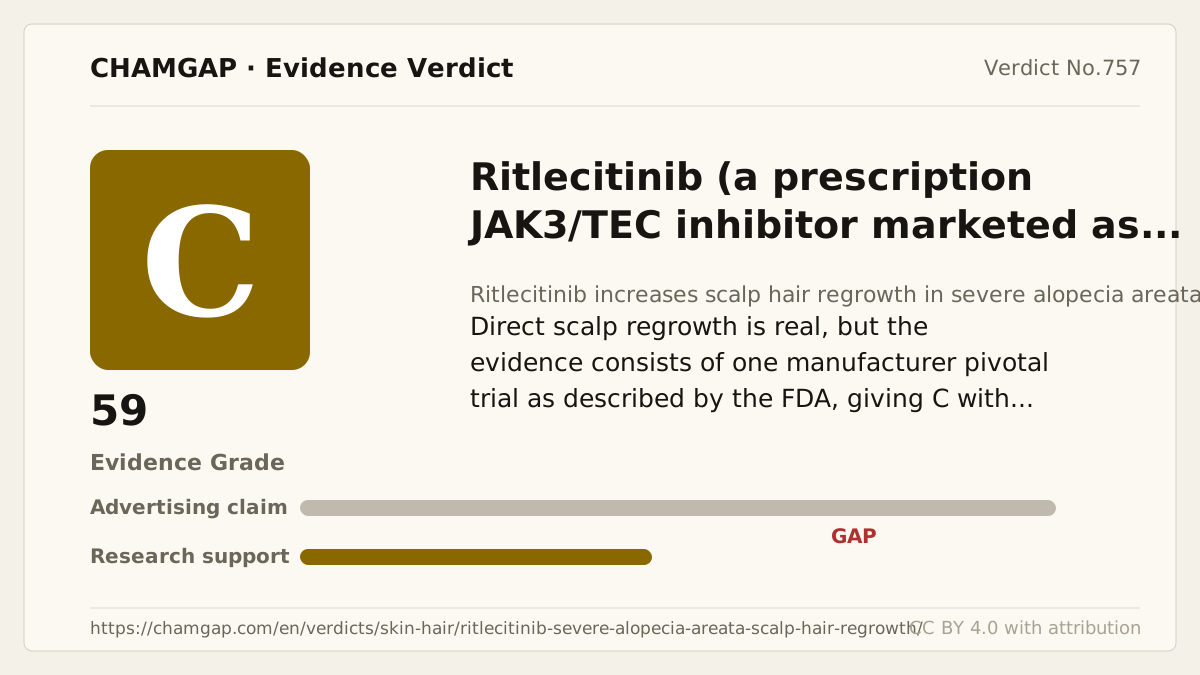
[Chamgap] Ritlecitinib x scalp hair regrowth in adults and adolescents with severe alopecia areata — Evidence Grade C·59. 3 cited sources checked. Source: https://chamgap.com/en/verdicts/skin-hair/ritlecitinib-severe-alopecia-areata-scalp-hair-regrowth/ · CC BY 4.0CC BY 4.0 — free to use with attribution; do not distort grades, numbers, or verdict meaning.
What this document does and does not do
Chamgap is an information source. It reports what research has and has not confirmed; it does not tell readers what to take or buy. That decision belongs to readers and, when needed, medical or legal professionals. This verdict reflects literature available up to the search date and may change as new research appears. Nothing here is medical advice.