
Reducing bathing or showering to once or twice weekly in people with eczema,
does it really help with Better eczema symptoms over four weeks than bathing or showering at least six times weekly?
research showsThe grade is D. In a UK online randomized trial, the adjusted four-week mean POEM difference for once- or twice-weekly versus at least six-times-weekly bathing was -0.4 points (95% CI -1.3 to 0.4; P=.30), a null result. The observed interval excluded the 2.2-point difference used for sample-size planning. However, 2.2 points was this trial's power assumption, not a validated minimum clinically important difference. At four weeks, the benefit of the size anticipated by the trial did not emerge.
ads claimThis trial did not support the belief that people with eczema should wash less. When usual moisturizers and topical treatment continued, near-daily washing did not worsen symptoms over four weeks. The result should not be generalized to longer periods, hot and humid settings, or groups at high infection risk.
Useful facts when choosing a product
- POEM is a seven-item 0-to-28 measure of eczema symptoms during the previous week; higher scores indicate worse symptoms.
- The trial compared once or twice weekly with at least six times weekly for four weeks while both groups continued usual moisturizers and topical treatment.
- Bath additives in [verdict 2887 are D with 30 points](/en/verdicts/skin-hair/emollient-bath-additives-childhood-eczema-symptom-control/), and domestic water softeners in [verdict 2426 are D with 30 points](/en/verdicts/skin-hair/ion-exchange-water-softener-childhood-atopic-eczema-improvement/); both are separate null verdicts.
Chamgap Semantic Classification Code
Candidate index · review held
UNK.reducing-bathing-or-showering-to-once-or-twice-in-people-with-eczema.UNK.better-eczema-symptoms-over-than-bathing-or-showering-at-least-six-times-weekly.assess.placeboUnknown > Reducing bathing or showering to once or twice in people with eczema > Unknown > Better eczema symptoms over than bathing or showering at least six times weekly > Association or change assessment > Placebo
An automated migration candidate, not an issued permanent code; exact claim scope remains under review. This machine-generated migration candidate helps retrieval but is not a permanent assignment. The original verdict ID and URL remain authoritative.
What the research actually shows
This UK-wide online pragmatic superiority trial randomized 438 people aged at least one year with POEM scores of at least 3: 220 to once or twice weekly and 218 to at least six times weekly. The primary model included 388 participants with at least one follow-up POEM, 193 and 195, and analysis by randomized allocation plus missing-data sensitivity analyses gave the same conclusion. Both groups continued their usual moisturizers and topical treatment. Two design limitations materially weaken the evidence: four-week follow-up and use of only an active lifestyle comparator of at least six baths or showers weekly. Participant masking was impossible for an assigned washing frequency and was not counted as an additional defect. NIHR Programme Grants for Applied Research funded the work under NIHR203279, and the funder had no role in design, collection, analysis, publication decisions, or writing. No commercial product, device, placebo supply, or commercial analysis service was reported. Disclosures included E.J.M.'s personal fees from AbbVie and authorship of POEM by H.C.W. and RECAP by L.H. and K.S.T.
Why this is classified as D (30)
The publicly funded 438-participant trial had a null primary patient-centered endpoint and excluded the 2.2-point difference used for sample-size planning. That value was not a validated clinical threshold; a prior pediatric crossover trial reported benefit in the opposite direction, and the present trial had two design limitations—four-week follow-up and an active lifestyle comparator—giving D with 30 points.
Counterpoint. A 42-child crossover trial found that twice-daily 15-to-20-minute soak-and-seal baths followed immediately by an occlusive moisturizer reduced SCORAD 21.2 points more than twice-weekly baths of 10 minutes or less (95% CI 14.9 to 27.6). More frequent bathing therefore performed better, but the trial had fewer than 50 participants, lasted two weeks, used a crossover design, and paired bathing with immediate occlusive moisturizer. It is not the same comparison. A 2020 systematic review also found too few heterogeneous studies to establish an optimal frequency.
Rejudgment record. Cross-check applied — Null POEM result in a publicly funded 438-participant trial, exclusion of the 2.2-point effect used for sample-size planning but absence of a validated minimum clinically important difference, an opposite-direction prior pediatric report, four-week follow-up, and an active lifestyle comparator
| Endpoint | P | Symptom or function itself is the target - including patient reports and performance tests |
| Replication | R0 | Trials conflict in direction |
| Independence | I2 | Decisive evidence is publicly or non-profit funded |
| Effect size | E0 | Null |
| Precision | C0 | The confidence interval leaves room for benefit |
Stored derived and displayed grades match; this is not a current recalculation or validity check (D).
Sub-claim grades by effect
This ingredient is marketed for several effects. A single overall grade blends strong and weak claims together, so each effect is graded separately here. The overall grade reflects the strongest disconfirming or core claim.
| Effect (sub-claim) | Grade | Basis |
|---|---|---|
| Reducing bathing to once or twice weekly improves mean eczema symptoms over four weeks | D | The adjusted POEM difference was null at -0.4 points (95% CI -1.3 to 0.4), P=.30. |
| Reducing bathing increases the proportion with at least a three-point POEM improvement | D | Rates were 57.4% versus 53.2%, adjusted RR 1.06 (95% CI 0.89 to 1.28), a null result. |
| Reducing bathing lowers days of flare-control cream use | C | Use was 0.5 days per week lower, but this secondary endpoint was not promoted into symptom benefit. |
Cross-check — AI research and Codex final gate
Evidence Table
| Study | Design | Sample | Funding | Endpoint | Result | Weight |
|---|---|---|---|---|---|---|
| Bradshaw L et al. 2026 Eczema Bathing Study | UK-wide online pragmatic parallel-group randomized superiority trial | 438 randomized (220/218); 388 in the primary model (193/195) | NIHR Programme Grants for Applied Research, NIHR203279; no funder role in design, collection, analysis, publication decisions, or writing | Primary: eczema symptoms assessed weekly over four weeks with POEM | Adjusted difference for once or twice weekly versus at least six times weekly -0.4 points (95% CI -1.3 to 0.4), P=.30; excluded the 2.2-point effect used for sample-size planning | Pivotal publicly funded null trial |
| Cardona ID et al. 2019 pediatric soak-and-seal trial | Randomized single-blind pediatric crossover trial | 42 randomized and 40 completed | The abstract is indexed as Research Support, Non-U.S. Gov't, but the specific funder could not be established in the publicly checked material | Primary: atopic dermatitis severity by SCORAD | Twice-daily 15-to-20-minute soak-and-seal reduced SCORAD 21.2 points more than twice-weekly baths of 10 minutes or less (95% CI 14.9 to 27.6), P<.0001 | Small indirect opposite-direction evidence using a different moisturizer protocol |
| Hua T et al. 2020 systematic review and meta-analysis | Systematic review and meta-analysis of bathing and showering frequency studies | 13 prospective studies | The review's specific funding source could not be established in the publicly checked material | Eczema severity by bathing or showering frequency | Daily bathing was not associated with worse severity, but sparse heterogeneous evidence left the optimal frequency unclear | Background evidence showing sparse heterogeneous prior research |
Receipt — 3 References
All 3 cited sources were verified for existence at the original page (as of 2026-08-26).
Final verification and publication gate: Codex · Evidence date: 2026-08-26 · Corrections: none
Cite this verdict
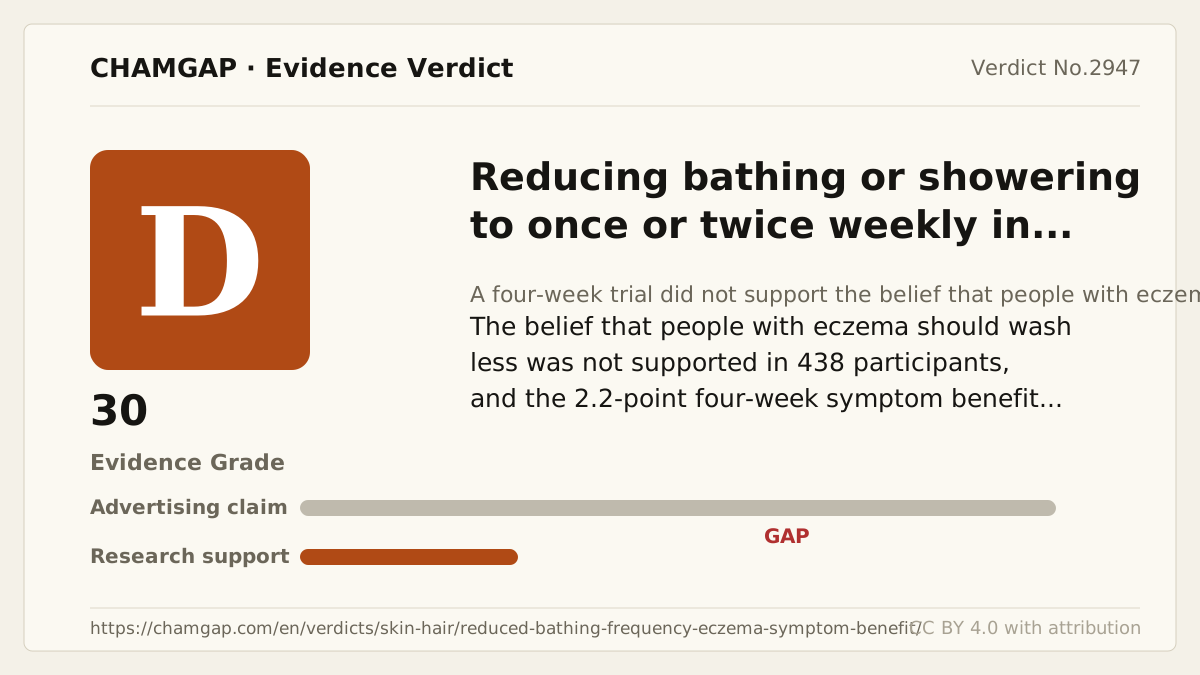
[Chamgap] No Benefit of Reducing Bathing or Showering for Eczema Symptoms — Evidence Grade D·30. 3 cited sources checked. Source: https://chamgap.com/en/verdicts/skin-hair/reduced-bathing-frequency-eczema-symptom-benefit/ · CC BY 4.0CC BY 4.0 — free to use with attribution; do not distort grades, numbers, or verdict meaning.
What this document does and does not do
Chamgap is an information source. It reports what research has and has not confirmed; it does not tell readers what to take or buy. That decision belongs to readers and, when needed, medical or legal professionals. This verdict reflects literature available up to the search date and may change as new research appears. Nothing here is medical advice.