
Redensyl scalp ampoules,
does it really help with Reduced hair loss and increased hair density?
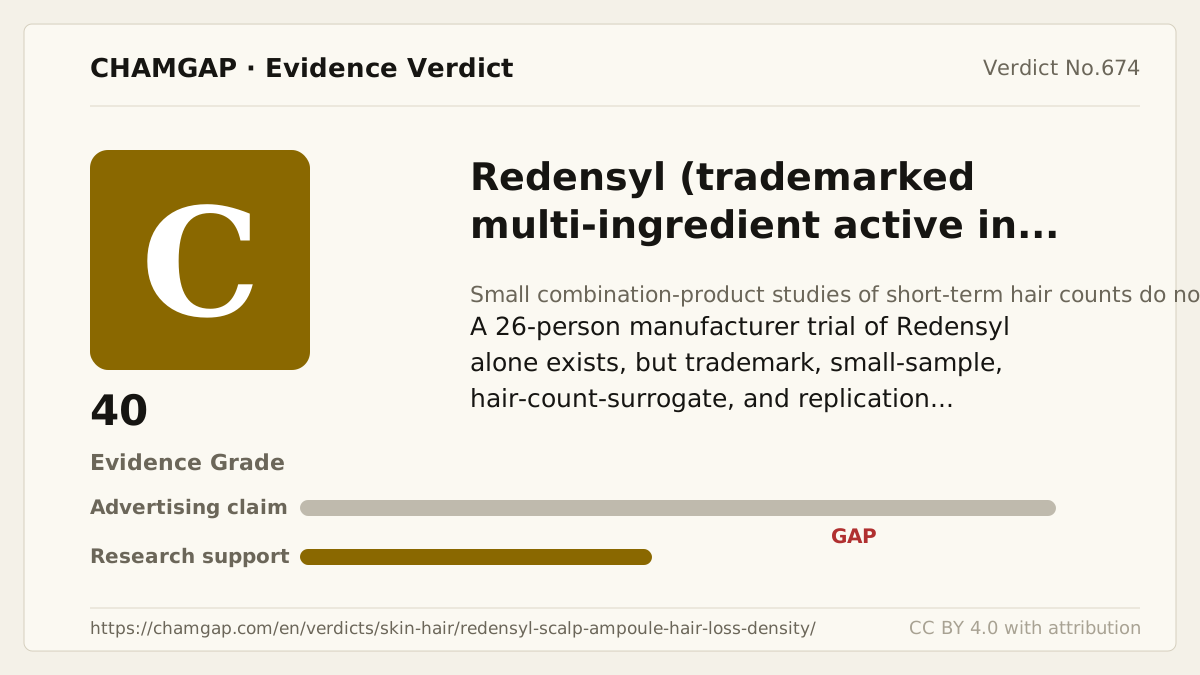
research showsRedensyl scalp ampoules are rated C for reducing hair loss and increasing hair density. A manufacturer-reported randomized double-blind placebo trial of 3% Redensyl alone in 26 participants over 84 days means the evidence is neither preclinical-only nor devoid of human research. However, it is not an independent peer-reviewed study and relies on a small-sample hair-count surrogate. The 44-person paper tested a Redensyl-plus-Sepicontrol A5 lotion, preventing attribution to Redensyl alone.
ads claimMarketing expands an 84-day hair-count change or results from a combination lotion into claims that Redensyl regenerates follicles and replaces minoxidil. A surrogate hair count over a limited scalp area is not the same as durable slowing of hair loss, visible improvement, or persistence after discontinuation.
Useful facts when choosing a product
- Redensyl is a trademarked mixture containing dihydroquercetin glucoside, epigallocatechin gallate glucoside, glycine, zinc chloride, and formulation components.
- Redensyl is not minoxidil, the GHK-Cu copper peptide, or pea extract, and it does not inherit clinical evidence for those ingredients.
- Scalp ampoules can contain other actives, preservatives, and fragrances; use should stop if stinging, itching, redness, or contact irritation occurs, and the full ingredient list should be checked.
Chamgap Semantic Classification Code
Candidate index · review held
UNK.redensyl.UNK.hair-loss-and-increased-hair-density.reduce.MULTIUnknown > Redensyl > Unknown > hair loss and increased hair density > Reduction claim > Multiple: primary unresolved
An automated migration candidate, not an issued permanent code; exact claim scope remains under review. This machine-generated migration candidate helps retrieval but is not a permanent assignment. The original verdict ID and URL remain authoritative.
What the research actually shows
Katoulis 2020 randomized 44 men and women with androgenetic alopecia to a lotion containing Redensyl plus Sepicontrol A5 or vehicle for 24 weeks, with 41 completing the study. Photographic and hair measures favored the active blend, but the study was small and single-blind and cannot attribute effects to Redensyl. A Givaudan technical file randomized 26 men to 3% Redensyl or placebo lotion for 84 days with phototrichogram measures over a limited scalp area; this was supplier material and did not establish long-term clinical control of alopecia. Bikash 2025 concluded that studies of Redensyl and similar cosmetic actives are mostly combination formulations with small samples, inadequate standard-treatment comparisons, nonuniform groups, and conflicts of interest.
Why this is classified as C (40)
C. A manufacturer-reported randomized double-blind placebo trial of 3% Redensyl alone in 26 participants over 84 days means a D based on absent human evidence would be excessive. Its lack of independent peer review, small sample, hair-count surrogate, and trademarked-ingredient context, plus non-attribution in the 44-person Redensyl-plus-Sepicontrol A5 paper, yield a bottom-of-band C with 40 points. Local irritation and formulation variability remain separate safety issues.
Counterpoint. Diagnosis should precede a cosmetic ampoule when the type of hair loss is unknown. Evidence-based care differs for androgenetic, alopecia areata, telogen, and scarring hair loss.
Rejudgment record. Reassessment (cross-check reflected) — Accepted the human signal from a manufacturer-reported randomized double-blind placebo trial of 3% Redensyl alone in 26 participants over 84 days, but applied a bottom-of-band C because it lacks independent peer review and large replication, relies on a hair-count surrogate, and the 44-person Redensyl-plus-Sepicontrol A5 paper prevents single-ingredient attribution
Sub-claim grades by effect
This ingredient is marketed for several effects. A single overall grade blends strong and weak claims together, so each effect is graded separately here. The overall grade reflects the strongest disconfirming or core claim.
| Effect (sub-claim) | Grade | Basis |
|---|---|---|
| Reduced hair loss and increased hair density | C | Evidence rests on a 26-person manufacturer study using a hair-count surrogate. |
| Single-ingredient attribution from the Redensyl-plus-Sepicontrol combination | ? | The 44-person trial tested a combination lotion, so single-ingredient attribution is impossible. |
| Independent peer review and large replication | ? | Independent replication and peer-reviewed evidence are absent. |
Cross-check — AI research and Codex final gate
Evidence Table
| Study | Design | Sample | Funding | Endpoint | Result | Weight |
|---|---|---|---|---|---|---|
| Katoulis AC et al. 2020 | Randomized single-blind vehicle-controlled trial | 44 participants with androgenetic alopecia randomized and 41 completed | Active-blend product study with limited conflict reporting | Twenty-four-week photography, hair growth, density, and quality of life | The active lotion improved some measures over vehicle, but it combined Redensyl and Sepicontrol A5 and cannot support single-ingredient attribution. | Small positive combination trial without single-ingredient attribution |
| Givaudan Redensyl Technical File 2014 | Supplier randomized double-blind placebo-controlled technical study | 26 men | Material from the Redensyl supplier | Eighty-four-day limited-area phototrichogram hair counts and anagen/telogen measures | A short-term hair-density signal was reported with a 3% lotion, but this was a supplier-funded small surrogate study. | Manufacturer technical material and surrogate evidence |
| Bikash C. 2025 | Review of alternative topical hair-loss actives | 24 relevant articles and technical files | No conflict of interest reported | Quality of clinical evidence for Redensyl and other cosmetic actives | Most studies involved mixtures and had small samples, inadequate comparison with standard therapy, nonuniform groups, and conflicts of interest. | Synthesis of evidence limitations |
Receipt — 3 References
All 3 cited sources were verified for existence at the original page (as of 2026-07-19).
Final verification and publication gate: Codex · Evidence date: 2026-07-19 · Corrections: none
Cite this verdict
[Chamgap] Redensyl scalp ampoules x reduced hair loss and increased hair density — Evidence Grade C·40. 3 cited sources checked. Source: https://chamgap.com/en/verdicts/skin-hair/redensyl-scalp-ampoule-hair-loss-density/ · CC BY 4.0CC BY 4.0 — free to use with attribution; do not distort grades, numbers, or verdict meaning.
What this document does and does not do
Chamgap is an information source. It reports what research has and has not confirmed; it does not tell readers what to take or buy. That decision belongs to readers and, when needed, medical or legal professionals. This verdict reflects literature available up to the search date and may change as new research appears. Nothing here is medical advice.