
Peppermint essential oil,
does it really help with Topical promotion of hair regrowth in androgenetic alopecia?
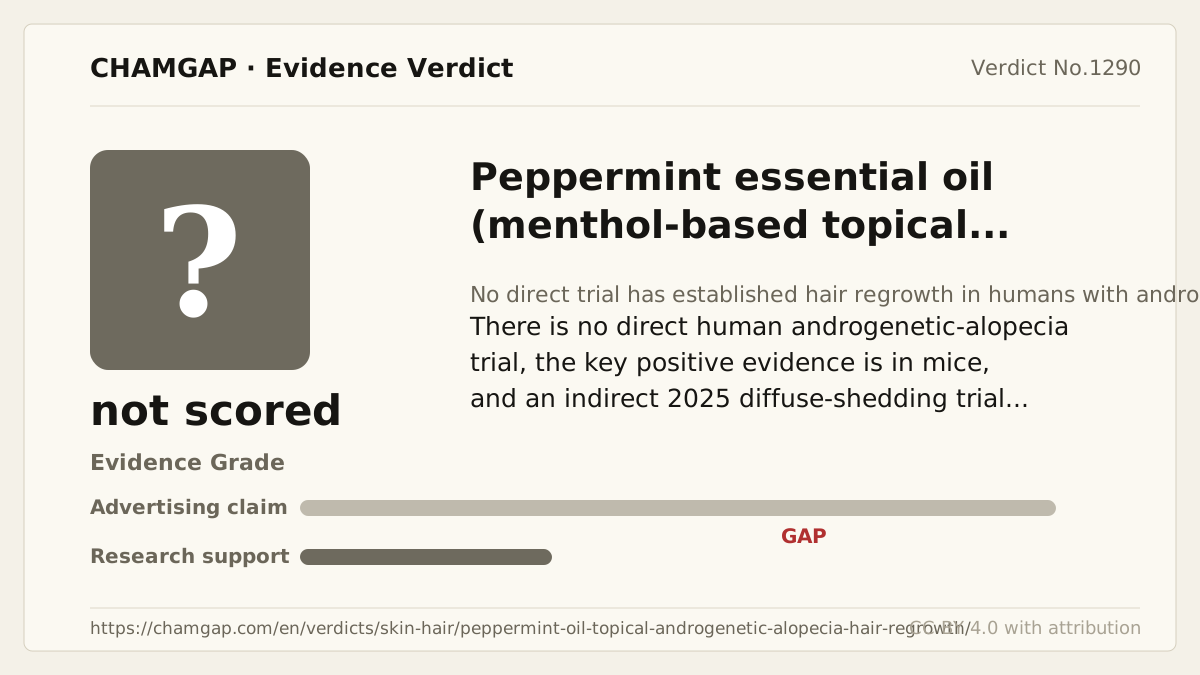
research showsPeppermint essential oil is rated unknown for hair regrowth in androgenetic alopecia. The widely cited positive study was not a human alopecia trial; it applied 3% peppermint oil to C57BL/6 mice for four weeks and found increases in hair growth, follicle number, and follicle depth. A 2024 review of natural alternatives for androgenetic alopecia explicitly found no human study of peppermint oil for this indication. A newer 2025 one-month trial in 60 young women with diffuse hair shedding did not enroll patients diagnosed with androgenetic alopecia, and hair counts did not differ significantly between peppermint-plus-coconut-oil massage and coconut-oil massage. Because no direct human efficacy trial addresses the claimed indication, the grade is unknown rather than D and the score is null.
ads claimMarketing says peppermint is a natural regrowth treatment 92% stronger than minoxidil, awakens dead follicles through blood flow, or reverses DHT-related hair loss without adverse effects by presenting a mouse skin-growth area as a human regrowth percentage. The 92% figure was an observed area on mouse skin, not a percentage increase in human hair count, and no direct human androgenetic-alopecia trial exists.
Useful facts when choosing a product
- Peppermint essential oil is a concentrated aromatic ingredient containing menthol, menthone, and related compounds. Scalp cosmetics mix it with carrier oils, alcohol, surfactants, or other ingredients, so both peppermint concentration and the whole formulation matter.
- Applying undiluted essential oil can cause burning, redness, irritant dermatitis, or allergic contact dermatitis. Follow product dilution instructions, patch test a small area, and avoid eyes, mucous membranes, and broken skin.
- A cooling sensation or temporary itch relief is not reversal of follicular miniaturization or creation of new hair. Results from products combining coconut oil, massage, or other botanicals cannot be assigned to peppermint alone.
- Early diagnosis and sustained treatment matter in androgenetic alopecia. Sudden diffuse shedding, patchy loss, inflammation or scarring, or symptoms suggesting anemia or thyroid disease warrant evaluation rather than delay with an oil.
Chamgap Semantic Classification Code
Candidate index · review held
S.peppermint-essential-oil.topical-skin.topical-promotion-of-hair-regrowth-in-androgenetic-alopecia.assess.placeboSupplements and nutraceuticals > Peppermint essential oil > Topical skin > Topical promotion of hair regrowth in androgenetic alopecia > Association or change assessment > Placebo
An automated migration candidate, not an issued permanent code; exact claim scope remains under review. This machine-generated migration candidate helps retrieval but is not a permanent assignment. The original verdict ID and URL remain authoritative.
What the research actually shows
Oh 2014 treated groups of five C57BL/6 mice for four weeks and measured visible hair growth, histology, alkaline-phosphatase activity, and IGF-1 expression. Peppermint oil accelerated anagen and improved follicular measures, but no patient with alopecia was studied. A 2024 review of natural ingredients for androgenetic alopecia reported no human study evaluating peppermint oil for hair growth or treatment of the condition. Malarvizhi 2025 randomized 60 women with a mean age of 20.5 years to massage with 1 mL peppermint oil plus 5 mL coconut oil or coconut oil alone three times weekly for one month. The study did not diagnose androgenetic alopecia, lacked participant masking and an evidence-based sample-size calculation, and found no significant between-group hair-count difference despite selected within-group hair-count and itch changes. A six- to twelve-month placebo-controlled trial measuring hair count, shaft diameter, and standardized photographs in diagnosed androgenetic alopecia is still needed.
Why this is classified as ?
The pivotal positive evidence is a four-week C57BL/6 mouse study, and a 2024 review confirmed the absence of a human androgenetic-alopecia trial. A 2025 one-month indirect trial in 60 women with diffuse shedding neither studied diagnosed androgenetic alopecia nor found a significant between-group hair-count benefit versus coconut oil. Direct human efficacy literature for the claimed androgenetic-alopecia regrowth outcome is absent, so the unknown-versus-D rule gives unknown and a null score.
Counterpoint. Using a diluted product for fragrance or cooling is separate from claiming treatment of androgenetic alopecia. For regrowth, establish the diagnosis and prioritize treatments supported by human trials; if peppermint is used, keep it at the level of an adjunctive cosmetic and monitor for irritation.
Rejudgment record. Cross-check applied — Applied the unknown rule because positive evidence remains a C57BL/6 mouse study, a 2024 review confirmed no human androgenetic-alopecia trial, and a 2025 indirect diffuse-shedding study neither enrolled diagnosed androgenetic alopecia nor found a significant between-group hair-count benefit
Sub-claim grades by effect
This ingredient is marketed for several effects. A single overall grade blends strong and weak claims together, so each effect is graded separately here. The overall grade reflects the strongest disconfirming or core claim.
| Effect (sub-claim) | Grade | Basis |
|---|---|---|
| Promotion of hair regrowth in androgenetic alopecia | ? | The human trial tested peppermint plus coconut oil and massage in young women with diffuse shedding, not androgenetic alopecia, so it cannot be attributed as ingredient-specific evidence for peppermint alone in androgenetic alopecia. |
| Increased hair count in male or female pattern hair loss | ? | No human trial of peppermint alone comparing standardized hair counts in diagnosed pattern hair loss was identified. |
| Reversal of androgen-driven follicular miniaturization | ? | Neither the C57BL/6 coat-cycle experiment nor the 2025 diffuse-shedding trial assessed reversal of human androgenetic miniaturization. |
Cross-check — AI research and Codex final gate
Evidence Table
| Study | Design | Sample | Funding | Endpoint | Result | Weight |
|---|---|---|---|---|---|---|
| Oh JY et al. 2014 | Randomized topical-application experiment in C57BL/6 mice | 20 mice; five per group | Inadequately reported | Four-week hair-growth area, dermal and follicular histology, alkaline phosphatase, and IGF-1 | Three-percent peppermint oil accelerated anagen and increased follicle number and depth, dermal thickness, alkaline phosphatase, and IGF-1 in mice. | Positive preclinical evidence not directly applicable to human androgenetic alopecia |
| Bin Rubaian NF et al. 2024 | Narrative review of natural alternatives for androgenetic alopecia | Literature on peppermint, rosemary, and other natural ingredients | Authors reported no conflicts of interest | Availability of human hair-growth and treatment evidence in androgenetic alopecia | The review explicitly reported no human study evaluating peppermint oil for hair growth or treatment of androgenetic alopecia. | Evidence-gap confirmation for direct human efficacy |
| Malarvizhi S et al. 2025 | One-month parallel-group randomized controlled trial | 60 young women reporting excessive diffuse hair shedding | No funding and no conflicts stated | Frontal, mid-pattern, and vertex hair counts, itch, and a women's hair-growth questionnaire | Selected within-group changes occurred with peppermint plus coconut oil, but objective hair counts did not differ significantly from coconut oil and participants were not diagnosed with androgenetic alopecia. | Indirect null human evidence that does not fill the androgenetic-alopecia gap |
Receipt — 3 References
All 3 cited sources were verified for existence at the original page (as of 2026-07-24).
Final verification and publication gate: Codex · Evidence date: 2026-07-24 · Corrections: none
Cite this verdict
[Chamgap] Peppermint essential oil x hair regrowth in androgenetic alopecia — Evidence Grade ?. 3 cited sources checked. Source: https://chamgap.com/en/verdicts/skin-hair/peppermint-oil-topical-androgenetic-alopecia-hair-regrowth/ · CC BY 4.0CC BY 4.0 — free to use with attribution; do not distort grades, numbers, or verdict meaning.
What this document does and does not do
Chamgap is an information source. It reports what research has and has not confirmed; it does not tell readers what to take or buy. That decision belongs to readers and, when needed, medical or legal professionals. This verdict reflects literature available up to the search date and may change as new research appears. Nothing here is medical advice.