
PEG feeding tube,
does it really help with Prevention of new pressure ulcers or improved healing of existing pressure ulcers?
research showsThe grade is D. In a national propensity-matched cohort, new stage 2 or higher pressure ulcers occurred in 35.6% with PEG versus 19.8% without PEG, adjusted OR 2.27 (95% CI 1.95-2.65). Existing ulcers improved in 27.1% versus 34.6%, adjusted OR 0.70 (0.55-0.89), again not favoring PEG. Because this was not randomized and residual confounding remains possible, the result gives D with 34 points.
ads claimDelivering nutrition through a tube is a fact about route of feeding; it does not establish fewer or faster-healing pressure ulcers. In this population, comparative data showed no preventive or healing benefit and pointed in the opposite direction.
Useful facts when choosing a product
- PEG places a tube through the abdominal wall into the stomach to deliver enteral nutrition.
- The new-ulcer endpoint was stage 2 or higher, and healing was assessed at the first posthospital Minimum Data Set assessment.
- Propensity matching balances measured variables but cannot remove unmeasured differences in severity or treatment selection.
- No duplicate PEG-advanced-dementia-pressure-ulcer verdict or reuse of PMID 22782196 or DOI 10.1001/archinternmed.2012.1200 was found in the existing list.
Chamgap Semantic Classification Code
Candidate index · review held
P.percutaneous-endoscopic-gastrostomy-feeding-in-advanced-dementia.transdermal.new-pressure-ulcers-or-improved-healing-of-existing-pressure-ulcers.prevent.UNKProcedures, devices and tests > Percutaneous endoscopic gastrostomy feeding in advanced dementia > Transdermal > new pressure ulcers or improved healing of existing pressure ulcers > Occurrence-prevention claim > Unknown
An automated migration candidate, not an issued permanent code; exact claim scope remains under review. This machine-generated migration candidate helps retrieval but is not a permanent assignment. The original verdict ID and URL remain authoritative.
What the research actually shows
Teno and colleagues linked eight years of US Minimum Data Set assessments with Medicare claims in a propensity-score-matched observational cohort, not an RCT, matching nursing-home residents with advanced cognitive impairment who received PEG during hospitalization to three controls. The new-ulcer analysis included 1,124 PEG recipients and 2,082 unique controls; reuse of controls and one-third weighting produced an analytic weight of 1,124 per group. The healing analysis used a weighted 461 per group. Adjustment covered age, sex, race, marital status, education, advance directives, DNR/DNH orders, 19 conditions, dehydration, fever, weight loss, swallowing or chewing problems, wound infection, intake, BMI, ADL, ADEPT, and CHESS. Mean time to the first posthospital assessment was 24.6 days. There was no random assignment or trial registration, unmeasured confounding remained possible, and the US National Institute on Aging funded the study.
Why this is classified as D (34)
Hard ulcer-incidence and healing outcomes did not favor PEG and showed statistically significant adjusted adverse associations. However, the evidence is one publicly funded propensity-matched observational cohort with unavoidable residual confounding, so it was not elevated to repeated refutation and receives D with 34 points.
Counterpoint. This verdict is limited to prevention and healing of pressure ulcers in nursing-home residents with advanced dementia. Short-term nutrition in other diseases, medication access, and decompression are separate PEG indications.
Rejudgment record. Cross-check applied — We directly checked unique and weighted sample sizes, absolute rates, adjusted odds ratios, funding, and the residual-confounding limitation in both propensity-matched analyses.
| Endpoint | H | Hard endpoint - actual events such as death |
| Replication | R1 | Single confirmatory trial |
| Independence | I2 | Decisive evidence is publicly or non-profit funded |
| Effect size | E- | Harm increased in the trials |
| Precision | C0 | The confidence interval leaves room for benefit |
The stored derived grade is B while the verdict assigns D. A single nonrandomized propensity-matched cohort cannot remove unmeasured severity and treatment-selection confounding, so its adjusted adverse associations were not treated as confirmatory evidence and the grade was lowered.
Sub-claim grades by effect
This ingredient is marketed for several effects. A single overall grade blends strong and weak claims together, so each effect is graded separately here. The overall grade reflects the strongest disconfirming or core claim.
| Effect (sub-claim) | Grade | Basis |
|---|---|---|
| PEG prevents new pressure ulcers in advanced dementia. | D | New ulcers were more common with PEG, 35.6% versus 19.8%, and the adjusted adverse association remained, with residual confounding in this observational study. |
| PEG improves healing of existing pressure ulcers in advanced dementia. | D | Improvement was 27.1% versus 34.6% and did not favor PEG. |
Cross-check — AI research and Codex final gate
Evidence Table
| Study | Design | Sample | Funding | Endpoint | Result | Weight |
|---|---|---|---|---|---|---|
| Teno et al., Archives of Internal Medicine 2012 | National propensity-score-matched cohort using claims and nursing-home assessment data | New ulcers: 1,124 PEG recipients and 2,082 unique controls, weighted to 1,124 per group; healing: weighted 461 per group | US National Institute on Aging grant ARRA 1RC1AG036418-01 | New stage 2 or higher pressure ulcer and improvement of an existing ulcer | New ulcers 35.6% versus 19.8%, adjusted OR 2.27 (95% CI 1.95-2.65); improvement 27.1% versus 34.6%, adjusted OR 0.70 (0.55-0.89) | Only direct comparative evidence; nonrandomized with residual confounding |
Receipt — 1 References
All 1 cited sources were verified for existence at the original page (as of 2026-08-14).
Final verification and publication gate: Codex · Evidence date: 2026-08-14 · Corrections: none
Cite this verdict
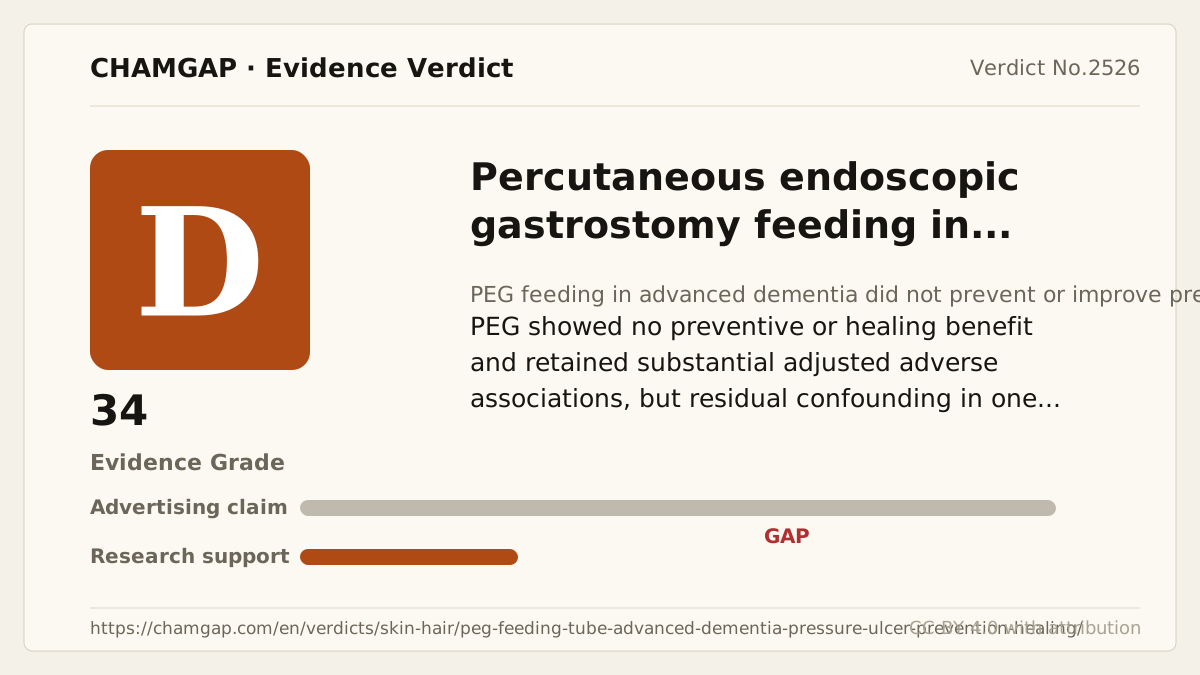
[Chamgap] PEG feeding tube x pressure-ulcer prevention and healing in advanced dementia — Evidence Grade D·34. 1 cited sources checked. Source: https://chamgap.com/en/verdicts/skin-hair/peg-feeding-tube-advanced-dementia-pressure-ulcer-prevention-healing/ · CC BY 4.0CC BY 4.0 — free to use with attribution; do not distort grades, numbers, or verdict meaning.
What this document does and does not do
Chamgap is an information source. It reports what research has and has not confirmed; it does not tell readers what to take or buy. That decision belongs to readers and, when needed, medical or legal professionals. This verdict reflects literature available up to the search date and may change as new research appears. Nothing here is medical advice.