
Oral single-active biotin and atopic dermatitis severity
research showsThe accessed evidence does not establish the size of an oral single-active biotin effect on atopic dermatitis severity relative to a comparator. An oral pediatric case-report record with low biotinidase activity exists, so universal absence of human studies is not claimed. Unverified composition, diagnosis, comparison and severity data do not establish zero effect or equivalence.
ads claimNo specific product advertisement was verified. Improvement in deficiency dermatitis, blood concentrations or topical findings must not be promoted as general atopic dermatitis severity benefit or replacement of standard treatment.
Four separate assessment dimensions
| Effect direction and size | The accessed evidence does not establish the size of an oral single-active biotin effect on atopic dermatitis severity relative to a comparator. An oral pediatric case-report record with low biotinidase activity exists, so universal absence of human studies is not claimed. Unverified composition, diagnosis, comparison and severity data do not establish zero effect or equivalence. |
|---|---|
| Evidence certainty | Precision, methods and independent replication of a direct comparison remain unverified. No formal GRADE certainty rating was invented. |
| Applicability | The low-enzyme-activity pediatric report is not generalized to biotin-replete children or adults; topical exposure, deficiency/metabolic disease and other endpoints are separated. |
| Safety | Caution: adverse-event and withdrawal denominators and time windows, long-term or high-dose exposure and special-population safety in atopic dermatitis remain unverified. Some susceptible immunoassays can be affected according to exposure, platform, reagent and sampling time. This is not a universal claim about all tests or a personal interruption or treatment-change instruction. The existing 3106 assessment is unchanged. |
? / null is an explicitly unscored state because the supplied rules and original calculator cannot fully encode this evidence state without fabrication. The raw C returned before validation was rejected because replication and bias are invalid required axes. This is not the no-human-study gate, zero points or a new scoring system.
Useful facts when choosing a product
- This page addresses oral biotin as the sole additional active ingredient.
- The S01 title explicitly describes oral biotin treatment in children.
- The actual molecular form, sole-active composition, active dose, total intake and formulation in S01 were not verified.
- Results for topical ointments or combination products are not transferred to this oral sole-active ingredient.
Chamgap Semantic Classification Code
Permanent code issued
S.biotin-sole-added-active-ad.oral.diagnosed-atopic-dermatitis-age-deficiency-separated.defined-time-ad-severity-comparison.oral-biotin-ad-actual-comparator-unverifiedSupplements and nutraceuticals > Biotin as the sole added active ingredient in the question > Clinically diagnosed atopic dermatitis, separating children, adolescents, adults and deficiency states. S01 names children with low biotinidase activity; exact diagnostic, age and deficiency criteria are unverified. > Severity at a defined time using EASI, SCORAD or another verified instrument is the question. The actual S01 instrument, units, values and registered primary endpoint remain unverified. > Separate actual matched-background placebo, no-biotin, usual-care and active comparisons. The actual S01 comparator is unverified. > Oral, explicitly stated in the S01 title; topical and injectable routes are separate.
Original declared policy gap, ?/null, submitted axes, human report existence, Caution and whole bilingual reports preserved. The code identifies the intervention and claim; it never contains the evidence grade, score, or safety result.
Exact Claim Classification
These independent facets prevent evidence from different forms, routes, populations, effects, and comparators from being mixed.
| Intervention class | S · Supplement or nutraceutical |
|---|---|
| Canonical ingredient or intervention | Biotin as the sole added active ingredient in the question |
| Source or part used | Unverified manufacturing source, material and exact chemical form; food and diet results are separate. |
| Formulation or processing | The question concerns a single-active oral product; actual purity, tablet/capsule, excipients and co-active ingredients in S01 are unverified. |
| Route | Oral, explicitly stated in the S01 title; topical and injectable routes are separate. |
| Dose | Unverified active dose, frequency and total dietary plus supplemental intake for an eligible product. |
| Duration | Unverified oral exposure duration and defined severity evaluation time. |
| Population | Clinically diagnosed atopic dermatitis, separating children, adolescents, adults and deficiency states. S01 names children with low biotinidase activity; exact diagnostic, age and deficiency criteria are unverified. |
| Effect or condition | Comparative effect on atopic dermatitis severity |
| Primary endpoint | Severity at a defined time using EASI, SCORAD or another verified instrument is the question. The actual S01 instrument, units, values and registered primary endpoint remain unverified. |
| Comparator | Separate actual matched-background placebo, no-biotin, usual-care and active comparisons. The actual S01 comparator is unverified. |
| Duplicate-detection key | biotin|sole-added-active-oral|diagnosed-atopic-dermatitis|age-deficiency-separated|defined-time-severity|actual-matched-background-comparator-unverified |
What the research actually shows
# Oral single-active biotin and atopic dermatitis severity
**TASK-1037 / R01-077 · Final research report within a declared scope · 2026-09-17**
The supplied input snapshot is dated **2026-09-17T13:56:16+09:00**. External literature was checked on **2026-09-17**. The snapshot is not assumed to be identical to the live site at a later time. This report does not evaluate a particular advertisement and does not prescribe a personal dose or a treatment change.
## 1. The reader answer
**The accessed evidence does not establish how much oral biotin, as the sole added active ingredient, improves atopic dermatitis severity relative to a comparator.** Human evidence is not wholly absent: an actual 1988 case-report record describes oral treatment in children with atopic dermatitis and low biotinidase activity, with a favorable assertion in its title. However, neither an abstract nor the full article was available through the accessed bibliographic and publisher pages. Sole-active composition, diagnostic criteria, comparison, severity instrument, denominators and effect estimates could not be verified. [S01]
The existence and favorable title of that report have been retained. They have not been converted into an EASI or SCORAD improvement, a general treatment success rate or a causal estimate. **The conclusion is not zero effect, equivalence to placebo, universal absence of human studies or verified safety.** The low-enzyme-activity pediatric report is not pooled with presumed effects in biotin-replete children or adults. This conclusion is restricted to the declared search and access scope.
The current efficacy display is **`?` with score `null`, meaning unscored**. Here, `?` denotes a disclosed representation gap between the evidence state and the supplied calculator, not the `no_human_study=true` gate and not a score of zero. **Safety is Caution. Document quality is A, self-assessed**, separately from efficacy. The result is `completed_with_uncertainty`; content is `ready_with_uncertainty`. Technical handling of the unsupported legacy scoring state and assignment of publication identity remain distinct from clinical content completion. They are not a request for another clinical investigation.
## 2. Duplicate boundaries and exact reuse
All **3,152 supplied index records** were parsed and searched. The full supplied originals for **009, 866, 1639, 3103, 3104, 3105 and 3106** were read and compared. The biotin-name search identified those seven records. An expanded atopic-dermatitis/eczema search also identified 18 records for other ingredients or management approaches. Those additional records were available only as index entries; their absent full originals were not claimed to have been read. [Input: index and original records.]
| Existing ID | Completed claim | Boundary relative to this task | |---|---|---| | 009 | Hair loss and hair growth | Hair outcomes are not atopic dermatitis severity. Mentioning deficiency-related skin symptoms does not make the treatment claim identical. | | 866 | Brittle nail thickness and hardness | Nail structure and dermatitis symptoms are separate endpoints. | | 1639 | Disability and walking in progressive multiple sclerosis | The diagnosis, treatment target and high-dose context concern neurologic efficacy. | | 3103 | Non-vellus hair density in adult androgenetic alopecia | Ingredient and route overlap, but the population and endpoint differ. | | 3104 | Breakage frequency in adult brittle nails | Repeated nail-breakage events define a different comparison. | | 3105 | HbA1c in adults with type 2 diabetes | The same oral ingredient does not make this the same clinical claim. | | 3106 | Falsely low TSH with specific immunoassays | Analytical interference is separate from clinical skin efficacy. Only the safety map is reused. |
The operation is therefore **`new`**: no exactly matching completed claim was identified in the supplied scope. Candidate presence or absence alone was not used as proof of novelty. Existing efficacy and safety grades were not changed, and completed reports were not retranslated. The existing warning assessment for 3106 remains unchanged. Each original `ko/en.what_research` string is preserved exactly in `what_research_original.json`, together with its UTF-8 byte identity and source identity.
Completed pantothenic-acid, B6 and task 72–76 materials were used for provenance and handoff-state comparison, not repeated clinical investigation. The previous five completed tasks are not the same as the three completed tasks, 74, 75 and 76, in this chat. For task 76, the delivered alias `research_report.md` was matched to the original `research_report_ko.md` using the rotation record and original manifest hash; it was not treated as a new report. Historical unassigned-ID and pre-deployment manifests remain unchanged. Later completion is recorded separately from the supplied rotation and deployment receipts. No new site HTTP checks or deployment were performed in this task.
## 3. The question is not a set of verified study facts
The boundary is **biotin as the sole additional active ingredient → oral administration → clinically diagnosed atopic dermatitis → separate age and deficiency strata → severity at a defined time → the actual comparator**. Manufacturing source, stereochemical form, salt, purity, tablet or capsule, dose and duration are not established by the task proposal. An unspecified product called biotin is not automatically documented D-biotin of known active content or sole-active composition.
Validated severity instruments such as EASI or SCORAD are the preferred target, but the registered primary endpoint and this page's question must remain distinct. Pruritus, quality of life, flares, steroid use and circulating biotin are separate outcomes, not interchangeable severity scores. Within-group improvement, incremental benefit above the same background treatment and replacement of standard treatment are different claims. An appropriate design with identical background treatment and biotin as the only between-arm difference could evaluate an incremental effect; the actual design must establish those conditions.
Biotin-deficiency dermatitis, biotinidase deficiency, holocarboxylase synthetase deficiency and other metabolic disorders, other eczema or seborrheic dermatitis, and hair or nail outcomes are not pooled with confirmed atopic dermatitis. A statement of low enzyme activity does not by itself confirm an inherited enzyme defect or nutritional biotin deficiency. [S01, S03, S04; interpretation boundary.]
## 4. Study-level evidence
| Source | What was actually verified | Use for this question | Important information not verified | |---|---|---|---| | **S01: Iikura et al., 1988** | A pediatric oral-treatment case-report record whose title specifies atopic dermatitis and low biotinidase activity. PubMed and publisher metadata were accessible; the abstract and article were not. | Retain the existence of a human oral-treatment report and its favorable title. Do not treat it as a verified between-group severity estimate. | Diagnostic and deficiency tests, individual ages and counts, sole-active formulation, dose, duration, adherence, comparator, background therapy, severity values, CI and safety. | | **S02: Makino et al., 1999** | The primary abstract describes 20 atopic dermatitis patients and 11 healthy volunteers, **topical** biotin ointment and serum absorption. Patients also used steroid ointment. | Exclude from the oral sole-active severity effect because route, biomarker target and background treatment differ. | Age-specific analyses and the target severity effect, timing and precision were not verified. Mean age does not establish an adult-only trial. | | **S03: Seymons et al., 2004** | A four-year-old girl's dermatologic presentation associated with biotin deficiency and multiple carboxylase deficiency, described in an accessible abstract. | Do not transfer improvement in a deficiency/metabolic disorder to atopic dermatitis efficacy. | This is not a confirmed atopic dermatitis comparison. Route, dose and duration are not filled in from assumption. | | **S04: Oizumi et al., 1987** | A letter on partial biotinidase-activity deficiency, without an abstract; seborrheic-dermatitis indexing and overlapping authors with S01. | Do not count it as a separate atopic dermatitis treatment cohort or independent replication. | Participant overlap, independence, an actual atopic dermatitis population, intervention and severity comparison remain unresolved. |
The official publication date of S01 is **September 1988**. Later database or indexing dates encountered during searching were not treated as a new study date. The first-author spelling variant between the publisher and PubMed is associated with the same DOI and was not counted as another study. The publisher PDF route did not yield the full PDF; access to a landing page was not described as full-text review. A later paper citing S01 does not add independent replication. [S01, S04]
## 5. Actual exposure, deficiency, age and missing information
For S01, the verified title-level facts are pediatric population, atopic dermatitis, low enzyme activity and oral biotin treatment. Baseline severity, diagnostic instrument, biotin or enzyme assay and thresholds, genetic confirmation, nutrition and diet, manufacturing source, exact molecular form, sole-active composition, excipients, active dose, total intake, frequency, exposure duration and evaluation time remain **`null` with an access-specific reason**. This does not assert that those details are absent everywhere in the original article.
Actual counts by pediatric age stratum were not verified, and the report is not generalized to adults. No directly eligible severity comparison in biotin-replete children or adults was verified within the search scope, but universal absence in those populations is not asserted. The mean ages of 20.5 years in the atopic dermatitis group and 25.5 years in healthy volunteers in S02 do not establish the age distribution, adult-only enrollment or an oral effect. [S02]
S02's abstract describes application of 7 g/day of 0.3% biotin ointment and, for patients, 1–4 g/day of steroid ointment. These are **topical application details used to explain exclusion**, not oral doses, absorbed quantities or personal recommendations. Healthy volunteers were not reclassified as an atopic dermatitis placebo arm, and effects of differing background treatments were not attributed solely to biotin. [S02]
Background standard therapy, treatment changes, adherence, renal and hepatic function, pregnancy and other special circumstances in S01 were not verified. Unreported supplement use was not converted into no supplementation; unreported deficiency into normal status; or unreported medication into no medication. Existing medication and assay-safety information was reused only to the extent needed for this question. [S05; application limits.]
## 6. Severity, comparison and numerical verification
**The table of directly eligible numerical effects is empty.** An empty table does not mean zero effect. The actual severity instrument, units, baseline and final values, within-group changes, adjusted between-group effects, SD, SE, CI and test statistics for S01 were not accessible. No EASI or SCORAD value, response percentage, standardized effect, p value or NNT was reconstructed. Randomized, analyzed, completed, withdrawn and missing counts; ITT or as-treated analysis; and crossover, paired or clustered structure were not established. None was manufactured as a study fact.
Registered primary, secondary and post hoc endpoints, multiplicity, responder definitions, MCID and time-specific clinical importance remain unverified. An individual response threshold is not a between-group minimum difference. General EASI or SCORAD conventions were not attached to a report with no verified use of those instruments. A missing confidence interval cannot establish equivalence or exclusion of a clinically meaningful benefit.
Serum biotin in S02 remains an absorption outcome. A blood concentration change does not automatically establish clinical severity improvement. Deficiency-related improvement in S03 and the letter in S04 were not pooled as second and third independent replications of S01. People, assays, lesions and repeated measurements were not interchanged as denominators.
`study_extraction.json` provides 76 fields for each of four records, with values, status and reasons in both languages. `inaccessible` means the accessed bibliographic material could not establish a value. `not_reported` is restricted to **the abstract accessed in this task**, not the unseen full article. A `not_applicable` calculation means it was not performed without eligible inputs; it does not mean a numerical result of zero.
## 7. Contrary evidence, uncertainty and the search scope
S01's favorable title was not hidden or rewritten as an unfavorable result. Its inability, in the accessed form, to establish a causal effect size or broad applicability was retained alongside that positive signal. No quantitatively verified negative or null controlled oral single-active biotin severity result was identified in this scope either. That is not a universal statement that contrary or unpublished results do not exist.
On 2026-09-17, **46 actual search queries** were executed. They included English, Korean and Japanese biotin/atopic-dermatitis/severity terms; age and deficiency terms; EASI and SCORAD; randomized and placebo terms; exact titles and DOI; trial-registration searches; and correction or retraction terms. This was web searching plus accessible PubMed, publisher and official-source review, not an exhaustive systematic search of every bibliographic database. The full query log is in `search_log.json`.
Direct ClinicalTrials.gov search-page and API requests failed. Subscription Embase, a full CENTRAL export, Ichushi, a complete WHO ICTRP search, author correspondence and individual participant data acquisition were not performed. Limitations include the lack of abstracts and full text for S01 and S04, the verification gate blocking a 2023 retrospective dermatology biotin-testing article (L01), and a biotin-binding-immunoglobulin search lead without a verified article URL (L02). Sample sizes or doses stated in secondary sources or root-page snippets were not promoted to primary-verified numbers. An additional treatment cohort was not confirmed from those leads.
No specific correction or retraction notice was identified on the accessed PubMed and publisher pages or through the targeted queries. A complete Crossmark or journal-archive audit is not claimed, and permanent absence of a notice is not guaranteed. Two linked pages for one paper were not counted as two independent reviews.
## 8. Supplied efficacy rules and the actual calculator run
The supplied rubric and the unchanged original calculator were applied. No new scoring engine or alternative definition of the A–F grades was invented.
| Item | Actual input or decision | Reason | |---|---|---| | Claim | `claim_type=B` | This is a clinical efficacy question. | | Endpoint | `endpoint=P` | This classifies the page's symptom/severity treatment target; it does not establish a specific instrument in S01. | | Human evidence | `no_human_study=false` | An actual oral pediatric atopic dermatitis case-report record exists. | | Replication | `replication=null` | R1 means a single **confirmatory trial**. A metadata-level case report cannot truthfully be encoded as R1, R2, R0, RX or RE. | | Independence | `independence=I1` | This is the supplied Case 29 fallback for unverified funding, not proof of mixed sponsorship or independent work. | | Magnitude | `effect=EX` | There are no recoverable inputs for between-group magnitude, dispersion or a test statistic. Missing MCID alone was not the reason. | | Bias | `bias=null` | The inaccessible methods do not permit a count of particular avoidable defects. Neither B0 nor an invented B2 is assigned. | | Precision | `precision=CX` | The target comparison CI could not be verified. |
Calling the original `derive_grade` function without prior validation returns **C**. However, the same calculator's `validate_axes` and `check_verdict` return **two required-axis errors: replication and bias**. The direct derivation function does not first validate missing values. Therefore, its raw C is not accepted as a valid finalized grade. Actual inputs, errors, output and the unchanged source-code SHA are preserved in `grading_calculator_result.json`.
The rubric's discussion of the missing replication code for observational evidence, lines 481–487, already recognizes this representation gap. Its suggested effect/bias correction applies when actual magnitude and defects can be assessed; those inputs also remain unavailable here. Section 5 of the current handoff prompt and the TASK-1037-specific contract permit a disclosed **unscored `? / null`** completion for a rule/code support gap. No fixed score anchor was selected. A universal absence flag, fabricated axis or zero score was not inserted to pass a technical gate.
This is not a deferred clinical investigation. The supported conclusion, limitations and revision conditions are complete. Handling of this state in the legacy publication engine is separately marked `needs_format_mapping`, without requesting new clinical research or grading from Codex. Publication identity is separately `needs_id_assignment`.
## 9. Safety and laboratory interference
**Safety label: Caution.** For the atopic dermatitis patients in S01, adverse-event collection, time window, arm denominators, events, withdrawals and long-term safety were not verified. Those gaps were not converted into no adverse events. Benefits and risks for high-dose use, pregnancy, children, renal or hepatic impairment and concomitant medication cannot be settled by that record.
The existing 3106 assay-interference map was reused, with a bounded check of the relevant NIH and FDA official explanations. Some biotin-streptavidin-based immunoassays may be affected according to exposure, sampling time, platform and reagent characteristics. The FDA describes falsely low results with certain troponin assays. The claim is not that every test, device or exposure is affected in the same direction or to the same extent. [S05, S06]
The absence of a tolerable upper intake level is not a guarantee of unlimited safety. General communication of supplement product, dose and recent exposure to clinical and laboratory staff differs from prescribing a personal interruption interval or changing treatment. This report gives no universal stopping interval. Clinical EASI or SCORAD assessments are not treated as susceptible immunoassay results, and a blood marker change alone is not sufficient proof of skin-treatment efficacy. [S05, S06; interpretation boundary.]
## 10. Classification, completion and revision conditions
Classification is **kind=S, category=skin-hair, domain=NUT and research field=R01**. R01 and TASK numbers are not permanent site IDs or semantic codes. Manufacturing source, source part and exact molecular form have no verified values; missing codebook details were not inferred. ID, site ID, slug, URL, first publication time and permanent or semantic codes remain **unassigned `null`**.
The result is `completed_with_uncertainty`, content is `ready_with_uncertainty`, and content verification is `completed_with_declared_scope`. **Document quality A** is a self-assessment of source traceability, numerical handling, boundaries, uncertainty, bilingual completeness and format within the requested scope; it is not the efficacy grade. `editorial_review.version=1.0`, `independent_review=false`, and the verification date is **2026-09-17**. Initial `corrections=[]` is separate from the pre-submission revision and review audit.
Revision conditions include access to the S01 full article, formulation or original data; verified diagnosis, deficiency state and age-specific denominators; an eligible matched-background comparator with a defined severity instrument, time point and CI; unpublished results, new comparative studies, corrections, retractions or classification-boundary changes; and formal support for this state in the grading policy. Any later revision should preserve the subsequently assigned ID and URL and document changed values and evidence. Recording revision conditions does not transfer an unfinished clinical task.
**Single-author self-review is not independent external review, journal certification or a guarantee of no errors.** Agreement between two language versions and successful technical restoration are not independent clinical replication or proof of truth. This submission completes the research deliverable for task 77; it is not counted as a site deployment. No server access, deployment or work on task 78 was performed.
## Sources and access levels
- **S01** Iikura et al. Acta Paediatr Scand. 1988;77(5):762–763. PMID 3201984; DOI 10.1111/j.1651-2227.1988.tb10748.x. https://pubmed.ncbi.nlm.nih.gov/3201984/ ; https://onlinelibrary.wiley.com/doi/abs/10.1111/j.1651-2227.1988.tb10748.x . Bibliographic record, title and publisher landing page; no abstract or full article obtained. - **S02** Makino et al. J Nutr Sci Vitaminol. 1999;45(3):347–352. DOI 10.3177/jnsv.45.347. https://www.jstage.jst.go.jp/article/jnsv1973/45/3/45_3_347/_article/-char/en . Primary publisher abstract accessed. - **S03** Seymons et al. Pediatr Dermatol. 2004;21(3):231–235. PMID 15165201; DOI 10.1111/j.0736-8046.2004.21308.x. https://pubmed.ncbi.nlm.nih.gov/15165201/ . Abstract accessed. - **S04** Oizumi et al. J Pediatr. 1987;110(5):818–819. PMID 2952782; DOI 10.1016/s0022-3476(87)80038-0. https://pubmed.ncbi.nlm.nih.gov/2952782/ . Bibliography and letter classification accessed; no abstract. - **S05** NIH Office of Dietary Supplements. Biotin—Health Professional. https://ods.od.nih.gov/factsheets/Biotin-HealthProfessional/ . Official safety, assay-interference and medication context accessed. - **S06** FDA. Biotin Interference with Troponin Lab Tests. https://www.fda.gov/medical-devices/in-vitro-diagnostics/biotin-interference-troponin-lab-tests-assays-subject-biotin-interference . Official explanation of assay-specific susceptibility accessed. - **L01/L02** Inaccessible and unresolved leads are identified separately in `sources.json` and `search_log.json`. No additional effect, denominator or dose was accepted from them.
Immutable input identifiers are `전달_프롬프트.md`, `선택작업.json`, `선택분야모듈.json`, `선택분야맞춤지침.json`, `기존판정_색인.json`, `기존자료/`, `참고자료/`, and `이전완료기록/`. These filenames identify original sources and are intentionally not translated. Detailed extraction is in `study_extraction.json`, boundary review in `boundary_review.json`, the original calculator run in `grading_calculator_result.json`, and content review in `verification_report.md`.
Why this is classified as ?
? / null is an explicitly unscored state because the supplied rules and original calculator cannot fully encode this evidence state without fabrication. The raw C returned before validation was rejected because replication and bias are invalid required axes. This is not the no-human-study gate, zero points or a new scoring system.
Counterpoint. The accessed evidence does not establish the size of an oral single-active biotin effect on atopic dermatitis severity relative to a comparator. An oral pediatric case-report record with low biotinidase activity exists, so universal absence of human studies is not claimed. Unverified composition, diagnosis, comparison and severity data do not establish zero effect or equivalence.
Rejudgment record. Comparative magnitude unverified; evidence-state representation gap — ? / null is an explicitly unscored state because the supplied rules and original calculator cannot fully encode this evidence state without fabrication. The raw C returned before validation was rejected because replication and bias are invalid required axes. This is not the no-human-study gate, zero points or a new scoring system.
| Endpoint | P | Symptom or function itself is the target - including patient reports and performance tests |
| Independence | I1 | Mixed funding sources |
| Effect size | EX | The clinical size of the effect could not be judged |
| Precision | CX | No pooled confidence interval could be confirmed |
Review performed and remaining limitations
The S01 full article, actual formulation, diagnostic and deficiency tests, denominators, comparator, severity instrument, timing, effect, CI, funding and safety could not be verified. Direct registry and API access also failed; these limitations were not converted into absence or no risk.
Evidence Table
| Study | Design | Sample | Funding | Endpoint | Result | Weight |
|---|---|---|---|---|---|---|
| Iikura et al., 1988; PMID 3201984 | PubMed case-report classification; abstract and full text not obtained | Unverified: the accessed record does not establish actual counts or arm denominators. | Unverified: funding, product provision and conflict disclosures were not accessible. | Title identifies oral pediatric atopic dermatitis treatment; actual severity instrument and timing are unverified | The favorable title claim is retained; no comparative effect or CI was derived. | A related human oral-treatment signal, not an extractable eligible comparative effect. |
| Makino et al., 1999; DOI 10.3177/jnsv.45.347 | Topical application and serum absorption study; primary publisher abstract accessed | Abstract participation counts: 20 atopic dermatitis patients and 11 healthy volunteers; not assumed analyzed or completed denominators. | Funding and product provision were not verified in the accessed abstract. | Serum biotin absorption, not an oral severity comparison. | Topical exposure, different background therapy and biomarker results were not used to infer oral sole-active efficacy. | Excluded on route, endpoint and comparison boundaries. |
| Seymons et al., 2004; PMID 15165201 | Metabolic/biotin-deficiency dermatologic case report; abstract accessed | One four-year-old girl; not an atopic dermatitis comparison arm. | Funding and product provision are unverified in the accessed abstract. | Deficiency-related dermatologic manifestations, separate from confirmed atopic dermatitis severity. | Improvement in deficiency disease was not transferred to atopic dermatitis efficacy. | Excluded because the diagnosis differs. |
| Oizumi et al., 1987; PMID 2952782 | Letter without an abstract; a related reference in S01 | Unverified: counts, a distinct atopic dermatitis population and overlap with S01 were not established. | Funding and product provision were not verified. | Biotinidase-deficiency and seborrheic-dermatitis indexing; actual severity comparison unverified | Not counted as another atopic dermatitis treatment trial or independent replication. | Used for linkage and possible overlap, not quantitative pooling. |
| NIH ODS biotin professional fact sheet | Official safety information, not an atopic dermatitis efficacy trial. | Not applicable: not a comparison-trial denominator for this page. | The NIH institutional source is separate from funding of individual trials. | Safety interpretation concerning UL, assay interference and medications | No UL was not interpreted as a safety guarantee, and susceptible-assay interference was not generalized to all tests. | Safety context only, not independent efficacy replication. |
| FDA biotin–troponin assay-interference information | Official laboratory-test safety information | Not applicable: not an atopic dermatitis risk denominator. | An agency source, not evidence of product provision for a clinical trial. | Falsely low results in certain troponin assays | Assay and platform specificity is retained; no personal interruption interval is invented. | Bounded safety context, not evidence of an atopic dermatitis treatment effect. |
Receipt — 6 References
Evidence access cutoff: 2026-09-17. Each citation states its actual access level (full-text transcription, abstract, index, or other) and remaining limitations. Bibliographic checking does not certify the study results or treatment efficacy.
Technical integration by: Codex · Evidence date: 2026-09-17 · Corrections: none
Cite this verdict
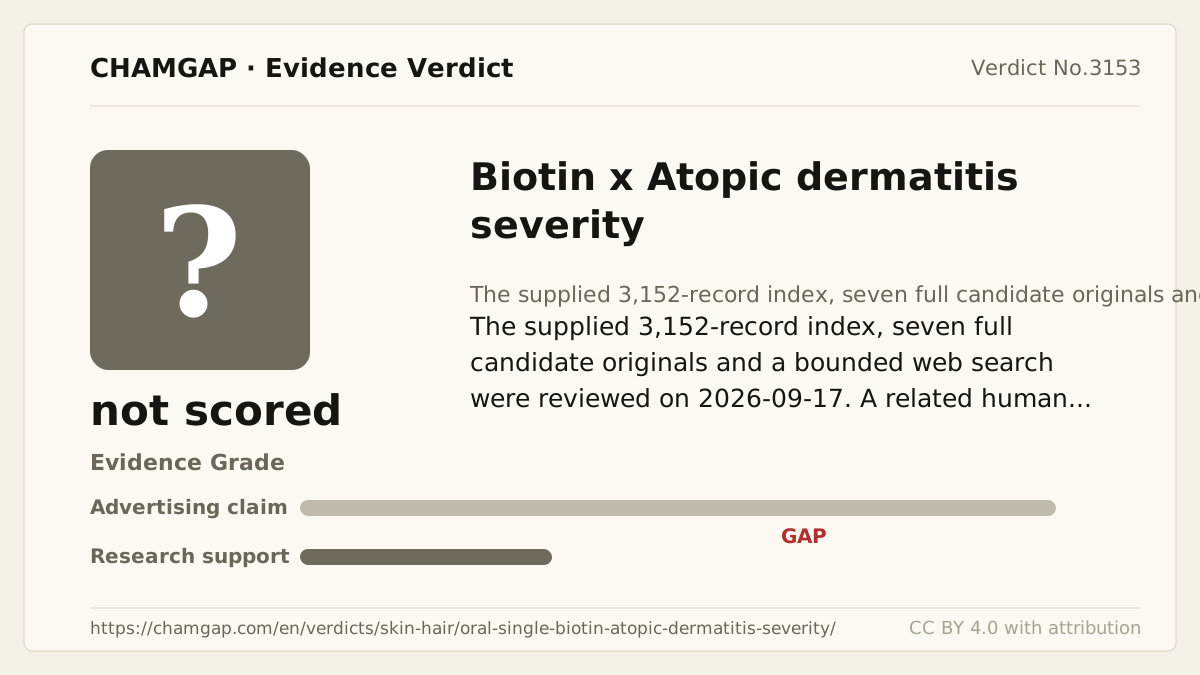
[Chamgap] Oral single-active biotin and atopic dermatitis severity — Evidence Grade ?. 6 cited sources checked. Source: https://chamgap.com/en/verdicts/skin-hair/oral-single-biotin-atopic-dermatitis-severity/ · CC BY 4.0CC BY 4.0 — free to use with attribution; do not distort grades, numbers, or verdict meaning.
What this document does and does not do
Chamgap is an information source. It reports what research has and has not confirmed; it does not tell readers what to take or buy. That decision belongs to readers and, when needed, medical or legal professionals. This verdict reflects literature available up to the search date and may change as new research appears. Nothing here is medical advice.