
Oral single-active-ingredient pantothenic acid supplementation,
does it really help with Reduction in inflammatory lesion counts in adults with mild-to-moderate facial acne?
research showsThe currently verified material does not establish that oral pantothenic acid alone reduces inflammatory acne lesion counts more than placebo. Related human studies exist, but multicomponent products, unverified single-ingredient identity and different endpoints prevent direct attribution to this single claim. ? means no directly eligible result was verified within the recorded search, not no effect. [S01][S02][S03]
ads claimIngredient presence, NAD or cellular mechanisms, and topical hydration findings do not establish inflammatory-lesion reduction with the specified oral monotherapy. The 68.21% figure was not accepted as an additional placebo-adjusted effect attributable to pantothenic acid alone. [S01][S03][S10][S11]
Four separate assessment dimensions
| Effect direction and size | No directly eligible between-group effect verified |
|---|---|
| Evidence certainty | ? denotes scoped direct-evidence uncertainty, not no effect |
| Applicability | Adults with mild-to-moderate facial acne; oral single ingredient; inflammatory lesions |
| Safety | Caution |
Stage 0 gate, score null, strength count null
Useful facts when choosing a product
- The reported 2.2 g/day for 12 weeks in the 2014 product study is not a validated B5 monotherapy dose or duration. [S01]
- The 2012 product contained multiple active ingredients and was taken as 2 tablets per dose, 2 doses daily, for 8 weeks. Full composition extraction and the unverified unit are retained in a separate ledger. [S03]
- The single product's manufacturing origin, exact salt, brand, purity, batch, release type and adherence remain unverified. Calcium pantothenate is retained as a separate search stratum; equivalence to free acid was not assumed. [S01][S03][S06]
Chamgap Semantic Classification Code
Permanent code issued
S.pantothenic-acid.oral.inflammatory-acne-lesion-count.reduce.placeboSubstances and nutrients > Pantothenic acid (vitamin B5), sole active ingredient > Oral > Inflammatory facial acne lesion count > Reduction claim > Placebo
Bound to the ChatGPT-fixed inflammatory-lesion-count claim for oral pantothenic acid as the sole active ingredient. Salt, dose, duration and between-group endpoint values for a directly eligible product remain unresolved. The code identifies the intervention and claim; it never contains the evidence grade, score, or safety result.
Exact Claim Classification
These independent facets prevent evidence from different forms, routes, populations, effects, and comparators from being mixed.
| Intervention class | S · Supplement or nutraceutical |
|---|---|
| Canonical ingredient or intervention | Pantothenic acid (vitamin B5), sole active ingredient; calcium salt verified separately |
| Source or part used | Not verified — manufacturing origin of an eligible single product not established |
| Formulation or processing | Single-active oral formulation — exact salt, tablet/capsule and release type unverified |
| Route | Oral |
| Dose | Not verified — no directly eligible monotherapy dose established |
| Duration | Not verified — eligible monotherapy assessment time unverified |
| Population | Adults with mild-to-moderate facial acne; distinct from deficiency treatment |
| Effect or condition | Reduction in inflammatory facial acne lesion count |
| Primary endpoint | Between-group difference in inflammatory-lesion change; endpoint contrast reported separately, eligible numbers unverified |
| Comparator | Placebo under the same background treatment — exact composition for an eligible single-product comparison unverified |
| Duplicate-detection key | pantothenic-acid|oral-single-active|dose-not-verified|mild-to-moderate-facial-acne-adults|inflammatory-lesion-count-change|duration-not-verified|placebo-on-same-background-care |
What the research actually shows
Table 1 gives baseline inflammatory-lesion mean (SD) of 15.3 (8.9) for the product and 17.3 (14.3) for placebo. This is a baseline comparison, not efficacy. Exact inflammatory-lesion endpoint values, between-group change difference, CI, P value and endpoint-specific analysis denominators were not verified; graph values were not reconstructed. [S01]
Why this is classified as ?
The original rubric's direct-human-evidence gate yields ? with null score for the fixed claim. The 7 axes are B / P / null / null / null / null / null. The last five axes and strength count are unscored, not 0. Neither a C for related combination products nor the C in legacy 028 was inherited.
Counterpoint. The 20.45→11.18 global-lesion result in the uncontrolled 2012 study is a within-group change. In the 2025 intramuscular dexpanthenol plus topical adapalene study, the inflammatory-lesion endpoint comparison was nonsignificant, P=0.476. Different route and molecule mean it is not treated as a 0 effect or repeated refutation of oral pantothenic acid. [S03][S04]
Rejudgment record. No directly eligible controlled single-ingredient result verified — Original rubric stage 0; combination products, other endpoints and other routes do not replace the direct-evidence gate
| Endpoint | P | Symptom or function itself is the target - including patient reports and performance tests |
Stored derived and displayed grades match; this is not a current recalculation or validity check (?).
Review performed and remaining limitations
Single-active composition, inflammatory between-group data, registration/SAP and MCID unverified
Evidence Table
| Study | Design | Sample | Funding | Endpoint | Result | Weight |
|---|---|---|---|---|---|---|
| Yang 2014 Pantothen | Randomized double-blind placebo-controlled, 12 weeks | 48 randomized, 41 evaluable; groups 20/21 | Avilan research funding; Nutraceutical Medical Research publication fees; no conflicts declared | Total lesions primary; inflammatory lesions and others secondary | Full composition unverified. P=0.0197 is for total lesions; exact inflammatory between-group values unverified. | Excluded from direct grading; boundary/counterevidence review |
| Capodice 2012 Pantothen | Uncontrolled open-label, 8 weeks | 11 enrolled, 10 completed | Nutraceutical Medical Research affiliation; funding, supply, employment/patents and COI details unverified | Within-group global lesion change | 20.45→11.18 is within-group global lesion change with a multi-active product. | Excluded from direct grading; boundary/counterevidence review |
| Saki 2025 intramuscular study | Single-blind, adapalene background, 2 months | Analysis groups 31/28 | Shiraz University of Medical Sciences and Actoverco; no conflicts declared | Inflammatory lesions; a non-oral comparison | Endpoint between-group P=0.476. Different route/molecule; not evidence of no oral B5 effect. | Excluded from direct grading; boundary/counterevidence review |
| Leung historical hypothesis and related report | Controlled primary design not verified | Not verified | Not verified; not coded independent | No directly eligible inflammatory between-group result verified | Bibliographic leads and secondary citations not converted into a single-ingredient RCT with results. | Excluded from direct grading; boundary/counterevidence review |
Receipt — 9 References
Evidence access cutoff: 2026-09-15. Each citation states its actual access level (full-text transcription, abstract, index, or other) and remaining limitations. Bibliographic checking does not certify the study results or treatment efficacy.
Technical integration by: Codex · Evidence date: 2026-09-15 · Corrections: none
Cite this verdict
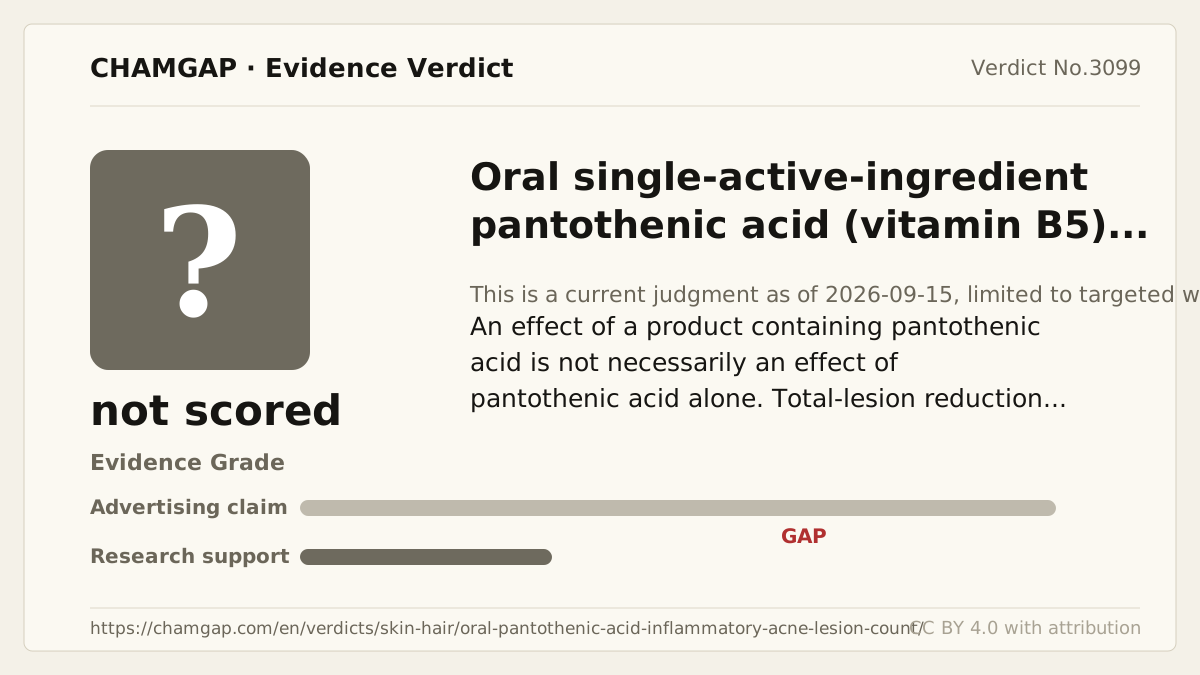
[Chamgap] Oral pantothenic acid monotherapy × inflammatory acne lesion count — Evidence Grade ?. 9 cited sources checked. Source: https://chamgap.com/en/verdicts/skin-hair/oral-pantothenic-acid-inflammatory-acne-lesion-count/ · CC BY 4.0CC BY 4.0 — free to use with attribution; do not distort grades, numbers, or verdict meaning.
What this document does and does not do
Chamgap is an information source. It reports what research has and has not confirmed; it does not tell readers what to take or buy. That decision belongs to readers and, when needed, medical or legal professionals. This verdict reflects literature available up to the search date and may change as new research appears. Nothing here is medical advice.