
Lactoferrin,
does it really help with Reduced inflammatory and total lesion counts and severity in mild-to-moderate acne?
research showsOral lactoferrin is rated C because it may reduce inflammatory lesions, total lesion counts, and severity in mild-to-moderate acne. In a 36-person, 12-week double-blind trial, lactoferrin-enriched fermented milk improved inflammatory lesions by 38.6%, total lesions by 23.1%, and acne grade by 20.3% compared with control fermented milk. A 168-person trial was also positive but combined lactoferrin with vitamin E and zinc, preventing isolation of the lactoferrin effect. Small samples or cointerventions and no direct comparison with standard acne therapy limit the finding to a supportive signal.
ads claimRelative lesion reductions must not be converted into a percentage of patients cured, and results from a vitamin E and zinc combination cannot be assigned wholly to pure lactoferrin. The evidence does not justify delaying treatment for severe nodular or scarring acne.
Useful facts when choosing a product
- Research formulations used fermented milk containing 200 mg lactoferrin or capsules combining lactoferrin with vitamin E and zinc, so commercial supplements cannot be assumed to have identical ingredient purity or dosing.
- Because lactoferrin is milk derived, people with milk-protein allergy should avoid it; lactose intolerance is more likely to matter for lactose-containing formulations than for purified lactoferrin itself.
- Oral use can cause abdominal discomfort, nausea, diarrhea, or constipation, and evidence on pregnancy, breastfeeding, and long-term high-dose safety is limited.
- Widespread inflammatory acne, nodules, cysts, or scarring should prompt dermatologic standard topical or systemic treatment rather than delay with a supplement.
Chamgap Semantic Classification Code
Candidate index · review held
S.lactoferrin.oral.inflammatory-and-total-lesion-counts-and-severity-in-mild-to-moderate-acne.reduce.placeboSupplements and nutraceuticals > Lactoferrin > Oral > inflammatory and total lesion counts and severity in mild-to-moderate acne > Reduction claim > Placebo
An automated migration candidate, not an issued permanent code; exact claim scope remains under review. This machine-generated migration candidate helps retrieval but is not a permanent assignment. The original verdict ID and URL remain authoritative.
What the research actually shows
Kim and colleagues double-blind randomized 36 patients with acne to fermented milk containing 200 mg lactoferrin or the same fermented-milk control for 12 weeks. Compared with control, the lactoferrin group improved inflammatory lesion count by 38.6%, total lesion count by 23.1%, acne grade by 20.3%, and sebum by 31.1%. Chan and colleagues randomized 168 participants aged 13 to 40 to lactoferrin with vitamin E and zinc or placebo for three months; maximum reductions at week 10 were 28.5% for total lesions, 32.5% for comedones, and 44% for inflammatory lesions. That study tested three ingredients together. Mueller's 43-person open-label single-arm study showed a total-lesion signal, but inflammatory-lesion reduction had p=0.054 and the uncontrolled design was not confirmatory.
Why this is classified as C (50)
A 36-person double-blind controlled trial showed improvements in lesion count and severity, and a larger combination trial supported the direction. The ingredient-attributable trial was very small, the larger trial coadministered vitamin E and zinc, and long-term and standard-treatment comparisons are absent. This limited small-trial evidence supports C with 50 points.
Counterpoint. There is room to try lactoferrin as an adjunct in mild-to-moderate acne, but absence of objective lesion reduction after 8 to 12 weeks should prompt a switch to evidence-based treatment.
Rejudgment record. Cross-check applied — Accepted lesion and severity reductions in a 36-person double-blind trial, while applying the C ceiling because the attributable trial was very small and the 168-person supporting trial coadministered vitamin E and zinc. At cross-check the score was lowered to 50 because the direct evidence is a single 36-participant trial and larger trials used zinc and vitamin E combinations, limiting attribution to lactoferrin alone (grade C retained).
Sub-claim grades by effect
This ingredient is marketed for several effects. A single overall grade blends strong and weak claims together, so each effect is graded separately here. The overall grade reflects the strongest disconfirming or core claim.
| Effect (sub-claim) | Grade | Basis |
|---|---|---|
| Reduced inflammatory acne lesion count | C | A 36-person trial showed 38.6% improvement, but each group had only 18 participants and the larger trial used vitamin E and zinc. |
| Reduced total acne lesion count | C | A small controlled trial showed 23.1% improvement and the combination trial supported the direction, but long-term confirmation is absent. |
| Improved acne severity | C | Acne grade improved by 20.3% at 12 weeks, but this came from one small formulation-specific trial. |
Cross-check — AI research and Codex final gate
Evidence Table
| Study | Design | Sample | Funding | Endpoint | Result | Weight |
|---|---|---|---|---|---|---|
| Kim J et al. 2010 | Twelve-week randomized double-blind fermented-milk-controlled trial | 36 patients with acne; 18 per group | Inadequately reported in the abstract and indexing record | Inflammatory and total lesion counts, acne grade, sebum, and skin-surface lipids | Compared with control, inflammatory lesions improved by 38.6%, total lesions by 23.1%, acne grade by 20.3%, and sebum by 31.1%. | Pivotal ingredient-specific small randomized trial |
| Chan H et al. 2017 | Three-month randomized double-blind placebo-controlled trial | 168 randomized and 164 analyzed per protocol | Participation by United Laboratories research and development staff | Total lesions, comedones, inflammatory lesions, and sebum | The lactoferrin, vitamin E, and zinc combination showed maximum placebo-adjusted reductions at week 10 of 28.5% in total lesions, 32.5% in comedones, and 44% in inflammatory lesions. | Larger supportive randomized trial limited by cointerventions |
| Mueller EA et al. 2011 | Eight-week open-label single-arm exploratory study | 43 enrolled and 39 completed per protocol | Inadequately reported in the abstract and indexing record | Inflammatory, noninflammatory, and total lesion counts | Total lesions fell by 22.5%, but the 20.2% inflammatory-lesion reduction had p=0.054 and there was no control group. | Exploratory supportive consistency evidence |
Receipt — 3 References
All 3 cited sources were verified for existence at the original page (as of 2026-07-23).
Final verification and publication gate: Codex · Evidence date: 2026-07-23 · Corrections: none
Cite this verdict
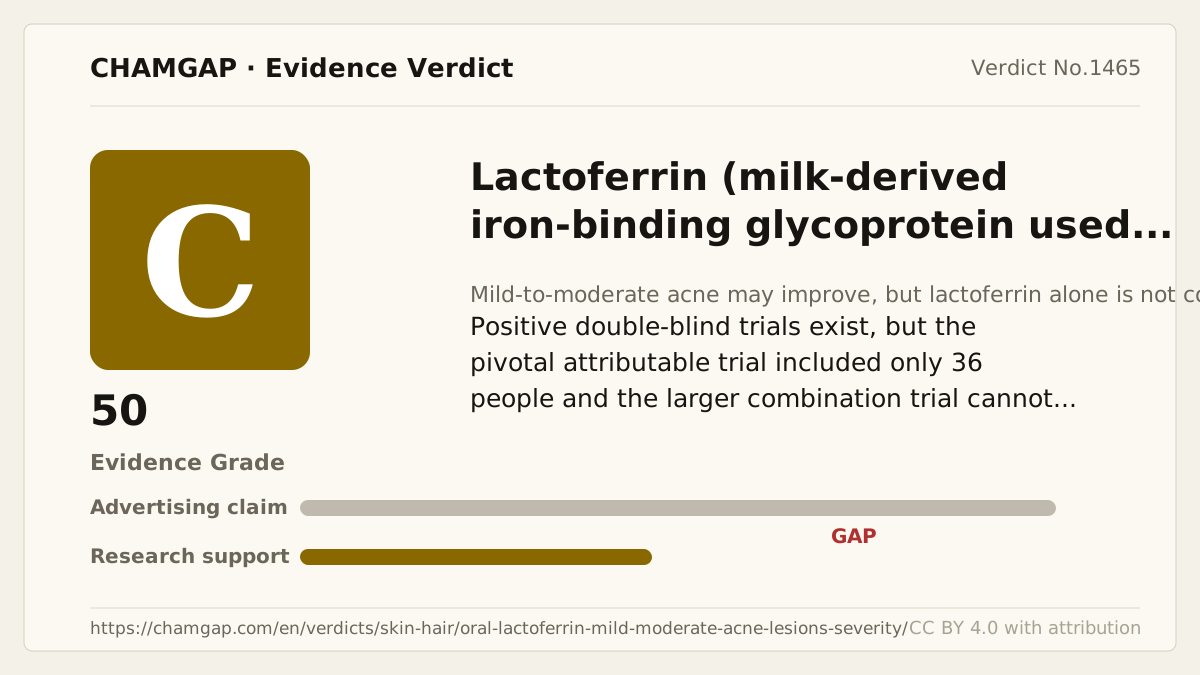
[Chamgap] Lactoferrin x reduced lesion counts and severity in mild-to-moderate acne — Evidence Grade C·50. 3 cited sources checked. Source: https://chamgap.com/en/verdicts/skin-hair/oral-lactoferrin-mild-moderate-acne-lesions-severity/ · CC BY 4.0CC BY 4.0 — free to use with attribution; do not distort grades, numbers, or verdict meaning.
What this document does and does not do
Chamgap is an information source. It reports what research has and has not confirmed; it does not tell readers what to take or buy. That decision belongs to readers and, when needed, medical or legal professionals. This verdict reflects literature available up to the search date and may change as new research appears. Nothing here is medical advice.