
OnabotulinumtoxinA,
does it really help with Reduction of severe primary axillary hyperhidrosis and daily-life impairment?
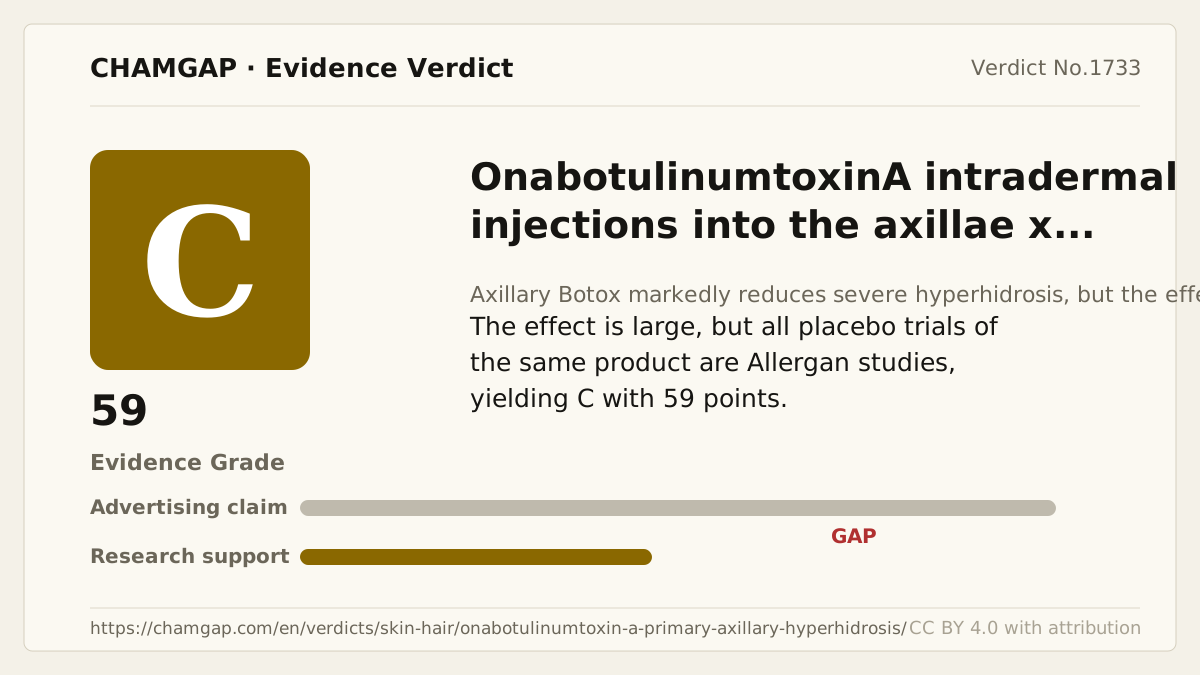
research showsAxillary onabotulinumtoxinA produces a large effect but is rated C. Lowe 2007 analyzed all 322 randomized participants by intention to treat; at week four, an HDSS improvement of at least two grades occurred in 75% versus 25%, P<0.001. However, there are no placebo-controlled trials of the same product, onabotulinumtoxinA/BOTOX, that are independent of Allergan. The rule ②-b ceiling therefore applies directly, giving C with 59 points.
ads claimMarketing may imply permanent sweat elimination after one treatment, but median benefit lasted roughly six to seven months and varied among patients. This is not treatment of whole-body sweating needed for thermoregulation.
Useful facts when choosing a product
- The hyperhidrotic area is mapped and multiple shallow intradermal injections are placed across each axilla.
- Benefit usually begins within days and lasts for months; reinjection may be needed after recurrence.
- Injection pain, bruising, local discomfort, and compensatory sweating can occur.
- Neuromuscular-junction disease, interacting antibiotics or muscle relaxants, pregnancy, and breastfeeding require clinician review.
Chamgap Semantic Classification Code
Candidate index · review held
UNK.onabotulinumtoxina-intradermal-injections-into-the-axillae.UNK.severe-primary-axillary-hyperhidrosis-and-daily-life-impairment.reduce.placeboUnknown > OnabotulinumtoxinA intradermal injections into the axillae > Unknown > severe primary axillary hyperhidrosis and daily-life impairment > Reduction claim > Placebo
An automated migration candidate, not an issued permanent code; exact claim scope remains under review. This machine-generated migration candidate helps retrieval but is not a permanent assignment. The original verdict ID and URL remain authoritative.
What the research actually shows
Lowe et al. 2007 randomized 322 patients with severe primary axillary hyperhidrosis to onabotulinumtoxinA 50 U, 75 U, or placebo and analyzed all randomized patients by intention to treat. At week four, an HDSS improvement of at least two grades occurred in 75% versus 25%, P<0.001. Lowe 2007 and Naumann 2001 were both supported by Allergan, leaving zero placebo-controlled trials of the same product, onabotulinumtoxinA/BOTOX, independent of Allergan. Two independent botulinum toxin A placebo trials both tested the different product Dysport (abobotulinumtoxinA): the 145-participant Heckmann trial was supported by competing manufacturer Ipsen, and funding for the 13-participant Schnider trial was unclear. Verdict 1694, which is C with 55 points, verdict 1705, which is C with 45 points, and verdict 1734, which is C with 55 points, sit alongside this C not because their effects are similar, but because their evidence structures are all confined to manufacturer studies.
Why this is classified as C (59)
Lowe 2007 found a large effect in 322 intention-to-treat participants, with week-four HDSS response of 75% versus 25%, P<0.001. However, there are zero same-product placebo trials independent of Allergan, and Naumann 2001 was also Allergan-supported. Rule ②-b therefore gives C with 59 points.
Counterpoint. It is a practical high-effect option for severe axillary hyperhidrosis inadequately controlled by topical treatment, but cost, pain, and repeated procedures matter.
Rejudgment record. Cross-check applied — Lowe 2007 showed a large effect in 322 intention-to-treat participants: at week four, an HDSS improvement of at least two grades occurred in 75% versus 25%, P<0.001. However, there are zero placebo-controlled trials of the same product, onabotulinumtoxinA/BOTOX, independent of Allergan, and Naumann 2001 was also Allergan-supported. The two independent botulinum toxin A placebo trials tested Dysport; the 145-participant Heckmann trial was Ipsen-supported and funding for the 13-participant Schnider trial was unclear. Rule ②-b therefore caps the grade at C.
Sub-claim grades by effect
This ingredient is marketed for several effects. A single overall grade blends strong and weak claims together, so each effect is graded separately here. The overall grade reflects the strongest disconfirming or core claim.
| Effect (sub-claim) | Grade | Basis |
|---|---|---|
| Reduction in axillary sweat production | C | A large direct effect was repeated in two large placebo-controlled trials and meta-analysis. |
| Reduction in daily-life impairment from hyperhidrosis | C | A two-grade patient-reported HDSS improvement succeeded at 75% versus 25%. |
| Maintenance of benefit for several months | C | Median duration was about 197 to 205 days, but the effect is not permanent. |
Cross-check — AI research and Codex final gate
Evidence Table
| Study | Design | Sample | Funding | Endpoint | Result | Weight |
|---|---|---|---|---|---|---|
| Lowe NJ et al. 2007 | Fifty-two-week multicenter randomized double-blind placebo-controlled dose trial | 322 randomized and included in the intention-to-treat primary analysis, 104 at 50 U, 110 at 75 U, and 108 placebo; 252 completed | Funded by Allergan Inc.; several coauthors were employees and shareholders | At least a two-grade HDSS improvement at week four | Primary endpoint succeeded: 75% in each dose group versus 25% with placebo, P<0.001. | Key direct symptom-and-function randomized trial |
| Naumann M and Lowe NJ. 2001 | Seventeen-center randomized double-blind placebo-controlled trial | 320 randomized and included in primary efficacy analysis, 242 versus 78; 307 completed | Allergan-supported product-development program with investigator grants and company-employee involvement | At least 50% reduction in spontaneous axillary sweat production at week four | Primary endpoint succeeded: 227 of 242 (94%) versus 28 of 78 (36%), P<0.001. | Large direct replication |
| Obed D et al. 2021 | Meta-analysis of placebo-controlled trials | Five trials for axillary sweat response and four trials for HDSS response | Academic research at Hannover Medical School; no manufacturer funding reported | At least 50% sweat reduction, at least two-grade HDSS improvement, and DLQI | Positive results: axillary sweat-response RD 0.63, HDSS-response RD 0.56, and DLQI MD -5.55. | Replicative synthesis |
Receipt — 3 References
All 3 cited sources were verified for existence at the original page (as of 2026-07-24).
Final verification and publication gate: Codex · Evidence date: 2026-07-24 · Corrections: none
Cite this verdict
[Chamgap] OnabotulinumtoxinA x primary axillary hyperhidrosis — Evidence Grade C·59. 3 cited sources checked. Source: https://chamgap.com/en/verdicts/skin-hair/onabotulinumtoxin-a-primary-axillary-hyperhidrosis/ · CC BY 4.0CC BY 4.0 — free to use with attribution; do not distort grades, numbers, or verdict meaning.
What this document does and does not do
Chamgap is an information source. It reports what research has and has not confirmed; it does not tell readers what to take or buy. That decision belongs to readers and, when needed, medical or legal professionals. This verdict reflects literature available up to the search date and may change as new research appears. Nothing here is medical advice.