
Skin-care programme,
does it really help with Prevention of occupational hand dermatitis in nurses?
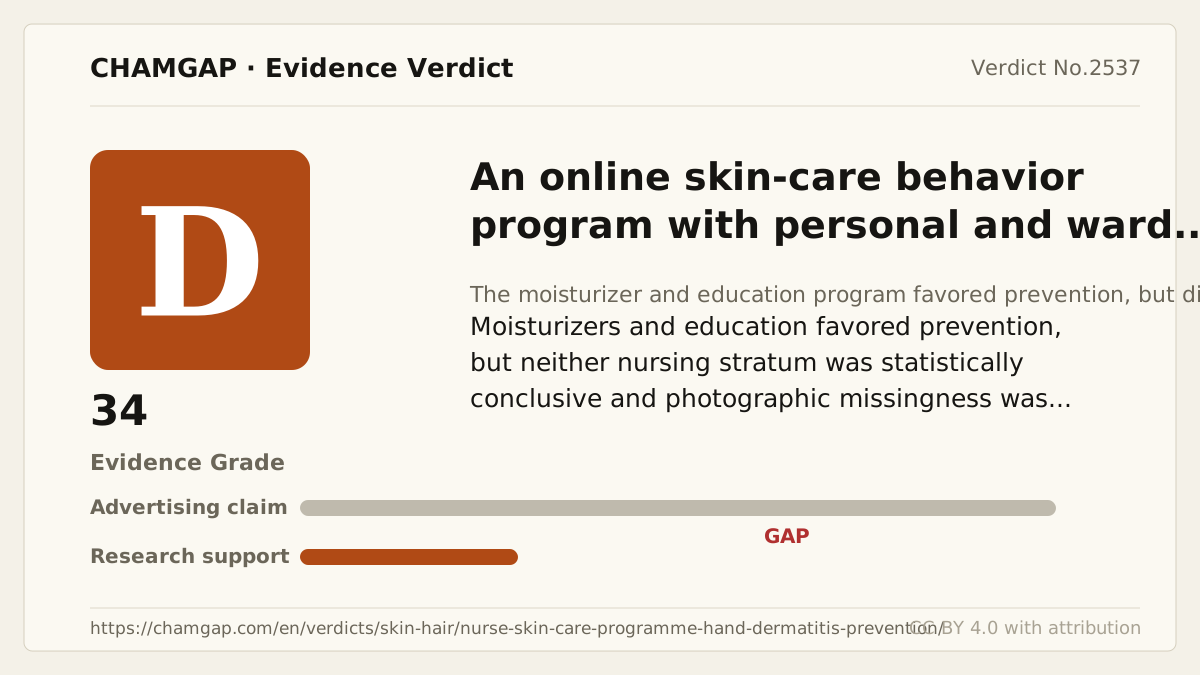
research showsThe grade is D. In a 35-site UK cluster trial, follow-up dermatitis in student nurses was 19/185 (10.3%) versus 17/142 (12.0%), adjusted OR 0.72 (95% CI 0.33-1.55). In intensive-care nurses it was 33/334 (9.9%) versus 46/333 (13.8%), OR 0.62 (0.35-1.10). Both strata included the null, and only 994 of 2,040 consented participants contributed photographs at both time points, giving D with 34 points.
ads claimSupplying moisturizers and teaching appropriate washing and glove use are reasonable workplace measures, but this trial did not establish that the bundled program prevents dermatitis. It also cannot isolate moisturizer-only benefit.
Useful facts when choosing a product
- The intervention bundled online education, reminders, washing and glove advice, and moisturizer provision.
- The registered and published primary outcome both measured change in visible hand dermatitis from baseline to follow-up.
- No direct duplicate of this nurse hand-dermatitis program or the selected PMID and DOI was identified in the existing corpus.
Chamgap Semantic Classification Code
Candidate index · review held
X.online-skin-care-behavior-program-with-personal-and-ward-moisturizers.behavioral.occupational-hand-dermatitis-in-nurses.prevent.usual-careBehaviors, exposures and policies > online skin-care behavior program with personal and ward moisturizers > Behavioral delivery > occupational hand dermatitis in nurses > Occurrence-prevention claim > Usual care
An automated migration candidate, not an issued permanent code; exact claim scope remains under review. This machine-generated migration candidate helps retrieval but is not a permanent assignment. The original verdict ID and URL remain authoritative.
What the research actually shows
SCIN cluster-randomized 35 UK hospital or university sites: 14 received an online behavior-change package plus moisturizers and 21 received a leaflet and usual care. Of 2,934 screened nurses, 2,040 consented and entered the assigned-group analysis, but only 994 (57.6%) had both baseline and 12-15-month photographs for the primary outcome. Two dermatologists blinded to other participant information assessed photographs independently, with a third arbitrator for disagreement. The registered and published primary outcome both concerned change in visible hand-dermatitis prevalence. Funding came from the public NIHR HTA program.
Why this is classified as D (34)
A publicly funded cluster trial found nonsignificant disease outcomes in both strata. The single axis-6 flaw counted was extensive missingness in the primary photographic outcome; unavoidable participant nonmasking was not counted again, giving D with 34 points.
Counterpoint. D does not mean moisturizing habits are worthless; it means prevention by this specific bundled program was not established.
Rejudgment record. Cross-check applied — We confirmed concealed allocation and blinded photographic assessment and counted only extensive primary-outcome missingness as the axis-6 flaw.
| Endpoint | H | Hard endpoint - actual events such as death |
| Replication | R1 | Single confirmatory trial |
| Independence | I2 | Decisive evidence is publicly or non-profit funded |
| Effect size | E0 | Null |
| Precision | C0 | The confidence interval leaves room for benefit |
Stored derived and displayed grades match; this is not a current recalculation or validity check (D).
Sub-claim grades by effect
This ingredient is marketed for several effects. A single overall grade blends strong and weak claims together, so each effect is graded separately here. The overall grade reflects the strongest disconfirming or core claim.
| Effect (sub-claim) | Grade | Basis |
|---|---|---|
| The bundled skin-care program prevents hand dermatitis in high-risk student nurses. | D | The adjusted OR was 0.72 (95% CI 0.33-1.55). |
| The bundled skin-care program prevents hand dermatitis in ICU nurses. | D | The adjusted OR was 0.62 (95% CI 0.35-1.10). |
Cross-check — AI research and Codex final gate
Evidence Table
| Study | Design | Sample | Funding | Endpoint | Result | Weight |
|---|---|---|---|---|---|---|
| Madan et al., SCIN cluster-randomized trial 2020 | 35-site cluster-randomized trial of a bundled skin-care program versus usual care | 2,040 consented and entered assigned-group analysis; 994 (57.6%) had baseline and follow-up photographs; photographic outcomes covered 327 students and 667 ICU nurses | UK NIHR Health Technology Assessment programme, grant 11/94/01 | Dermatologist-assessed visible hand dermatitis in 12-15-month photographs | Students 19/185 versus 17/142, adjusted OR 0.72 (95% CI 0.33-1.55); ICU 33/334 versus 46/333, OR 0.62 (0.35-1.10) | Only large directly relevant publicly funded trial, but with extensive outcome missingness |
Receipt — 2 References
All 2 cited sources were verified for existence at the original page (as of 2026-08-14).
Final verification and publication gate: Codex · Evidence date: 2026-08-14 · Corrections: none
Cite this verdict
[Chamgap] Skin-care programme x prevention of hand dermatitis in nurses — Evidence Grade D·34. 2 cited sources checked. Source: https://chamgap.com/en/verdicts/skin-hair/nurse-skin-care-programme-hand-dermatitis-prevention/ · CC BY 4.0CC BY 4.0 — free to use with attribution; do not distort grades, numbers, or verdict meaning.
What this document does and does not do
Chamgap is an information source. It reports what research has and has not confirmed; it does not tell readers what to take or buy. That decision belongs to readers and, when needed, medical or legal professionals. This verdict reflects literature available up to the search date and may change as new research appears. Nothing here is medical advice.