
Mohs micrographic surgery,
does it really help with Prevention of long-term local recurrence in recurrent high-risk facial basal cell carcinoma?
research showsMohs surgery is rated at the top of B because it reduced long-term local recurrence versus standard excision in recurrent high-risk facial basal cell carcinoma. At ten years in the randomized comparison, cumulative recurrence for recurrent BCC was 3.9% after Mohs versus 13.5% after standard excision (p=0.023), and the 2023 European consensus guideline recommends micrographically controlled surgery for high-risk, recurrent, and critical-site BCC. Direct superiority, however, rests essentially on one trial and its recurrent-tumor group; primary high-risk BCC was 4.4% versus 12.2% but p=0.10. The verdict is therefore B with 79 points rather than A.
ads claimPromotion may expand the evidence into a promise of 99% cure and no scar for every BCC. The strongest comparative evidence concerns local-recurrence reduction in recurrent high-risk facial BCC, while tumor size, site, histology, and patient factors can make standard excision or other options reasonable.
Useful facts when choosing a product
- Mohs surgery removes the tumor in stages, maps each specimen, examines the peripheral and deep margins comprehensively, and repeats excision until no residual cancer is detected.
- It is particularly considered for high-risk or recurrent BCC on the face where conserving uninvolved tissue is important and requires trained surgical, pathology, and reconstruction expertise.
- It is commonly performed under local anesthesia, but repeated stages can take time and risks include bleeding, infection, pain, nerve injury, scarring, and reconstructive procedures.
- Recurrence can occur beyond five years, so skin self-examination and risk-adapted long-term follow-up remain necessary.
Chamgap Semantic Classification Code
Candidate index · review held
P.mohs-micrographic-surgery.diagnostic.long-term-local-recurrence-in-recurrent-high-risk-facial-basal-cell-carcinoma.prevent.UNKProcedures, devices and tests > Mohs micrographic surgery > Diagnostic or screening > long-term local recurrence in recurrent high-risk facial basal cell carcinoma > Occurrence-prevention claim > Unknown
An automated migration candidate, not an issued permanent code; exact claim scope remains under review. This machine-generated migration candidate helps retrieval but is not a permanent assignment. The original verdict ID and URL remain authoritative.
What the research actually shows
Between 1999 and 2002, 408 high-risk primary facial BCCs and 204 recurrent facial BCCs were randomized to standard excision or Mohs surgery. At ten years, van Loo and colleagues reported cumulative recurrence of 3.9% after Mohs and 13.5% after standard excision for recurrent tumors. Primary tumors had recurrence of 4.4% versus 12.2%, but the difference was not statistically significant at p=0.10. Many recurrences arose after five years, emphasizing long follow-up. The 2023 EADO-led European consensus guideline states that micrographically controlled surgery should be offered for high-risk, recurrent, or critical-anatomical-site BCC.
Why this is classified as B (79)
A procedure-specific randomized hard endpoint showed ten-year recurrence of 3.9% versus 13.5% in recurrent high-risk facial BCC, reinforced by guideline-standard use. Lack of independent randomized replication and a nonsignificant primary high-risk comparison limit the verdict to B with 79 points.
Counterpoint. Mohs surgery is a standard option for recurrent high-risk facial BCC and improves long-term local control, but it is not automatically necessary for every low-risk BCC.
Rejudgment record. New verdict — Applied the B ceiling because a procedure-specific randomized trial significantly reduced ten-year local recurrence in recurrent high-risk facial BCC and guidelines establish the procedure as standard, but independent randomized replication is absent and the primary high-risk comparison was not significant
Sub-claim grades by effect
This ingredient is marketed for several effects. A single overall grade blends strong and weak claims together, so each effect is graded separately here. The overall grade reflects the strongest disconfirming or core claim.
| Effect (sub-claim) | Grade | Basis |
|---|---|---|
| Reduced long-term local recurrence in recurrent high-risk facial BCC | B | The randomized ten-year result was significant at 3.9% versus 13.5%, but only one direct randomized trial exists. |
| Reduced long-term local recurrence in primary high-risk facial BCC | B | The direction favored Mohs at 4.4% versus 12.2%, but statistical superiority was not established at p=0.10. |
| Improved local control through complete margin clearance in high-risk and recurrent BCC | B | Comprehensive margin examination and guideline-standard status support the clinical recurrence evidence. |
Cross-check — AI research and Codex final gate
Evidence Table
| Study | Design | Sample | Funding | Endpoint | Result | Weight |
|---|---|---|---|---|---|---|
| van Loo E et al. facial BCC randomized trial, 2014 | Ten-year follow-up of a randomized comparison of Mohs surgery and standard excision | 408 high-risk primary and 204 recurrent facial BCCs | Dutch public and health-research support; no industry sponsorship reported for the long-term article | Cumulative probability of histologically confirmed local recurrence | Recurrent BCC 3.9% versus 13.5% (p=0.023); primary high-risk BCC 4.4% versus 12.2% (p=0.10). | Pivotal long-term hard-endpoint randomized trial |
| Peris K et al. European BCC guideline update, 2023 | European multidisciplinary consensus clinical guideline | Multidisciplinary experts from EADO, EDF, ESTRO, UEMS, and EADV | Society-led; authors reported no competing interests | Risk-adapted BCC diagnosis and treatment recommendations | Recommended micrographically controlled surgery for high-risk, recurrent, and critical-site BCC. | Guideline-standard supportive evidence |
Receipt — 2 References
All 2 cited sources were verified for existence at the original page (as of 2026-07-23).
Final verification and publication gate: Codex · Evidence date: 2026-07-23 · Corrections: none
Cite this verdict
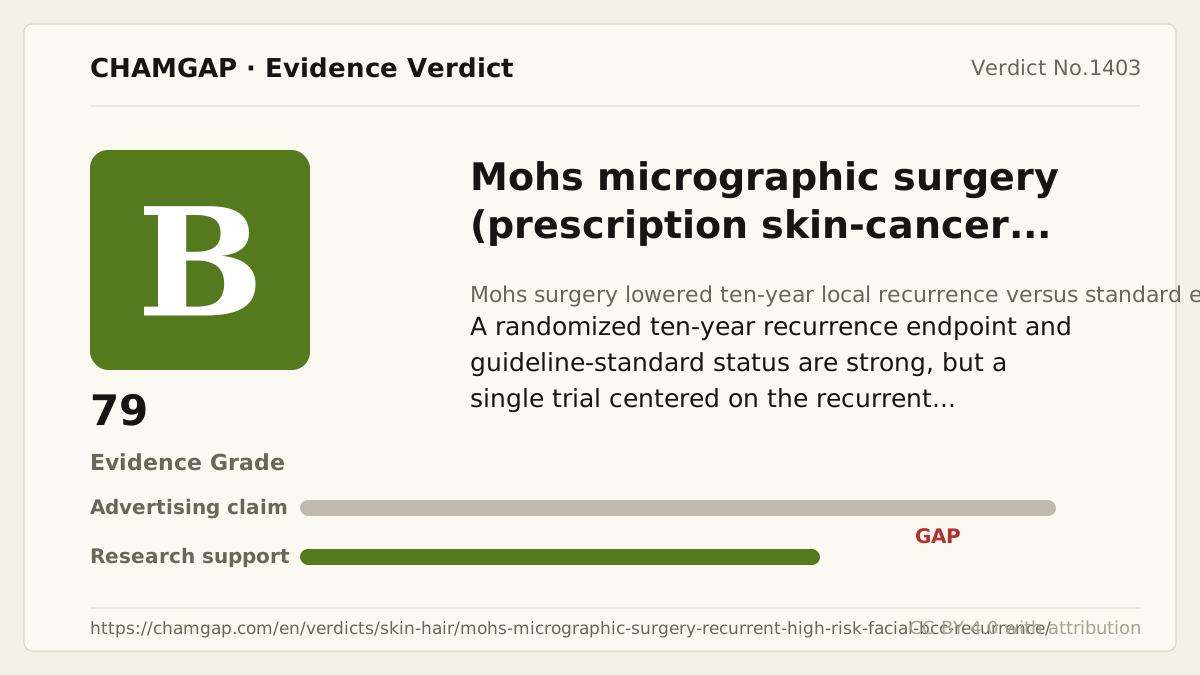
[Chamgap] Mohs micrographic surgery x prevention of long-term local recurrence in recurrent high-risk facial basal cell carcinoma — Evidence Grade B·79. 2 cited sources checked. Source: https://chamgap.com/en/verdicts/skin-hair/mohs-micrographic-surgery-recurrent-high-risk-facial-bcc-recurrence/ · CC BY 4.0CC BY 4.0 — free to use with attribution; do not distort grades, numbers, or verdict meaning.
What this document does and does not do
Chamgap is an information source. It reports what research has and has not confirmed; it does not tell readers what to take or buy. That decision belongs to readers and, when needed, medical or legal professionals. This verdict reflects literature available up to the search date and may change as new research appears. Nothing here is medical advice.