
Modern silver-containing dressings,
does it really help with Faster wound closure of partial-thickness burns than daily 1% silver sulfadiazine?
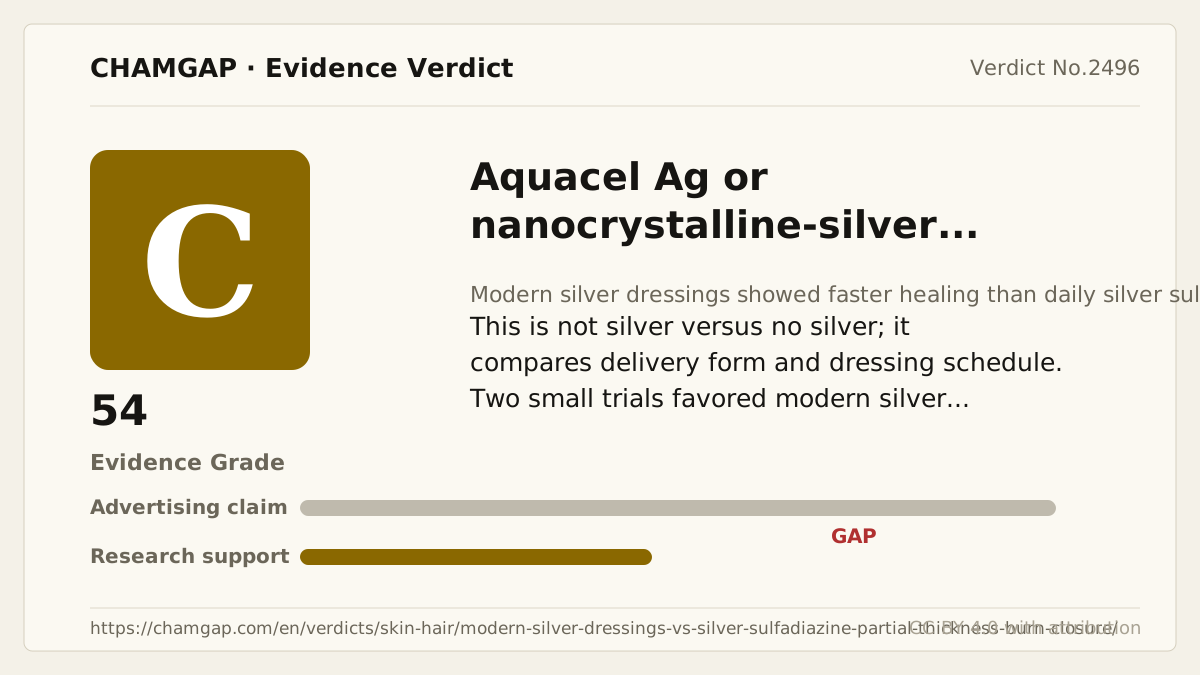
research showsThe grade is C. In a 70-participant randomized trial, closure took 10.0±3.0 days with Aquacel Ag versus 13.7±4.3 days with daily 1% silver sulfadiazine, a difference of -3.7 days (95% CI -5.44 to -1.96). A separate trial randomized 163 but lost 57 (35.0%) and analyzed 106; at least 50% healing by four weeks occurred in 25/31 versus 13/27 in its deep partial-thickness subgroup. Different dressings and outcomes and unverified blinded assessment give C with 54 points.
ads claimModern dressings also contain silver. These trials did not compare silver with no treatment; they compared a less frequently changed silver dressing with daily silver-sulfadiazine cream.
Useful facts when choosing a product
- Aquacel Ag was changed every three days, whereas silver-sulfadiazine cream was changed daily.
- The Muangman confidence interval was calculated from public means, standard deviations, and 35 participants per arm; it was not directly reported by the paper.
- Existing verdicts 057, 229, 950, 973, 1075, and 1114 cover adjacent burn, silver, or wound-care topics but not this exact comparator and closure claim; the pivotal PMID and DOI were not duplicated.
Chamgap Semantic Classification Code
Candidate index · review held
UNK.aquacel-ag-or-nanocrystalline-silver-dressings.UNK.faster-wound-closure-of-partial-thickness-burns-than-daily-1-percent-silver-sulfadiazine.improve.UNKUnknown > Aquacel Ag or nanocrystalline-silver dressings > Unknown > Faster wound closure of partial-thickness burns than daily 1% silver sulfadiazine > Improvement claim > Unknown
An automated migration candidate, not an issued permanent code; exact claim scope remains under review. This machine-generated migration candidate helps retrieval but is not a permanent assignment. The original verdict ID and URL remain authoritative.
What the research actually shows
Muangman randomized 70 outpatients with partial-thickness burns involving less than 15% body surface area, 35 per arm. The public full text states computer randomization but did not verify allocation concealment, participant or closure-assessor masking, or a prospectively registered primary endpoint. Adhya was an open-label parallel randomized trial: 163 were randomized, 57 (35.0%) dropped out, and evaluable data remained for 52 nanocrystalline-silver and 54 silver-sulfadiazine patients. Blinded wound assessment was not verified. The first trial had Siriraj institutional support; Adhya reported ‘Source of Support: DST West Bengal’.
Why this is classified as C (54)
A randomized trial showed a large difference in actual closure and a second trial pointed in the same direction, but the products and endpoints were not comparable enough for independent replication. Both bodies of evidence were small and blinded assessment was not verified. The hard outcome and large-effect strengths give C with 54 points.
Counterpoint. Fewer changes and reduced pain or cost may be separate advantages; this grade addresses only speed of partial-thickness burn closure.
Rejudgment record. Cross-check applied — We cross-checked randomized and evaluable counts, closure-time and healing-event results, assessor masking, and disclosed funding against the two primary reports.
| Endpoint | H | Hard endpoint - actual events such as death |
| Replication | R1 | Single confirmatory trial |
| Independence | I1 | Mixed funding sources |
| Effect size | E+ | Meets the clinically important threshold |
Stored derived and displayed grades match; this is not a current recalculation or validity check (C).
Sub-claim grades by effect
This ingredient is marketed for several effects. A single overall grade blends strong and weak claims together, so each effect is graded separately here. The overall grade reflects the strongest disconfirming or core claim.
| Effect (sub-claim) | Grade | Basis |
|---|---|---|
| Aquacel Ag speeds partial-thickness burn closure versus daily silver sulfadiazine. | C | The 70-participant trial found a 3.7-day mean difference without independent replication of the same estimate. |
| Nanocrystalline silver improves four-week healing of deep partial-thickness burns. | C | At least 50% healing increased in a small subgroup, while complete healing did not differ significantly. |
Cross-check — AI research and Codex final gate
Evidence Table
| Study | Design | Sample | Funding | Endpoint | Result | Weight |
|---|---|---|---|---|---|---|
| Muangman et al., Int Wound J 2010 | Prospective randomized comparative trial | 70 randomized and analyzed (35/35) | A public evidence table lists Faculty of Medicine Siriraj Hospital; the paper's complete funding statement was not verified | Time to complete wound closure of partial-thickness burns | 10.0±3.0 versus 13.7±4.3 days, P<0.02; independently calculated mean difference -3.7 days (95% CI -5.44 to -1.96) | Pivotal closure-time trial |
| Adhya et al., J Basic Clin Pharm 2014 | Open-label parallel-group randomized comparative trial | 163 randomized; 57 dropped out (35.0%); 106 analyzed (52/54); deep partial-thickness subgroup 31/27 | Original text: ‘Source of Support: DST West Bengal’ | At least 50% healing and complete healing by four weeks | At least 50% healing in deep partial-thickness burns: 25/31 versus 13/27, independently calculated RR 1.67 (95% CI 1.09-2.56); complete healing 4% versus 0%, P=0.116 | Supportive trial using a different product and outcome |
Receipt — 2 References
All 2 cited sources were verified for existence at the original page (as of 2026-08-14).
Final verification and publication gate: Codex · Evidence date: 2026-08-14 · Corrections: none
Cite this verdict
[Chamgap] Modern silver-containing dressings x partial-thickness burn closure — Evidence Grade C·54. 2 cited sources checked. Source: https://chamgap.com/en/verdicts/skin-hair/modern-silver-dressings-vs-silver-sulfadiazine-partial-thickness-burn-closure/ · CC BY 4.0CC BY 4.0 — free to use with attribution; do not distort grades, numbers, or verdict meaning.
What this document does and does not do
Chamgap is an information source. It reports what research has and has not confirmed; it does not tell readers what to take or buy. That decision belongs to readers and, when needed, medical or legal professionals. This verdict reflects literature available up to the search date and may change as new research appears. Nothing here is medical advice.