
Microneedling,
does it really help with Improved appearance of atrophic acne scars?
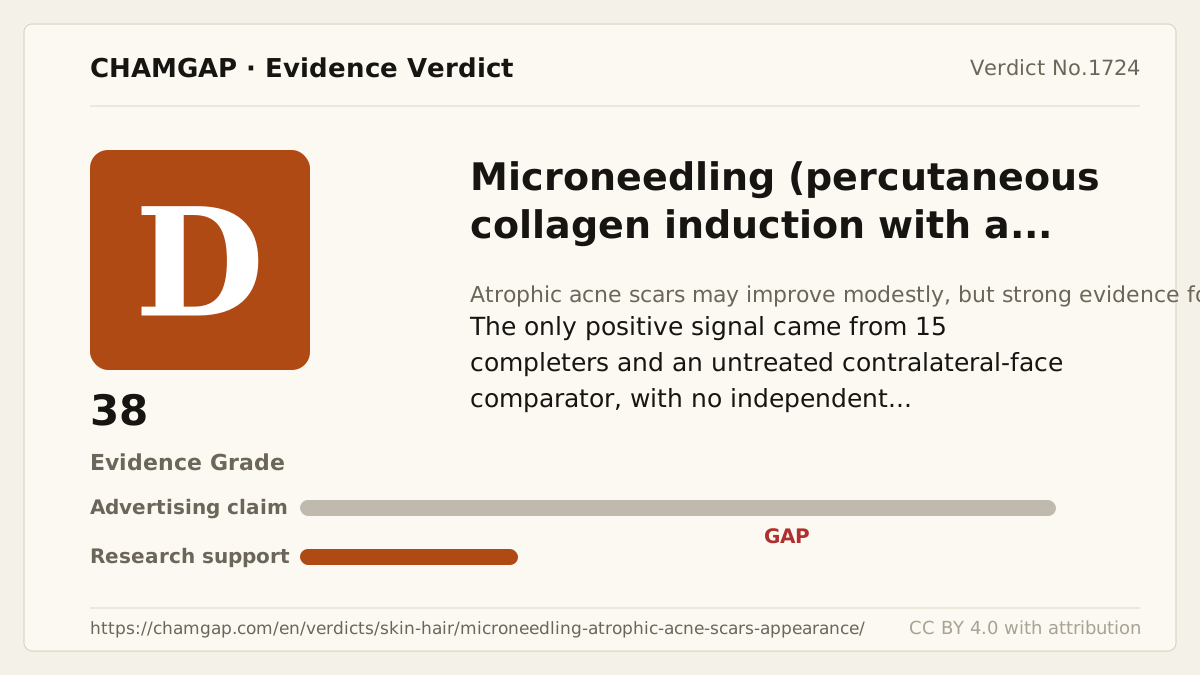
research showsMicroneedling is rated D despite a positive signal for the appearance of atrophic acne scars. Alam 2014 randomized 20 participants but analyzed only 15 completers. The comparator was not true sham needling; it was the untreated contralateral face with topical anesthetic only. The assessor-masked split-face design found a 3.4-point improvement from baseline at six months (95% CI 0.2 to 6.5; P=.03), but no independent sham-controlled replication was identified.
ads claimMarketing may promise scar erasure or equivalence to lasers. The evidence supports possible modest appearance improvement after several professional sessions, not complete removal.
Useful facts when choosing a product
- Professional treatment adjusts needle depth, session number, and interval to scar and skin type.
- Active acne, infection, keloid tendency, and recent isotretinoin use require assessment.
- Temporary erythema, swelling, and pain are common; infection, pigment change, and scarring are possible.
- Home rollers do not reproduce the hygiene or depth of professional trial procedures.
Chamgap Semantic Classification Code
Candidate index · review held
UNK.microneedling.transdermal.appearance-of-atrophic-acne-scars.improve.MULTIUnknown > Microneedling > Transdermal > appearance of atrophic acne scars > Improvement claim > Multiple: primary unresolved
An automated migration candidate, not an issued permanent code; exact claim scope remains under review. This machine-generated migration candidate helps retrieval but is not a permanent assignment. The original verdict ID and URL remain authoritative.
What the research actually shows
Alam 2014 randomized the two facial sides of 20 participants to microneedling or an untreated contralateral-face control with topical anesthetic only. Five left before the first treatment, leaving 15 completers for analysis. In the assessor-masked split-face design, the prespecified quantitative scar grade improved by 3.4 points from baseline on the treated side at six months (95% CI 0.2 to 6.5; P=.03). This was not a true sham-needling comparison, and no independent sham-controlled replication was identified. Later randomized trials mostly compared microneedling with active laser, resurfacing, or platelet-rich plasma treatments.
Why this is classified as D (38)
Only 15 of 20 randomized participants were analyzed, the control was not true sham needling, and no independent sham-controlled replication was identified, giving D with 38 points.
Counterpoint. Laser, peeling, subcision, or combination therapy may fit particular scar types better.
Rejudgment record. Cross-check applied — Accepted the assessor-masked split-face design and 3.4-point improvement at six months, but assigned D because only 15 of 20 randomized participants were analyzed, the comparator was an untreated contralateral face with topical anesthetic rather than true sham needling, and no independent sham-controlled replication was identified
Sub-claim grades by effect
This ingredient is marketed for several effects. A single overall grade blends strong and weak claims together, so each effect is graded separately here. The overall grade reflects the strongest disconfirming or core claim.
| Effect (sub-claim) | Grade | Basis |
|---|---|---|
| Objective appearance improvement in atrophic acne scars | D | The signal is positive but small and heterogeneous. |
| Improved patient satisfaction | D | Individual trials were positive, but meta-analysis did not show consistent superiority over other treatments. |
| Persistence of appearance improvement at six months | D | The positive result comes from a 15-completer trial and lacks independent long-term replication. |
Cross-check — AI research and Codex final gate
Evidence Table
| Study | Design | Sample | Funding | Endpoint | Result | Weight |
|---|---|---|---|---|---|---|
| Alam M et al. 2014 | Single-center assessor-masked split-face randomized trial with an untreated contralateral-face control receiving topical anesthetic only | 20 randomized; 15 completers in the actual primary analysis | Northwestern University Department of Dermatology research funds; not manufacturer-led | Quantitative global scar grade rated by masked dermatologists | Primary endpoint succeeded at six months: 3.4-point improvement from baseline on the treated side (95% CI 0.2 to 6.5; P=.03); three-month P=.052. | Very small direct completer evidence |
| Shen YC et al. 2022 | Systematic review and meta-analysis of randomized trials | 12 trials and 414 participants | No specific manufacturer funding reported; academic investigators in Taiwan | Objective scar improvement and subjective satisfaction | Objective improvement modestly favored non-radiofrequency microneedling, while satisfaction was generally not superior to comparators. | Heterogeneous synthesis |
Receipt — 2 References
All 2 cited sources were verified for existence at the original page (as of 2026-07-24).
Final verification and publication gate: Codex · Evidence date: 2026-07-24 · Corrections: none
Cite this verdict
[Chamgap] Microneedling x improved appearance of atrophic acne scars — Evidence Grade D·38. 2 cited sources checked. Source: https://chamgap.com/en/verdicts/skin-hair/microneedling-atrophic-acne-scars-appearance/ · CC BY 4.0CC BY 4.0 — free to use with attribution; do not distort grades, numbers, or verdict meaning.
What this document does and does not do
Chamgap is an information source. It reports what research has and has not confirmed; it does not tell readers what to take or buy. That decision belongs to readers and, when needed, medical or legal professionals. This verdict reflects literature available up to the search date and may change as new research appears. Nothing here is medical advice.