
Low-level red-light or laser helmet,
does it really help with Increased hair density in male and female androgenetic alopecia?
research showsLow-level red-light or laser helmet therapy has a positive hair-density signal in androgenetic alopecia but is rated C. The Yoon trial randomized 60 participants and included all 60 in the primary analysis; its week-16 primary rate-of-change endpoint for hair density succeeded. Absolute change was +41.90 versus +0.72 hairs per square centimeter with sham, P<.001. A meta-analysis of 11 double-blind randomized trials from eight studies was also positive at SMD 1.316. Hair density directly measures the treatment target in androgenetic alopecia, but a small 60-person 16-week trial, device heterogeneity, funding by manufacturer Y and J Bio, and no large independent confirmation trigger rule ①-ⓒ and support C with 50 points.
ads claimPromotion may imply that every red LED cap and laser helmet is equivalent or permanently revives follicles. Evidence evaluates short-term hair-count change with devices having specific wavelengths, outputs, and schedules.
Useful facts when choosing a product
- Clinical trials commonly used red light near 655 nm on a fixed schedule for several months.
- Matching wavelength does not ensure matching irradiance, diode configuration, scalp delivery, or clinical effect.
- Temporary shedding, scalp itch, redness, warmth, or headache may occur.
- Photosensitivity disorders or photosensitizing medicines require medical review, and direct eye exposure should be avoided.
Chamgap Semantic Classification Code
Candidate index · review held
UNK.low-level-red-light-or-laser-helmet-therapy.UNK.hair-density-in-male-and-female-androgenetic-alopecia.increase.shamUnknown > Low-level red-light or laser helmet therapy > Unknown > hair density in male and female androgenetic alopecia > Increase claim > Sham procedure or device
An automated migration candidate, not an issued permanent code; exact claim scope remains under review. This machine-generated migration candidate helps retrieval but is not a permanent assignment. The original verdict ID and URL remain authoritative.
What the research actually shows
Yoon and colleagues assigned 60 men and women with androgenetic alopecia to an active 655-nm helmet or sham, analyzed everyone, and reported funding from manufacturer Y and J Bio. The week-16 primary hair-density rate of change and absolute density significantly improved. Liu and colleagues combined 11 double-blind randomized trials from eight studies and reported SMD 1.316 versus sham, but pooled heterogeneous devices. A separate 40-person Suchonwanit trial found better density and diameter in 36 completers at week 24 while acknowledging a potentially inappropriate sham.
Why this is classified as C (50)
Hair density directly measures the androgenetic-alopecia treatment target. The pivotal study was nevertheless a small 60-person 16-week trial funded by Y and J Bio, devices were heterogeneous, and large independent confirmation is absent. Rule ①-ⓒ therefore supports C with 50 points.
Counterpoint. It is better viewed as an adjunct rather than a replacement for standard care, with progress judged using standardized photographs over several months.
Rejudgment record. Cross-check applied — Treated hair density as a direct measure of the androgenetic-alopecia treatment target, then applied rule ①-ⓒ for the small 60-person 16-week pivotal trial, device heterogeneity, funding by manufacturer Y and J Bio, and absence of large independent confirmation
Sub-claim grades by effect
This ingredient is marketed for several effects. A single overall grade blends strong and weak claims together, so each effect is graded separately here. The overall grade reflects the strongest disconfirming or core claim.
| Effect (sub-claim) | Grade | Basis |
|---|---|---|
| Increased hair density in androgenetic alopecia | C | The pivotal primary endpoint and an 11-trial synthesis were positive, but device heterogeneity is substantial. |
| Increased hair diameter in androgenetic alopecia | C | A separate 40-person randomized trial was positive among 36 completers but was small. |
| Improved photographic hair growth in male and female pattern loss | C | Patient and investigator photographs were positive in some trials, but meaningful thresholds and durability remain uncertain. |
Cross-check — AI research and Codex final gate
Evidence Table
| Study | Design | Sample | Funding | Endpoint | Result | Weight |
|---|---|---|---|---|---|---|
| Yoon JS et al. 2020 | Sixteen-week multicenter randomized double-blind sham-device-controlled trial | 60 randomized; 60 in the actual primary analysis | Funded by manufacturer Y and J Bio | Primary: between-group difference in the rate of change in hair density at week 16 | Primary endpoint succeeded: +41.90 with active treatment versus +0.72 hairs/cm² with sham, P<.001. | Key direct device randomized trial |
| Liu KH et al. 2019 | Systematic review and meta-analysis of double-blind sham-controlled randomized trials | Eight studies comprising 11 double-blind randomized trials | Academic systematic review | Change in hair density | LLLT versus sham was positive at SMD 1.316 (95% CI 0.993 to 1.639), with trial heterogeneity as a limitation. | Repeated positive synthesis limited by device heterogeneity |
| Suchonwanit P et al. 2019 | Twenty-four-week randomized double-blind sham-helmet-controlled trial | 40 randomized; 36 in the actual completer analysis (19 active, 17 sham) | Institution-developed RAMACAP device study | Hair density, diameter, and photographic assessment at week 24 | Density, P=.002, and diameter, P=.009, were positive, but the trial was small and the sham was potentially inadequate. | Replication with another device but methodological limitations |
Receipt — 3 References
All 3 cited sources were verified for existence at the original page (as of 2026-07-24).
Final verification and publication gate: Codex · Evidence date: 2026-07-24 · Corrections: none
Cite this verdict
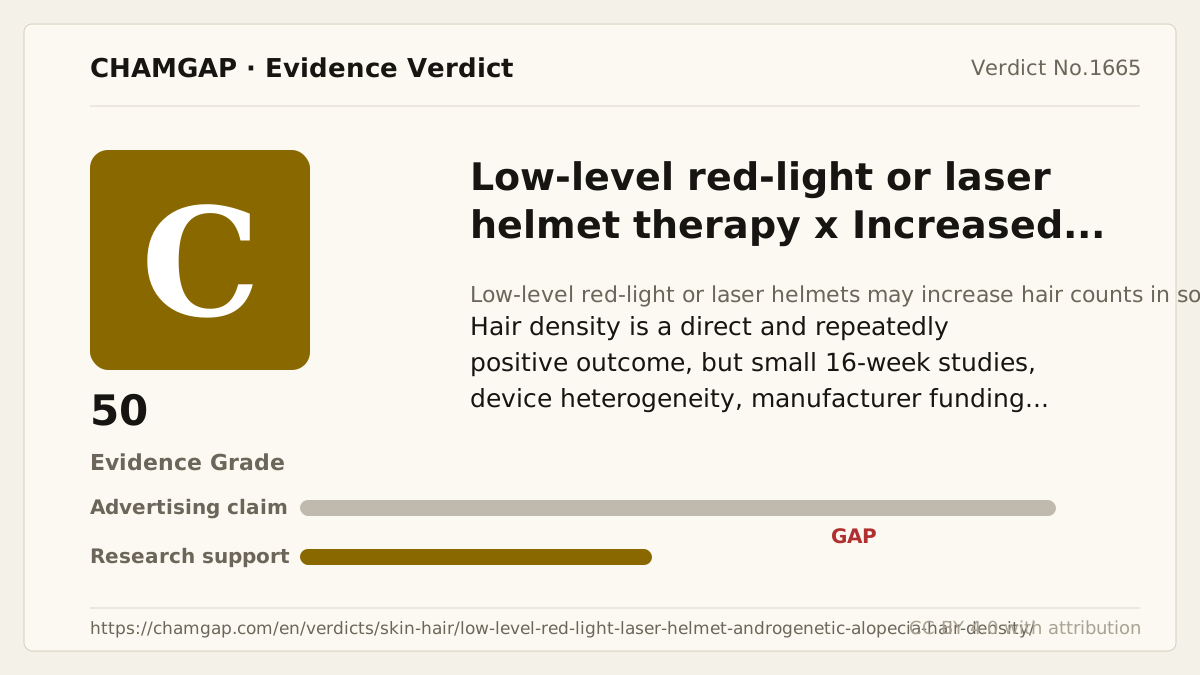
[Chamgap] Low-level red-light or laser helmet x increased hair density in androgenetic alopecia — Evidence Grade C·50. 3 cited sources checked. Source: https://chamgap.com/en/verdicts/skin-hair/low-level-red-light-laser-helmet-androgenetic-alopecia-hair-density/ · CC BY 4.0CC BY 4.0 — free to use with attribution; do not distort grades, numbers, or verdict meaning.
What this document does and does not do
Chamgap is an information source. It reports what research has and has not confirmed; it does not tell readers what to take or buy. That decision belongs to readers and, when needed, medical or legal professionals. This verdict reflects literature available up to the search date and may change as new research appears. Nothing here is medical advice.