
Ketoconazole shampoo,
does it really help with Reduced scalp seborrheic dermatitis, dandruff, itching, and recurrence?
research showsKetoconazole shampoo is rated B because it reduces scalp seborrheic dermatitis and dandruff. An independent 2015 Cochrane review found that ketoconazole 2% reduced four-week treatment failure versus placebo, with RR 0.69 (95% CI 0.59 to 0.81) across eight trials and 2,520 participants. Certainty was low, heterogeneity was I²=74%, and many trials were old, industry-linked, and symptom-based, giving low-range B with 64 points. The hair-loss extension remains a separate C because only five human studies with 318 participants provide limited signals and the reviewers called for randomized trials.
ads claimMarketing may turn control of dandruff into a permanent cure, claim no recurrence after one course, or expand antifungal action into DHT blockade and proven hair regrowth. Seborrheic dermatitis is relapsing, recurrence occurred even during maintenance, and androgenetic-alopecia evidence is only a limited adjunctive signal.
Useful facts when choosing a product
- A commonly studied ketoconazole 2% shampoo regimen used twice-weekly treatment for two to four weeks, followed in responders by weekly maintenance; actual use should follow national labeling and the product instructions.
- The shampoo is a topical medicine applied to wet scalp and hair, left in contact for the directed time, and rinsed thoroughly; contact with the eyes and injured mucosa should be avoided.
- Local irritation, burning, itching, dryness, hair-texture change, or uncommon hair loss can occur. Severe redness, swelling, or an allergic reaction warrants discontinuation and evaluation.
- Systemic absorption from shampoo is minimal, so oral ketoconazole hepatotoxicity should not be directly transferred to this product; minimal absorption does not imply systemic antifungal efficacy or established treatment of androgenetic alopecia.
Chamgap Semantic Classification Code
Candidate index · review held
UNK.ketoconazole-shampoo.topical-skin.scalp-seborrheic-dermatitis-dandruff-itching-and-recurrence.reduce.placeboUnknown > Ketoconazole shampoo > Topical skin > scalp seborrheic dermatitis, dandruff, itching, and recurrence > Reduction claim > Placebo
An automated migration candidate, not an issued permanent code; exact claim scope remains under review. This machine-generated migration candidate helps retrieval but is not a permanent assignment. The original verdict ID and URL remain authoritative.
What the research actually shows
Peter and Richarz-Barthauer 1995 treated 575 patients with moderate-to-severe scalp seborrheic dermatitis and dandruff using ketoconazole 2% shampoo twice weekly for two to four weeks and reported an excellent response in 88%. Among 312 responders assigned to six-month maintenance, relapse occurred in 19% with weekly active shampoo, 31% with alternating active shampoo and placebo, and 47% with weekly placebo. Okokon 2015 included 51 antifungal trials with 9,052 participants; eight ketoconazole 2%-versus-placebo trials with 2,520 participants gave a failed-clearance RR of 0.69, although heterogeneity was high. Extension to hair loss is separate: Fields 2020 reviewed five human topical-ketoconazole studies with 318 participants and found signals in hair-shaft diameter and related measures, but concluded that randomized placebo-controlled trials are needed, limiting that separate claim to C.
Why this is classified as B (64)
An independent Cochrane meta-analysis of eight ketoconazole 2%-versus-placebo trials with 2,520 participants found four-week treatment-failure RR 0.69 (95% CI 0.59 to 0.81), supporting B. Low certainty, I²=74%, old industry-linked trials, and symptom-based outcomes lower the score to 64. The separate hair-loss claim remains C because five human studies with 318 participants provide limited signals and the reviewers called for randomized trials.
Counterpoint. When treatment fails or thick plaques, pain, oozing, or hair loss accompany symptoms, psoriasis, contact dermatitis, tinea capitis, and other diagnoses should be assessed. Even after control, the condition can relapse and maintenance may be discussed when needed.
Rejudgment record. New verdict — Accepted direct symptom improvement and six-month relapse reduction in a multicenter trial plus a pooled benefit across eight placebo-controlled trials with 2,520 participants, but used B rather than A because the studies are old, follow-up is often short, heterogeneity is high, certainty is low, and industry conflicts are common
Sub-claim grades by effect
This ingredient is marketed for several effects. A single overall grade blends strong and weak claims together, so each effect is graded separately here. The overall grade reflects the strongest disconfirming or core claim.
| Effect (sub-claim) | Grade | Basis |
|---|---|---|
| Overall improvement of scalp seborrheic dermatitis and dandruff | B | A direct multicenter trial and placebo-controlled meta-analysis support overall clearance and reduced treatment failure. |
| Improvement of individual itching, redness, and scaling symptoms | C | In the Cochrane review, individual symptom outcomes were less consistent than overall clearance and were limited by subjective measurement. |
| Prevention of seborrheic-dermatitis and dandruff relapse during maintenance | B | In the six-month maintenance phase with 312 responders, weekly active shampoo produced fewer relapses than placebo. |
| Improvement of androgenetic alopecia | C | Limited human studies show signals such as increased hair-shaft diameter, but robust randomized placebo-controlled confirmation is absent, giving a separate C. |
| Systemic antifungal or other systemic benefit from scalp use | ? | Systemic absorption from shampoo is minimal, and no human efficacy literature evaluating systemic benefit from scalp use was identified. |
Cross-check — AI research and Codex final gate
Evidence Table
| Study | Design | Sample | Funding | Endpoint | Result | Weight |
|---|---|---|---|---|---|---|
| Peter RU and Richarz-Barthauer U. 1995 | Multicenter initial-treatment study and double-blind placebo-controlled maintenance trial | 575 initially; 312 responders in six-month maintenance | Limited reporting; conducted in the ketoconazole product-development era | Scalp seborrheic-dermatitis and dandruff response and relapse | Excellent initial response was 88%; six-month relapse was 19% with weekly active treatment, 31% with alternating active treatment and placebo, and 47% with weekly placebo. | Key direct symptom and relapse trial |
| Okokon EO et al. Cochrane review, 2015 | Systematic review and meta-analysis of randomized trials of topical antifungals | 51 trials and 9,052 participants; eight ketoconazole 2%-versus-placebo trials with 2,520 participants | Academic Cochrane review; 24 included trials had potential conflicts of interest | Failed clearance at four weeks, individual symptoms, and adverse events | The failed-clearance RR was 0.69 (95% CI 0.59 to 0.81), but certainty was low and heterogeneity was I²=74%. | Key efficacy synthesis that also establishes quality limitations |
| Fields JR et al. 2020 | Systematic review of topical ketoconazole for androgenetic alopecia | Five human studies with 318 participants; two animal studies with 40 animals | Academic literature review | Hair-shaft diameter, pilary index, photographs, and subjective assessment | Some positive signals were reported, but the authors concluded that randomized placebo-controlled trials are needed. | Limited separate evidence for the hair-loss extension |
Receipt — 4 References
All 4 cited sources were verified for existence at the original page (as of 2026-07-19).
Final verification and publication gate: Codex · Evidence date: 2026-07-19 · Corrections: none
Cite this verdict
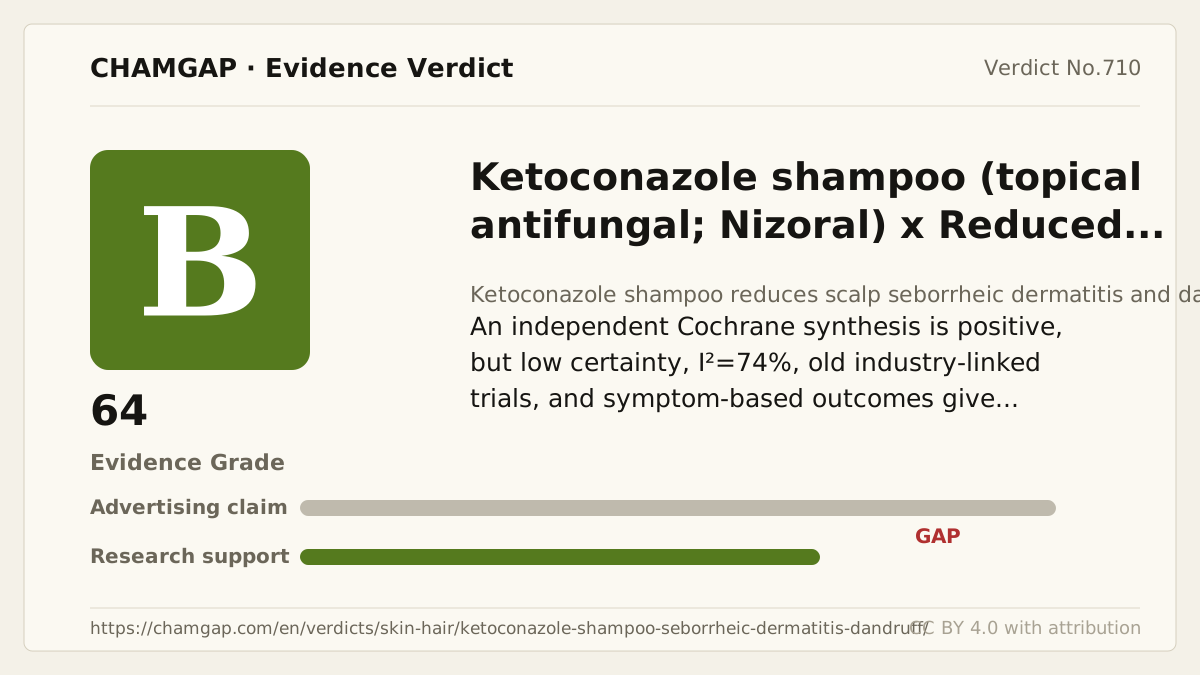
[Chamgap] Ketoconazole shampoo x reduced scalp seborrheic dermatitis, dandruff, itching, and recurrence — Evidence Grade B·64. 4 cited sources checked. Source: https://chamgap.com/en/verdicts/skin-hair/ketoconazole-shampoo-seborrheic-dermatitis-dandruff/ · CC BY 4.0CC BY 4.0 — free to use with attribution; do not distort grades, numbers, or verdict meaning.
What this document does and does not do
Chamgap is an information source. It reports what research has and has not confirmed; it does not tell readers what to take or buy. That decision belongs to readers and, when needed, medical or legal professionals. This verdict reflects literature available up to the search date and may change as new research appears. Nothing here is medical advice.