
Ivermectin,
does it really help with Mite clearance and clinical cure of classic scabies?
research showsOral ivermectin is rated B because it can clear active lesions and detectable mites and produce clinical cure in classic scabies. In a 2000 randomized trial, cure was 70% after one dose and rose to 95% after a second dose two weeks later. The 2018 Cochrane review estimated complete clearance at four weeks in 86% with ivermectin and 93% with permethrin, although most certainty was low to moderate. More decisively, a 2026 cluster trial of 1,075 people in 289 households found that two-dose ivermectin achieved household cure in 71.8% versus 88.5% with permethrin and failed non-inferiority. Ivermectin is therefore an effective alternative, but it is not superior or always equivalent to permethrin. Parity with permethrin scabies verdict 975, with a deduction for this inferiority signal, supports B with 68 points. COVID-19 verdict 713 is a wholly different pathogen and efficacy axis. Pregnancy, weight below 15 kg, liver disease, and rare neurologic events are separated under safety.
ads claimClaims of curing scabies with a single pill or of always matching permethrin are stronger than the evidence. Because scabies eggs are not reliably killed, repeat treatment after 7 to 14 days is generally needed. Household members and close contacts must be treated at the same time to avoid apparent failure from reinfestation. Itching can persist for weeks after mites are eliminated, so itch alone does not prove immediate failure.
Useful facts when choosing a product
- The common oral regimen for classic scabies is 200 micrograms/kg repeated after 7 to 14 days. Approval status and food instructions differ by country and product, so the prescription and local label should be followed.
- Treating only the index patient invites reinfestation, so household members and close contacts should be assessed and treated at the same time. Recently used clothing, bedding, and towels also require laundering or temporary sealed storage.
- Itching and dermatitis can persist for weeks after successful mite clearance. New burrows, new lesions, living mites, or continuing deterioration warrants reassessment.
- Safety is not adequately established in pregnancy or children weighing less than 15 kg. Clinicians should review liver disease, neurologic disease, and important interacting medicines before treatment.
Chamgap Semantic Classification Code
Candidate index · review held
M.ivermectin.UNK.mite-clearance-and-clinical-cure-of-classic-scabies.treat.activeMedicinal interventions > Ivermectin > Unknown > Mite clearance and clinical cure of classic scabies > Treatment or remission claim > Active comparator
An automated migration candidate, not an issued permanent code; exact claim scope remains under review. This machine-generated migration candidate helps retrieval but is not a permanent assignment. The original verdict ID and URL remain authoritative.
What the research actually shows
Usha in 2000 randomized 85 people with classic scabies to oral ivermectin 200 micrograms/kg or permethrin 5% cream and reported cure of 70% after one ivermectin dose, 95% after a second dose two weeks later, and 97.8% after one permethrin application. The 2018 Rosumeck Cochrane review examined 15 randomized trials with 1,896 participants and estimated four-week complete clearance at 86% with ivermectin and 93% with permethrin, risk ratio 0.92, 95% CI 0.82 to 1.03, with low certainty. Boralevi in 2026 cluster-randomized 1,075 participants in 289 households across 28 French hospitals and repeated both regimens on days 0 and 10; day-28 cure was 71.8% versus 88.5% by household, 76.6% versus 91.5% among index cases, and 85.3% versus 94.2% at the individual level, favoring permethrin. Ivermectin COVID-19 verdict 713 concerns a viral disease and an entirely different efficacy axis.
Why this is classified as B (68)
Across several randomized trials and the 15-trial Cochrane review, oral ivermectin repeatedly achieved the direct outcomes of complete clearance and clinical cure in classic scabies, with smaller studies often approaching 90% cure after two doses. Early evidence nevertheless had mostly low-to-moderate certainty and weaker single-dose efficacy. In the independent 2026 cluster trial with 1,075 participants, even two-dose ivermectin achieved only 71.8% household cure versus 88.5% with permethrin. This is inferiority to an active alternative, not a negative placebo trial establishing no effect, so parity with permethrin verdict 975 retains a B while lowering the score to 68. COVID-19 verdict 713 is not transferred to scabies, and safety is separate.
Counterpoint. Crusted scabies, immunosuppression, and institutional outbreaks may require more frequent oral dosing plus topical therapy, keratolysis, and coordinated contact control rather than two-dose ivermectin alone. Self-treatment based on itching without examination, microscopy, or dermoscopy can miss another skin disease.
Rejudgment record. Cross-verification incorporated — Prioritized repeated randomized evidence and the 15-trial Cochrane synthesis for the direct outcomes of complete clearance and clinical cure in classic scabies, while accounting for low-to-moderate certainty in early trials, weak single-dose performance, and inferior household cure of 71.8% versus 88.5% with permethrin in the 1,075-participant 2026 cluster trial, with parity to permethrin verdict 975 and strict separation from COVID-19 verdict 713
Sub-claim grades by effect
This ingredient is marketed for several effects. A single overall grade blends strong and weak claims together, so each effect is graded separately here. The overall grade reflects the strongest disconfirming or core claim.
| Effect (sub-claim) | Grade | Basis |
|---|---|---|
| Complete clearance of detectable mites and active lesions in classic scabies | B | Complete-clearance outcomes across randomized trials provide support, although clinical, microscopic, and dermoscopic definitions varied and retreatment is usually needed. |
| Clinical cure of classic scabies with two-dose oral ivermectin | B | A 95% cure rate in a small trial and 85.3% individual cure in the large trial provide direct support, but efficacy was lower than permethrin. |
| Complete cure of classic scabies after one ivermectin dose | C | Single-dose cure was about 70%, and limited activity against eggs generally requires a second dose after 7 to 14 days. |
Cross-check — AI research and Codex final gate
Evidence Table
| Study | Design | Sample | Funding | Endpoint | Result | Weight |
|---|---|---|---|---|---|---|
| Usha V, Gopalakrishnan Nair TV. 2000 | Randomized active-controlled clinical trial | 85 participants | Limited reporting | Clinical cure and complete response after retreatment | Ivermectin cure rose from 70% after one dose to 95% after a second dose two weeks later; one permethrin application achieved 97.8%. | Direct repeat-dose cure evidence |
| Rosumeck S et al. 2018 | Cochrane systematic review and meta-analysis of randomized trials | 15 trials and 1,896 participants; 5 trials and 581 participants at four weeks | Cochrane and academic work with incomplete sponsorship reporting in included trials | Complete clearance at one, two, and four weeks, retreatment, and adverse events | Four-week complete clearance was estimated at 86% with ivermectin and 93% with permethrin, RR 0.92, 95% CI 0.82 to 1.03, with low certainty. | Key synthesis with low-to-moderate certainty |
| Boralevi F et al. 2026 | Multicenter assessor-blinded household cluster-randomized non-inferiority trial | 289 households and 1,075 participants across 28 French hospitals | French Ministry of Health and French Society of Dermatology support; medicines supplied by MSD and Codexial | Household, index-case, and individual clinical cure at day 28 after treatment on days 0 and 10 | Household cure was 71.8% versus 88.5%, index-case cure 76.6% versus 91.5%, and individual cure 85.3% versus 94.2%, all favoring permethrin; ivermectin failed non-inferiority. | Latest large direct trial limiting comparative efficacy |
Receipt — 6 References
All 6 cited sources were verified for existence at the original page (as of 2026-07-21).
Final verification and publication gate: Codex · Evidence date: 2026-07-21 · Corrections: none
Cite this verdict
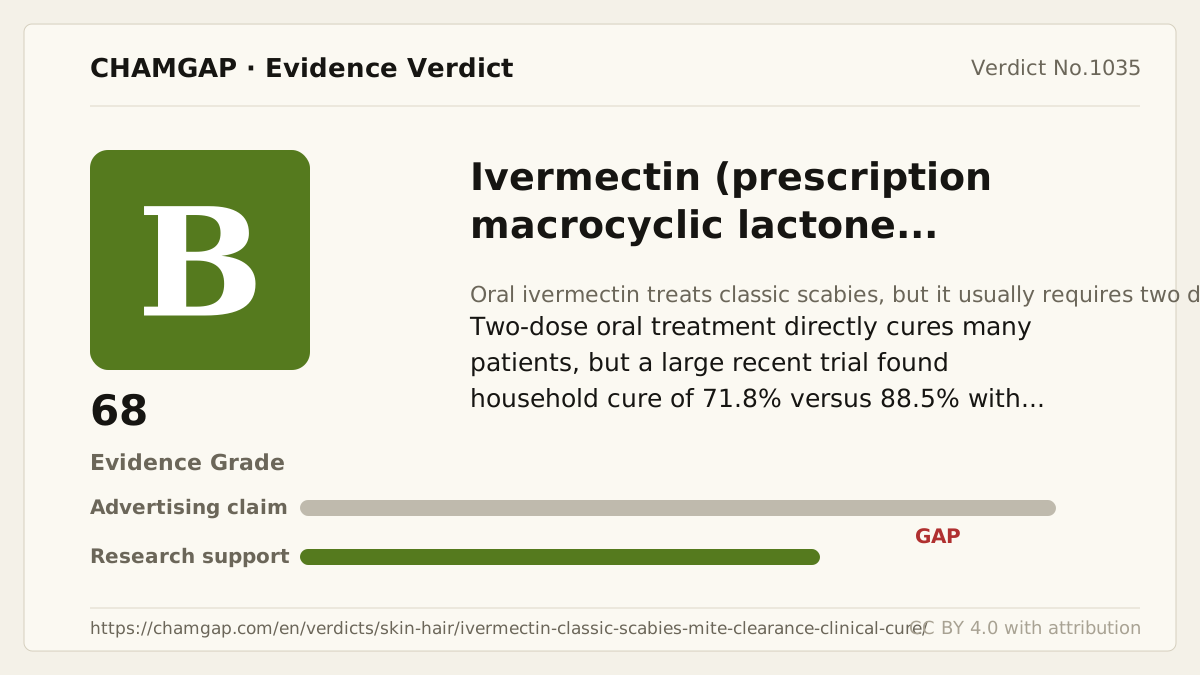
[Chamgap] Ivermectin x mite clearance and clinical cure of classic scabies — Evidence Grade B·68. 6 cited sources checked. Source: https://chamgap.com/en/verdicts/skin-hair/ivermectin-classic-scabies-mite-clearance-clinical-cure/ · CC BY 4.0CC BY 4.0 — free to use with attribution; do not distort grades, numbers, or verdict meaning.
What this document does and does not do
Chamgap is an information source. It reports what research has and has not confirmed; it does not tell readers what to take or buy. That decision belongs to readers and, when needed, medical or legal professionals. This verdict reflects literature available up to the search date and may change as new research appears. Nothing here is medical advice.