
Itraconazole,
does it really help with Mycological and clinical complete cure of dermatophyte toenail onychomycosis?
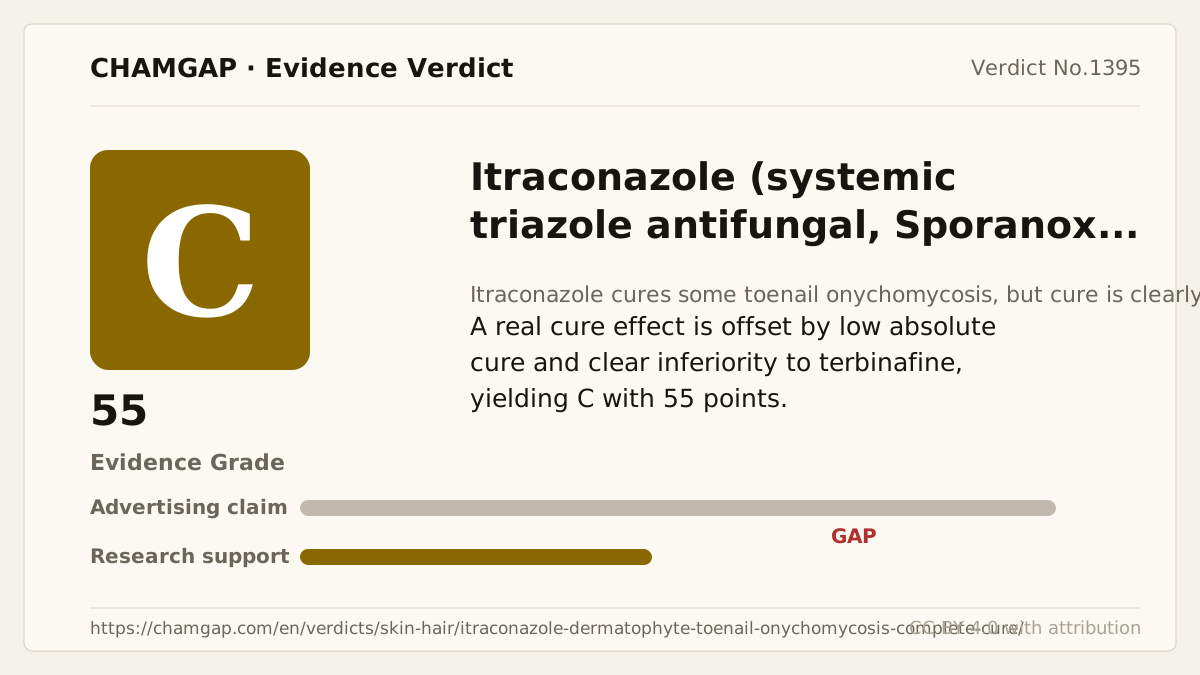
research showsItraconazole is rated C because it cures some dermatophyte toenail onychomycosis but performs clearly worse than first-line terbinafine. In the 496-participant LION trial, 72-week mycological cure was 38.3% after three itraconazole pulses and 49.1% after four, versus 75.7% and 80.8% with continuous terbinafine. Clinical outcomes also significantly favored terbinafine, and a Cochrane synthesis found lower mycological cure with azoles. The boundary rule for modest or low cure and clear inferiority to first-line therapy supports C with 55 points.
ads claimMarketing may portray oral therapy as a high complete-cure or relapse-free solution, while complete cure requires both a normal-growing nail and negative mycology and is substantially less frequent.
Useful facts when choosing a product
- Itraconazole is a systemic triazole antifungal, and microscopy, culture, or another appropriate test should confirm fungal nail infection before treatment.
- Continuous and pulse regimens are used; capsules and solution have different absorption characteristics, so formulation-specific food instructions matter.
- Hepatotoxicity and extensive CYP3A4 interactions require review of concomitant medicines and liver status.
- It should be avoided for onychomycosis in patients with heart failure or ventricular dysfunction risk, and QT-related interactions require caution.
Chamgap Semantic Classification Code
Candidate index · review held
M.itraconazole.oral.mycological-and-clinical-complete-cure-of-dermatophyte-toenail-onychomycosis.assess.MULTIMedicinal interventions > Itraconazole > Oral > Mycological and clinical complete cure of dermatophyte toenail onychomycosis > Association or change assessment > Multiple: primary unresolved
An automated migration candidate, not an issued permanent code; exact claim scope remains under review. This machine-generated migration candidate helps retrieval but is not a permanent assignment. The original verdict ID and URL remain authoritative.
What the research actually shows
Evans and Sigurgeirsson conducted LION across 35 centers, randomly assigning 496 participants under double-blind, double-dummy conditions to four regimens. Itraconazole produced culture and microscopy clearance but consistently lower mycological and clinical outcomes than terbinafine. A Cochrane review of 48 trials and 10,200 participants concluded that oral azoles improve clinical and mycological cure versus placebo but are less effective than terbinafine. Because LION was funded by the terbinafine manufacturer, absolute results and the broader synthesis were considered together.
Why this is classified as C (55)
Direct randomized evidence found only 38.3% to 49.1% mycological cure and clear inferiority to first-line terbinafine at 75.7% to 80.8%. The low-cure and first-line-inferiority boundary rule gives C with 55 points.
Counterpoint. Itraconazole remains an effective oral alternative to placebo, but complete cure of dermatophyte toenail disease should not be presented as comparable to terbinafine.
Rejudgment record. Cross-check applied — Applied boundary rule ★ to low absolute itraconazole cure and clear inferiority to terbinafine in LION, supported by the consistent Cochrane comparative synthesis. At cross-check the score was set to 55 for clear inferiority to terbinafine and a 38.3% mycological cure rate (grade C retained).
Sub-claim grades by effect
This ingredient is marketed for several effects. A single overall grade blends strong and weak claims together, so each effect is graded separately here. The overall grade reflects the strongest disconfirming or core claim.
| Effect (sub-claim) | Grade | Basis |
|---|---|---|
| Mycological cure | C | LION found 38.3% to 49.1% cure, clearly below terbinafine at 75.7% to 80.8%. |
| Clinical cure | C | Clinical secondary outcomes also significantly favored terbinafine in every comparison. |
| Combined mycological and clinical complete cure | C | Combined complete cure cannot exceed mycological cure and remains clearly inferior to first-line therapy. |
Cross-check — AI research and Codex final gate
Evidence Table
| Study | Design | Sample | Funding | Endpoint | Result | Weight |
|---|---|---|---|---|---|---|
| Evans EGV, Sigurgeirsson B; LION Study Group 1999 | Multicenter randomized double-blind double-dummy active-controlled trial | 496 participants | Novartis, the terbinafine manufacturer | Mycological cure at week 72 and clinical secondary outcomes | Itraconazole 38.3% and 49.1% versus terbinafine 75.7% and 80.8%; all comparisons P<0.0001. | Key head-to-head comparison |
| Kreijkamp-Kaspers S et al. Cochrane 2017 | Systematic review of randomized oral-antifungal trials | 48 trials and 10,200 participants | Cochrane systematic review with author disclosures | Clinical cure, mycological cure, and recurrence | Azoles were effective versus placebo but had lower mycological cure than terbinafine (RR 0.77, 95% CI 0.68 to 0.88). | Independent synthesis |
| Ameen M et al. BAD guideline 2014 | Evidence-based clinical guideline | Synthesis of onychomycosis treatment evidence | British Association of Dermatologists | Treatment selection for dermatophyte onychomycosis | Preferred terbinafine over itraconazole as first-line therapy for dermatophyte onychomycosis. | First-line comparative context |
Receipt — 3 References
All 3 cited sources were verified for existence at the original page (as of 2026-07-23).
Final verification and publication gate: Codex · Evidence date: 2026-07-23 · Corrections: none
Cite this verdict
[Chamgap] Itraconazole x complete cure of dermatophyte toenail onychomycosis — Evidence Grade C·55. 3 cited sources checked. Source: https://chamgap.com/en/verdicts/skin-hair/itraconazole-dermatophyte-toenail-onychomycosis-complete-cure/ · CC BY 4.0CC BY 4.0 — free to use with attribution; do not distort grades, numbers, or verdict meaning.
What this document does and does not do
Chamgap is an information source. It reports what research has and has not confirmed; it does not tell readers what to take or buy. That decision belongs to readers and, when needed, medical or legal professionals. This verdict reflects literature available up to the search date and may change as new research appears. Nothing here is medical advice.