
Isotretinoin,
does it really help with Lesion remission in severe, scarring-risk, or standard-treatment-refractory acne?
research showsOral isotretinoin is rated high B because it markedly reduces lesions and can induce remission after a treatment course in severe nodular or cystic acne, acne at risk of scarring, or acne refractory to standard treatment. A double-blind dose trial in 150 patients found a large response at every dose in treatment-resistant nodulocystic acne, and a systematic review of randomized trials found clinically important lesion reductions across the included studies. However, a 2018 Cochrane review rated the key comparison against standard oral-antibiotic plus topical therapy as very-low-certainty evidence. Direct trials are old and dominated by product-development, active-formulation, or dose comparisons, while long-term remission relies heavily on observational evidence. Clinical status alone therefore does not justify A, and the verdict is B with 78 points. Exposure during pregnancy can cause severe birth defects and is absolutely contraindicated; lipid, liver, and mood monitoring remain separate safety issues.
ads claimOnline promotion may call isotretinoin a permanent acne cure or, at the opposite extreme, a poison that inevitably causes depression. The evidence-based description is that it is among the most powerful disease-modifying treatments for severe, scarring-risk, or refractory acne, but relapse can occur and its absolute teratogenic risk requires strict prescribing, pregnancy prevention, and monitoring.
Useful facts when choosing a product
- Oral isotretinoin is a prescription medicine whose dose and treatment duration are adjusted by a specialist according to body weight, lesion severity, tolerability, and cumulative exposure, and food requirements vary by formulation.
- It is absolutely contraindicated in pregnancy, and patients who can become pregnant must follow pregnancy-testing and contraception requirements before, during, and after treatment; the United States uses the iPLEDGE risk-management program.
- Dry lips, skin, and eyes are very common, and triglycerides and liver enzymes can rise, so history- and risk-based laboratory and clinical monitoring is required.
- Mood changes or suicidal thoughts should be reported immediately even though causality is complex, and concomitant tetracycline antibiotics and vitamin A supplements should be avoided.
Chamgap Semantic Classification Code
Candidate index · review held
M.isotretinoin.oral.lesion-remission-in-severe-scarring-risk-or-standard-treatment-refractory-acne.treat.MULTIMedicinal interventions > Isotretinoin > Oral > Lesion remission in severe, scarring-risk, or standard-treatment-refractory acne > Treatment or remission claim > Multiple: primary unresolved
An automated migration candidate, not an issued permanent code; exact claim scope remains under review. This machine-generated migration candidate helps retrieval but is not a permanent assignment. The original verdict ID and URL remain authoritative.
What the research actually shows
The 1984 Strauss double-blind multicenter dose trial assigned 150 patients with treatment-resistant nodulocystic acne to three doses and found a highly significant clinical response at every dose. Retreatment was required in 42% of the 0.1-mg/kg/day group, suggesting that cumulative exposure affects durability. The 2018 Vallerand systematic review found clinically important lesion-count reductions favoring isotretinoin across 11 randomized trials, but study quality and heterogeneity were limitations. The Costa Cochrane review included 31 randomized trials and 3,836 participants; the inflammatory-lesion count did not differ from oral-antibiotic plus topical standard therapy, but certainty was very low, while physician-assessed severity may improve slightly more. The 2025 Lai and Barbieri claims cohort found relapse in 22.5% and retreatment in 8.2% of 19,907 patients, distinguishing durable remission for many from a permanent cure for everyone.
Why this is classified as B (78)
A large direct lesion response in a double-blind dose trial, consistent clinical reductions across 11 randomized trials, and durable remission in many patients in long-term cohorts support high B. However, Cochrane rated key comparisons with standard therapy as low or very low certainty, the largest trials were active-formulation product-development comparisons, and durable remission relies on observational data. The clinical effect is stronger than that of topical therapy in severe disease but does not meet the independent large superiority-trial standard for A, yielding B with 78 points. Absolute teratogenicity and lipid, liver, and mood monitoring remain separate safety issues.
Counterpoint. Topical retinoids and benzoyl peroxide or other lower-risk therapy may be preferable first for acne that is not severe and carries little scarring risk. Conversely, excessive delay can also be harmful when scarring is progressing or severe disease has failed appropriate antibiotic and topical treatment.
Rejudgment record. New verdict — Gave substantial weight to the large direct lesion reduction and remission signal in severe treatment-resistant acne, but applied a high-B rather than A grade because Cochrane rated key comparative evidence as low or very low certainty, randomized trials are dominated by old dose or active-formulation comparisons, and durable remission relies heavily on observation
Sub-claim grades by effect
This ingredient is marketed for several effects. A single overall grade blends strong and weak claims together, so each effect is graded separately here. The overall grade reflects the strongest disconfirming or core claim.
| Effect (sub-claim) | Grade | Basis |
|---|---|---|
| Lesion reduction in severe treatment-refractory nodular acne | B | Large direct lesion reductions were repeated in a double-blind dose trial and randomized-trial syntheses, but comparative certainty is low or very low. |
| Induction of clinical remission after one treatment course | B | Many patients remain off further systemic treatment after a course, but durable-remission evidence is heavily observational. |
| Reduction in long-term need for relapse treatment or retreatment | B | A large cohort found 22.5% relapse and 8.2% retrial, indicating substantial but not permanent durability. |
Cross-check — AI research and Codex final gate
Evidence Table
| Study | Design | Sample | Funding | Endpoint | Result | Weight |
|---|---|---|---|---|---|---|
| Strauss JS et al. 1984 | Multicenter double-blind randomized dose-response trial | 150 patients with treatment-resistant nodulocystic acne | Funding not reported in the PubMed abstract; early product-development era | Clinical lesion response, adverse effects, remission duration, and retreatment | All three doses produced highly significant clinical responses, while 42% of the 0.1-mg/kg/day group required retreatment. | Key direct lesion-efficacy trial without placebo |
| Vallerand IA et al. 2018 | Systematic review of controlled randomized trials | 11 randomized trials | Canadian academic investigators; no industry support reported in the PubMed abstract | Acne lesion counts and adverse events | Across trials, isotretinoin produced clinically important lesion reductions greater than placebo, antibiotics, or other controls, with heterogeneity and quality limitations. | Synthesis of consistent efficacy direction |
| Costa CS et al. 2018 | Cochrane systematic review of randomized trials | 31 randomized trials and 3,836 participants | Cochrane and academic institutions; some author industry interests disclosed | Inflammatory lesion count, physician-assessed severity, and adverse events | Inflammatory lesion counts did not differ from standard antibiotic-plus-topical therapy, but certainty was very low; physician-assessed severity may improve slightly more. | Certainty assessment limiting an A grade |
| Lai J and Barbieri JS. 2025 | Large retrospective insurance-claims cohort | 19,907 patients completing a treatment course | Academic cohort; funding not stated in the article abstract | Post-treatment acne relapse and isotretinoin retrial | Relapse occurred in 22.5% and retrial in 8.2%, showing durable benefit for many but recurrence in a meaningful minority. | Real-world adjustment for durable remission and relapse |
Receipt — 5 References
All 5 cited sources were verified for existence at the original page (as of 2026-07-21).
Final verification and publication gate: Codex · Evidence date: 2026-07-21 · Corrections: none
Cite this verdict
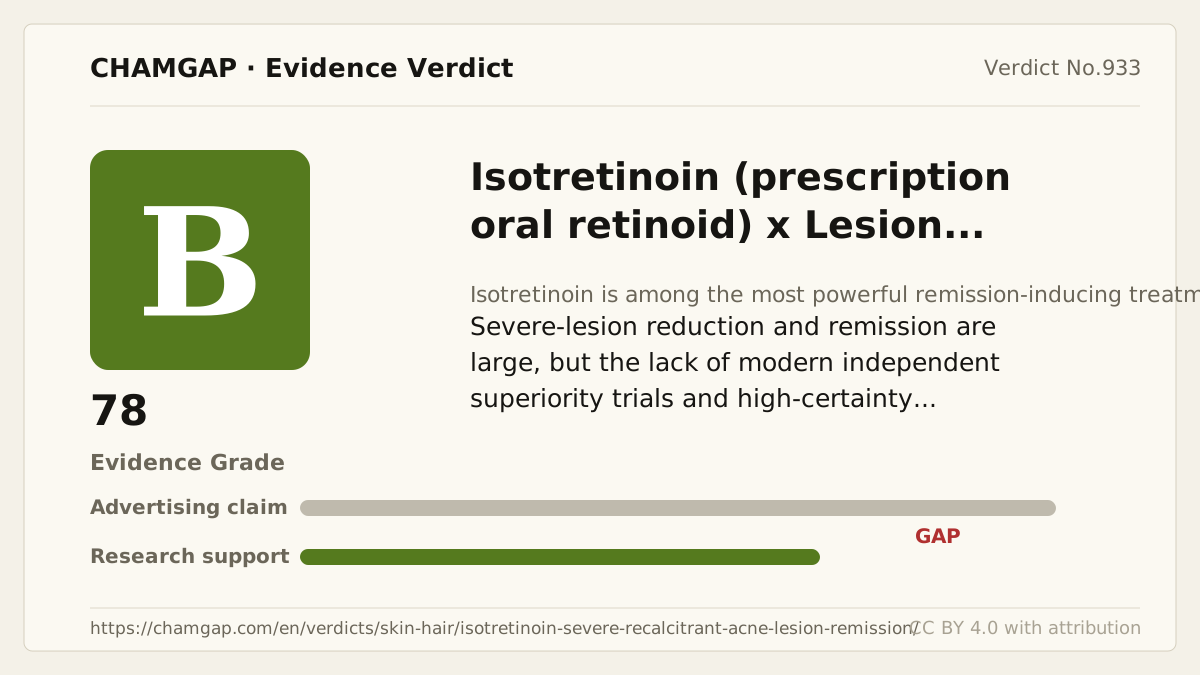
[Chamgap] Isotretinoin x lesion remission in severe, scarring-risk, or treatment-refractory acne — Evidence Grade B·78. 5 cited sources checked. Source: https://chamgap.com/en/verdicts/skin-hair/isotretinoin-severe-recalcitrant-acne-lesion-remission/ · CC BY 4.0CC BY 4.0 — free to use with attribution; do not distort grades, numbers, or verdict meaning.
What this document does and does not do
Chamgap is an information source. It reports what research has and has not confirmed; it does not tell readers what to take or buy. That decision belongs to readers and, when needed, medical or legal professionals. This verdict reflects literature available up to the search date and may change as new research appears. Nothing here is medical advice.