
Imiquimod 5% cream,
does it really help with Nonsurgical tumor clearance and long-term treatment success for low-risk superficial or nodular basal cell carcinoma?
research showsImiquimod 5% cream is rated B because randomized evidence and long-term follow-up demonstrate direct tumor treatment in primary superficial or nodular basal cell carcinoma at low-risk sites. In SINS, three-year success was 83.6% versus 98.4% with surgery, and five-year success was 82.5% versus 97.7%. Surgery therefore remains standard, while imiquimod can be a nonsurgical option for small low-risk lesions when scarring and patient preference matter.
ads claimMarketing can reduce the evidence to a scar-free cream that removes skin cancer as effectively as surgery. Local inflammation is common, failure and recurrence are more frequent than after surgery, and use is a nonsurgical alternative only for selected low-risk lesions.
Useful facts when choosing a product
- Imiquimod is a prescription topical immune-response modifier, and lesion subtype, site, and size should be confirmed by a dermatologist before treatment.
- SINS used daily treatment for six weeks in superficial disease and 12 weeks in nodular disease, but actual authorization and prescribing must follow the country-specific label.
- Erythema, itching, erosion, weeping, crusting, pain, and post-treatment pigment change are common; severe reactions or suspected infection require clinician review.
- Clinical disappearance does not exclude residual or recurrent disease, so ongoing skin surveillance is required.
Chamgap Semantic Classification Code
Candidate index · review held
M.imiquimod-5-percent-cream.topical-skin.nonsurgical-tumor-clearance-and-long-term-treatment-success-for-low-risk-superficial-or-nodular-basal-cell-carcinoma.treat.UNKMedicinal interventions > Imiquimod 5% cream > Topical skin > Nonsurgical tumor clearance and long-term treatment success for low-risk superficial or nodular basal cell carcinoma > Treatment or remission claim > Unknown
An automated migration candidate, not an issued permanent code; exact claim scope remains under review. This machine-generated migration candidate helps retrieval but is not a permanent assignment. The original verdict ID and URL remain authoritative.
What the research actually shows
Bath-Hextall 2014 randomized 501 participants with histologically confirmed primary superficial or nodular basal cell carcinoma at low-risk sites to imiquimod or excision with a 4-mm margin. Three-year success was 168 of 202 versus 184 of 187. Williams 2017 found five-year success of 170 of 206 versus 173 of 177, with most imiquimod failures occurring in year one.
Why this is classified as B (68)
Direct randomized comparison and five-year follow-up show durable nonsurgical tumor treatment. However, success of 83.6% at three years and 82.5% at five years is clearly below surgery at 98.4% and 97.7%, and results do not generalize to high-risk lesions, giving B with 68 points.
Counterpoint. When surgical burden or cosmetic concerns are substantial and a lesion is small and low risk, convenience and nonsurgical treatment may be preferred. This requires shared decision-making that acknowledges lower success and the need for surveillance.
Rejudgment record. Cross-check applied — Applied B because ingredient-specific randomized evidence and five-year follow-up establish direct treatment of primary low-risk superficial and nodular basal cell carcinoma, while materially lower success than excision imposes a comparative-inferiority ceiling. At cross-check the score was lowered to 68 to reflect clear inferiority to surgery (about 83% vs 98%) (grade B retained).
Sub-claim grades by effect
This ingredient is marketed for several effects. A single overall grade blends strong and weak claims together, so each effect is graded separately here. The overall grade reflects the strongest disconfirming or core claim.
| Effect (sub-claim) | Grade | Basis |
|---|---|---|
| Clearance of low-risk superficial basal cell carcinoma | B | Direct randomized evidence exists, but failures are more frequent than with surgery and applicability is limited to selected low-risk lesions. |
| Three-year recurrence-free treatment success in low-risk superficial or nodular basal cell carcinoma | B | SINS directly demonstrated 83.6% success, which was largely maintained at five years. |
| Nonsurgical clearance of low-risk nodular basal cell carcinoma | B | SINS included nodular disease, but treatment was inferior to surgery and does not apply to high-risk, aggressive, or recurrent lesions. |
Cross-check — AI research and Codex final gate
Evidence Table
| Study | Design | Sample | Funding | Endpoint | Result | Weight |
|---|---|---|---|---|---|---|
| Bath-Hextall F et al. 2014 SINS | Multicenter pragmatic noninferiority randomized controlled trial | 501 randomized; 389 in the three-year modified intention-to-treat analysis | Cancer Research UK | Three-year clinical success without initial failure or recurrence | Success was 83.2% (168/202) with imiquimod and 98.4% (184/187) with surgery, demonstrating inferiority. | Key direct tumor-treatment trial |
| Williams HC et al. 2017 SINS five-year follow-up | Long-term follow-up of a randomized trial | 383 participants with five-year data | Original trial funded by Cancer Research UK | Five-year treatment success | Success was 82.5% (170/206) with imiquimod and 97.7% (173/177) with surgery; most imiquimod failures occurred in year one. | Confirms durability and inferiority to surgery |
Receipt — 2 References
All 2 cited sources were verified for existence at the original page (as of 2026-07-23).
Final verification and publication gate: Codex · Evidence date: 2026-07-23 · Corrections: none
Cite this verdict
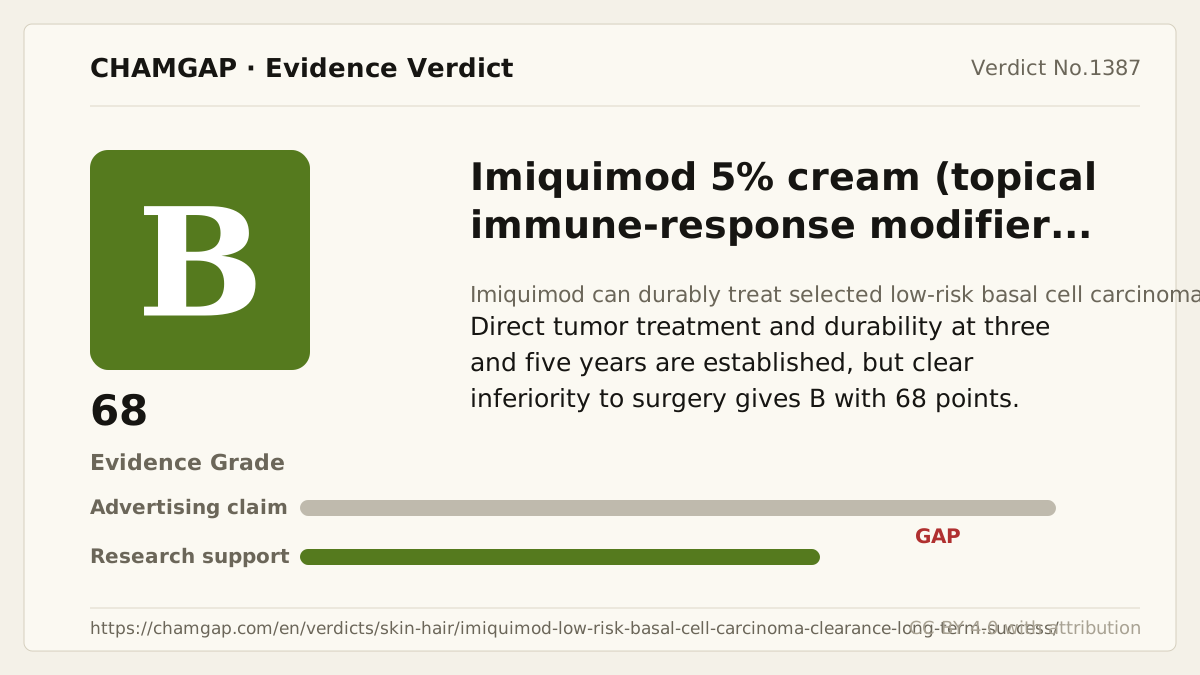
[Chamgap] Imiquimod 5% cream x nonsurgical clearance and long-term success in low-risk basal cell carcinoma — Evidence Grade B·68. 2 cited sources checked. Source: https://chamgap.com/en/verdicts/skin-hair/imiquimod-low-risk-basal-cell-carcinoma-clearance-long-term-success/ · CC BY 4.0CC BY 4.0 — free to use with attribution; do not distort grades, numbers, or verdict meaning.
What this document does and does not do
Chamgap is an information source. It reports what research has and has not confirmed; it does not tell readers what to take or buy. That decision belongs to readers and, when needed, medical or legal professionals. This verdict reflects literature available up to the search date and may change as new research appears. Nothing here is medical advice.