
Hydrocolloid acne patch,
does it really help with Improved appearance and severity of mild-to-moderate inflammatory acne lesions?
research showsThe grade is C with 46 points. A one-week randomized double-blind parallel trial assigned 20 participants, 10 per group, and found greater reductions in overall acne severity, inflammation, redness, oiliness, and pigmentation with hydrocolloid dressing than ordinary skin tape. Mean overall severity changed from 1.80 to 0.43 versus 1.08 to 0.80. This was not a split-face study, did not report absolute lesion counts, used a small ordinal appearance scale, did not specify one primary endpoint, and the confidence interval could not be confirmed because the full text was unavailable.
ads claimPatches sold through Korean drugstores, Olive Young, and online retailers vary in thickness, adhesive, additives, and microneedles. Social-media before-and-after reports often conflate absorbing fluid from an opened surface lesion with preventing new acne. This trial tested a drug-free 3M hydrocolloid against skin tape for one week.
Useful facts when choosing a product
- Hydrocolloid absorbs exudate into a gel and shields a lesion from touching and friction.
- UVB transmission was 7.4% with Acne Dressing and 38% with skin tape, a material property rather than proof of acne treatment.
- Verdict 1329 is D with 25 points for snail secretion filtrate in mask acne and recovery, a different cosmetic ingredient and intervention.
Chamgap Semantic Classification Code
Candidate index · review held
UNK.drug-free-hydrocolloid-acne-patch.UNK.appearance-and-severity-of-mild-to-moderate-inflammatory-acne-lesions.improve.activeUnknown > Drug-free hydrocolloid acne patch > Unknown > appearance and severity of mild-to-moderate inflammatory acne lesions > Improvement claim > Active comparator
An automated migration candidate, not an issued permanent code; exact claim scope remains under review. This machine-generated migration candidate helps retrieval but is not a permanent assignment. The original verdict ID and URL remain authoritative.
What the research actually shows
Chao and colleagues randomized 20 patients with mild-to-moderate acne to 3M Health Care Acne Dressing or ordinary skin tape, 10 per parallel group, applied every two days for up to one week. It was not split-face or within-person lesion randomization. The paper called the study randomized, double blind, and skin-type controlled, but the public abstract did not detail assessor masking. Overall severity changed from 1.80 to 0.43 with hydrocolloid and 1.08 to 0.80 with tape; between-group differences were significant from days 3 through 7. Redness, oiliness, dark pigmentation, and sebum casual level also improved more at days 3, 5, and 7. Absolute lesion counts were not included in the public abstract. Because the full text could not be obtained, SD, SE, confidence intervals, and test statistics could not be confirmed. The paper listed several objectives but did not identify one prespecified primary endpoint. It named the product as 3M Health Care Acne Dressing, but the full text could not be obtained, so funding and product provision could not be confirmed.
Why this is classified as C (46)
Appearance scores improved over active skin tape, but a 20-person one-week study with no clear primary endpoint, ordinal scoring, and an interval that could not be confirmed without the full text gives C with 46 points.
Counterpoint. A patch may cover and absorb a superficial inflamed lesion, but this does not establish treatment of comedone formation, deep nodules or cysts, or prevention of new lesions.
Rejudgment record. Cross-check applied — A 20-person parallel pilot improved ordinal appearance scores versus skin tape but had one-week follow-up, no clear primary endpoint, baseline imbalance, and precision that could not be confirmed because the full text was unavailable
| Endpoint | P | Symptom or function itself is the target - including patient reports and performance tests |
| Replication | R1 | Single confirmatory trial |
| Independence | I1 | Mixed funding sources |
| Effect size | EX | The clinical size of the effect could not be judged |
Stored derived and displayed grades match; this is not a current recalculation or validity check (C).
Sub-claim grades by effect
This ingredient is marketed for several effects. A single overall grade blends strong and weak claims together, so each effect is graded separately here. The overall grade reflects the strongest disconfirming or core claim.
| Effect (sub-claim) | Grade | Basis |
|---|---|---|
| One-week improvement in appearance and inflammation scores | C | The 20-person pilot favored hydrocolloid over skin tape. |
| Prevention of new lesions and treatment of deep cysts | ? | The study did not directly test these outcomes. |
Cross-check — AI research and Codex final gate
Evidence Table
| Study | Design | Sample | Funding | Endpoint | Result | Weight |
|---|---|---|---|---|---|---|
| Chao CM et al. 2006 | Randomized double-blind parallel active-comparator pilot | 20 participants, 10 hydrocolloid and 10 skin tape | Product identified as 3M Health Care Acne Dressing; funding and product provision could not be confirmed because the full text was unavailable | Overall severity, inflammation, redness, oiliness, pigmentation, and sebum; no clearly specified primary endpoint | Overall severity 1.80 to 0.43 versus 1.08 to 0.80; significant between groups on days 3-7; CI could not be confirmed without the full text | Early small trial using inactive tape as the control |
Receipt — 1 References
All 1 cited sources were verified for existence at the original page (as of 2026-08-07).
Final verification and publication gate: Codex · Evidence date: 2026-08-07 · Corrections: none
Cite this verdict
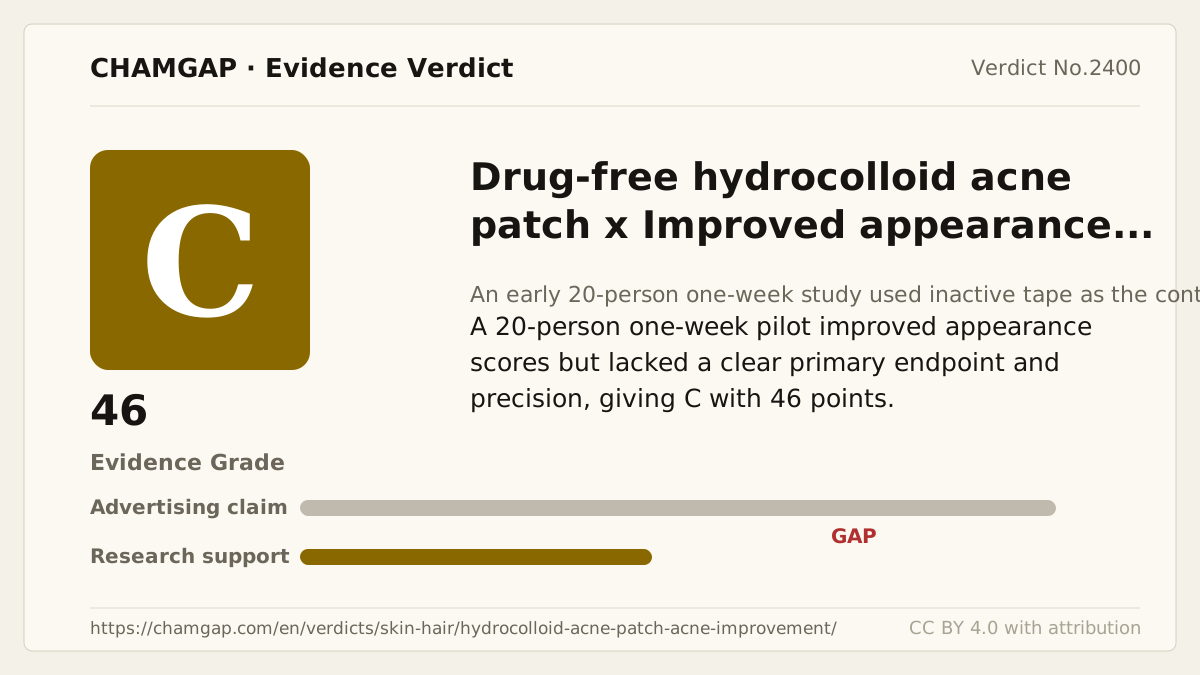
[Chamgap] Hydrocolloid acne patch x acne improvement — Evidence Grade C·46. 1 cited sources checked. Source: https://chamgap.com/en/verdicts/skin-hair/hydrocolloid-acne-patch-acne-improvement/ · CC BY 4.0CC BY 4.0 — free to use with attribution; do not distort grades, numbers, or verdict meaning.
What this document does and does not do
Chamgap is an information source. It reports what research has and has not confirmed; it does not tell readers what to take or buy. That decision belongs to readers and, when needed, medical or legal professionals. This verdict reflects literature available up to the search date and may change as new research appears. Nothing here is medical advice.