
Hyaluronic acid filler,
does it really help with Visible correction and durability of moderate-to-severe nasolabial folds?
research showsThe grade is C. Product documentation confirms that injected cross-linked hyaluronic acid gel occupies volume, and the pivotal Juvéderm trial found 24-week independent-rated improvement of 1.4 grades versus 0.4 with collagen. Most evidence, however, consists of product-specific manufacturer studies with another filler as the active control, limiting independent conclusions about the magnitude and duration of filler correction in general. The score is 55.
ads claimAn injected gel immediately occupying space does not guarantee a desired facial shape for a fixed duration. Trials show that specific products can lower fold severity for months, while results depend on product, volume, anatomy, and injector technique.
Useful facts when choosing a product
- Filler type was randomized between the two nasolabial folds of the same participant in a split-face comparison.
- One WSRS grade was the FDA trial responder definition, not a validated between-group minimal important difference.
- The sites and uses differ completely: 1577 is F 18 points for intra-articular knee injection, and 1849 is D 30 points for intra-articular hip injection; neither is a nasolabial-fold filler verdict.
Chamgap Semantic Classification Code
Candidate index · review held
UNK.cross-linked-hyaluronic-acid-dermal-filler.UNK.visible-correction-and-durability-of-moderate-to-severe-nasolabial-folds.assess.activeUnknown > Cross-linked hyaluronic acid dermal filler > Unknown > Visible correction and durability of moderate-to-severe nasolabial folds > Association or change assessment > Active comparator
An automated migration candidate, not an issued permanent code; exact claim scope remains under review. This machine-generated migration candidate helps retrieval but is not a permanent assignment. The original verdict ID and URL remain authoritative.
What the research actually shows
FDA pivotal data enrolled 439 participants in three cohorts of 147, 146, and 146. The 30HV cohort enrolled 146 and assessed 139 at week 24. Filler type was randomized between the two nasolabial folds of the same patient in a split-face comparison. Independent WSRS improvement was 1.4 grades versus 0.4 with collagen, P<0.0001. The manufacturer supported the trial. WSRS reliability and validity were established, but a patient-anchored between-group minimal important difference for one grade was not confirmed.
Why this is classified as C (54)
Randomized blinded assessment supports correction through 24 weeks, but small product-specific manufacturer studies with active controls dominate the evidence, giving C with 54 points.
Counterpoint. C does not deny the gel or immediate volume. Rheology, cross-linking, volume, and durability change across products and require product-specific evidence.
Rejudgment record. Cross-check applied — Physical gel volume and 24-week correction were demonstrated, but evidence centers on product-specific manufacturer trials with active comparators
| Endpoint | P | Symptom or function itself is the target - including patient reports and performance tests |
| Replication | R2 | Independently replicated across trials |
| Independence | I0 | Evidence comes only from manufacturer studies |
| Effect size | E+ | Meets the clinically important threshold |
Stored derived and displayed grades match; this is not a current recalculation or validity check (C).
Sub-claim grades by effect
This ingredient is marketed for several effects. A single overall grade blends strong and weak claims together, so each effect is graded separately here. The overall grade reflects the strongest disconfirming or core claim.
| Effect (sub-claim) | Grade | Basis |
|---|---|---|
| Twelve-week improvement in nasolabial-fold severity | C | All three products were noninferior to active collagen, but this was a manufacturer product trial. |
| Twenty-four-week nasolabial-fold improvement with a specific product | C | It was superior to active collagen but came from a manufacturer product trial. |
| Uniform long-term durability across all hyaluronic-acid fillers | ? | Products and follow-up differ, preventing one universal duration estimate. |
Cross-check — AI research and Codex final gate
Evidence Table
| Study | Design | Sample | Funding | Endpoint | Result | Weight |
|---|---|---|---|---|---|---|
| Baumann LS et al. 2007 US Juvéderm pivotal trial | Multicenter double-blind randomized split-face active-controlled trial | 146 fold pairs began in the Juvéderm 30HV cohort; 139 pairs had week-24 assessments | Manufacturer device-development study supporting approval | Independent evaluator improvement on a five-point nasolabial-fold severity scale | At week 24, 1.4 grades versus 0.4 with cross-linked bovine collagen, P<0.0001 | Pivotal product-specific active-control evidence |
| Cabral LRB et al. 2021 systematic review of randomized trials | Systematic review and meta-analysis of randomized nasolabial-fold filler trials | Randomized trials with heterogeneous products and comparator pairs | Review authors reported no conflict; many included trials were product-development studies | Fold severity, satisfaction, and adverse events | Product-specific efficacy was generally supported, but products, comparators, and follow-up varied. | Synthesis showing limits to generalization across products |
Receipt — 2 References
All 2 cited sources were verified for existence at the original page (as of 2026-08-02).
Final verification and publication gate: Codex · Evidence date: 2026-08-02 · Corrections: none
Cite this verdict
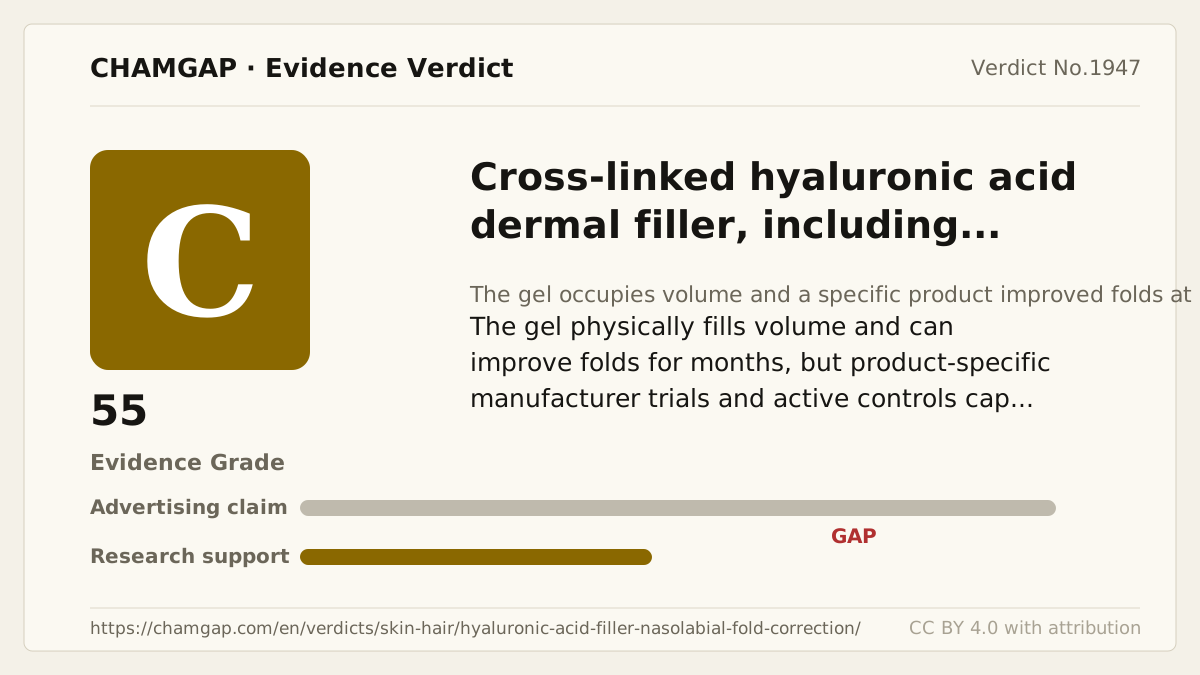
[Chamgap] Hyaluronic acid filler x nasolabial-fold correction — Evidence Grade C·54. 2 cited sources checked. Source: https://chamgap.com/en/verdicts/skin-hair/hyaluronic-acid-filler-nasolabial-fold-correction/ · CC BY 4.0CC BY 4.0 — free to use with attribution; do not distort grades, numbers, or verdict meaning.
What this document does and does not do
Chamgap is an information source. It reports what research has and has not confirmed; it does not tell readers what to take or buy. That decision belongs to readers and, when needed, medical or legal professionals. This verdict reflects literature available up to the search date and may change as new research appears. Nothing here is medical advice.