
Home narrowband UV-B,
does it really help with Control of psoriasis lesions and improvement of dermatology-related quality of life?
research showsHome narrowband UV-B is rated C for psoriasis effectiveness compared with office narrowband UV-B. LITE randomized and analyzed 783 patients by intention to treat. At 12 weeks, coprimary PGA 0 or 1 response was 32.8% versus 25.6%, and DLQI of 5 or lower was 52.4% versus 33.6%; both met the prespecified -15% noninferiority margin. However, the trial used a noninferiority design and only an active office-based comparator without placebo. These are two bias defects, B2, capping the grade at C.
ads claimA device emitting narrowband UV-B around 311 to 313 nm is a physical fact, while psoriasis benefit is a clinical claim. The evidence supports prescribed home delivery with dosing locks and education as generally noninferior to office delivery, not arbitrary use of a cosmetic ultraviolet lamp.
Useful facts when choosing a product
- The LITE home unit was a Daavlin 7-series eight-bulb narrowband UV-B device using prescription protocols and treatment-frequency limits. It is not equivalent to a generic cosmetic ultraviolet lamp.
- verdict 1815, which is C with 54 points, concerns guselkumab, a biologic drug compared with placebo; this verdict concerns home versus office delivery of phototherapy.
- Existing drug verdicts also differ: verdict 1342, which is B with 76 points, concerns secukinumab, while verdict 1796, which is C with 56 points, concerns deucravacitinib.
Chamgap Semantic Classification Code
Candidate index · review held
P.home-narrowband-uv-b-phototherapy.device.control-of-psoriasis-lesions-and-improvement-of-dermatology-related-quality-of-life.improve.activeProcedures, devices and tests > Home narrowband UV-B phototherapy > Device delivered > Control of psoriasis lesions and improvement of dermatology-related quality of life > Improvement claim > Active comparator
An automated migration candidate, not an issued permanent code; exact claim scope remains under review. This machine-generated migration candidate helps retrieval but is not a permanent assignment. The original verdict ID and URL remain authoritative.
What the research actually shows
Gelfand's LITE trial assigned 783 plaque or guttate psoriasis patients to home, 393, or office treatment, 390, and analyzed all 783 by intention to treat with missing outcomes counted as failures. At 12 weeks, PGA 0 or 1 occurred in 129 of 393 versus 100 of 390 and DLQI of 5 or lower in 206 of 393 versus 131 of 390; lower confidence bounds exceeded the prespecified -15% margin for both coprimary endpoints. Koek's PLUTO trial randomized 196, 98 per arm. Actual SAPASI50 analysis included 185, 94 and 91, and PASI50 analysis 175, 91 and 84. SAPASI50 difference 2.8% (95% CI -8.6 to 14.2) passed, while PASI50 -2.3% (-15.7 to 11.1) narrowly missed.
Why this is classified as C (56)
P, R2, I2, and E+ are present, and both LITE coprimary endpoints succeeded. Noninferiority and active-control-only design are two defects, B2, giving C with 56 points.
Counterpoint. Home treatment in these trials included prescription, education, skin-response dose adjustment, and use limits. Unsupervised self-irradiation is not the tested intervention.
Rejudgment record. Cross-check applied — Accepted successful PGA and DLQI coprimary noninferiority in all 783 LITE participants and broadly consistent PLUTO evidence, while recording the 15% noninferiority design and narrow PLUTO PASI50 miss
| Endpoint | P | Symptom or function itself is the target - including patient reports and performance tests |
| Replication | R2 | Independently replicated across trials |
| Independence | I2 | Decisive evidence is publicly or non-profit funded |
| Effect size | E+ | Meets the clinically important threshold |
Stored derived and displayed grades match; this is not a current recalculation or validity check (C).
Sub-claim grades by effect
This ingredient is marketed for several effects. A single overall grade blends strong and weak claims together, so each effect is graded separately here. The overall grade reflects the strongest disconfirming or core claim.
| Effect (sub-claim) | Grade | Basis |
|---|---|---|
| Achievement of PGA 0 or 1 with home treatment | C | The LITE coprimary endpoint was noninferior to office treatment. |
| Achievement of DLQI 5 or lower with home treatment | C | The patient-reported treatment-target coprimary endpoint was noninferior. |
| Achievement of PASI50 with home treatment | C | The PLUTO physician-assessed lower confidence bound missed the prespecified margin by 0.7 percentage point. |
Cross-check — AI research and Codex final gate
Evidence Table
| Study | Design | Sample | Funding | Endpoint | Result | Weight |
|---|---|---|---|---|---|---|
| Gelfand JM et al. 2024 LITE | Open-label multicenter pragmatic randomized noninferiority active-controlled trial | 783 randomized (393/390); actual primary intention-to-treat analysis 783 | Patient-Centered Outcomes Research Institute funding; Daavlin supplied devices, shipping, and optional education but had no research role | Coprimary week-12 PGA 0 or 1 and DLQI 5 or lower; noninferiority margin -15% | 32.8% versus 25.6% and 52.4% versus 33.6%; both coprimary noninferiority endpoints met. | Pivotal large pragmatic trial |
| Koek MBG et al. 2009 PLUTO | Multicenter pragmatic randomized single-blind noninferiority active-controlled trial | 196 randomized (98/98); SAPASI50 analysis 185 (94/91), PASI50 analysis 175 (91/84) | Public Netherlands Organisation for Health Research and Development funding | PASI50 and SAPASI50; noninferiority margin -15% | SAPASI50 met noninferiority, but the PASI50 lower bound of -15.7% missed the margin by 0.7 percentage point. | Independent replication with one borderline coprimary measure miss |
Receipt — 2 References
All 2 cited sources were verified for existence at the original page (as of 2026-07-24).
Final verification and publication gate: Codex · Evidence date: 2026-07-24 · Corrections: none
Cite this verdict
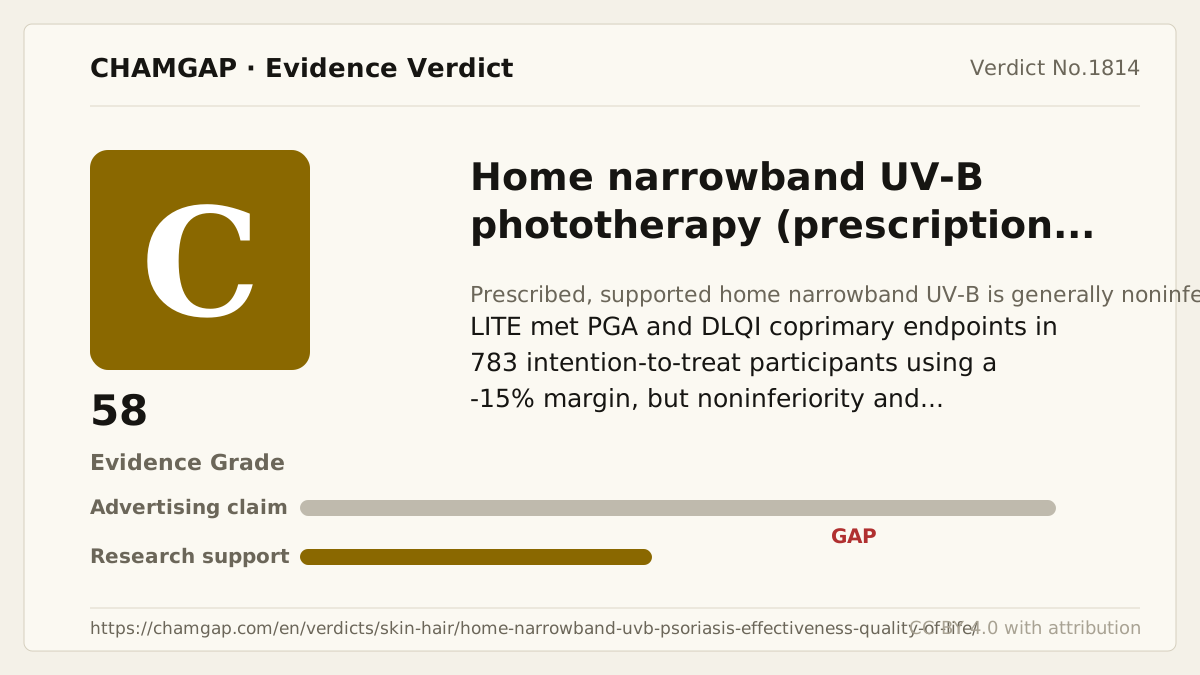
[Chamgap] Home narrowband UV-B x psoriasis control and quality-of-life improvement — Evidence Grade C·56. 2 cited sources checked. Source: https://chamgap.com/en/verdicts/skin-hair/home-narrowband-uvb-psoriasis-effectiveness-quality-of-life/ · CC BY 4.0CC BY 4.0 — free to use with attribution; do not distort grades, numbers, or verdict meaning.
What this document does and does not do
Chamgap is an information source. It reports what research has and has not confirmed; it does not tell readers what to take or buy. That decision belongs to readers and, when needed, medical or legal professionals. This verdict reflects literature available up to the search date and may change as new research appears. Nothing here is medical advice.